Electric buses need to maintain reliable power under conditions such as low temperatures in winter, high temperatures in summer, and long-duration operation. The environmental adaptability of the battery system directly affects vehicle availability and operational stability. For bus routes in cold regions, urban transportation in hot climates, and vehicles with frequent charging, a battery solution that performs well under only a single temperature condition may not cover all operating conditions.
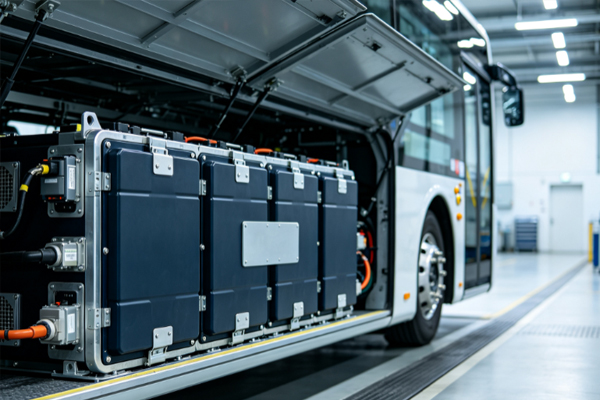
What Problems Should Wide-Temperature Batteries for Electric Buses Solve?
Different ambient temperatures can change the charging and discharging capability and thermal state of batteries. Wide-temperature solutions need to address high- and low-temperature operating conditions separately.
Ensuring Stable Operation in Low-Temperature Environments
Low temperatures can reduce the efficiency of internal electrochemical reactions and ion transport, making low-temperature charging particularly important to control.
- Select cells with good low-temperature discharge capability and charge acceptance.
- Limit charging current and charging power according to cell temperature.
- Preheat the battery before low-temperature startup so that the cells reach a suitable operating temperature.
- Adjust the vehicle’s charging and discharging power according to actual temperature conditions.
A reasonable low-temperature strategy can reduce range degradation, charging limitations, and abnormal cell degradation.
Controlling Temperature Rise Under High-Temperature Conditions
High ambient temperatures combined with long-duration operation and high-power output increase the thermal load inside the battery.
- Optimize cell arrangement and heat-transfer paths.
- Configure cooling capacity according to continuous power requirements.
- Monitor individual cell temperatures and temperature differences to identify localized hotspots in time.
- Limit certain power demands according to battery status under high-temperature conditions.
Controlling temperature rise helps reduce the impact of high-temperature operation on battery performance and long-term degradation.
Core Technical Design of Wide-Temperature Battery Systems
Wide-temperature performance cannot be achieved through cells alone. It requires coordinated operation among cells, thermal management, and control strategies.
Select Cells Suitable for Wide-Temperature Operating Conditions
Cell performance determines the temperature adaptability foundation of the battery system, so actual performance across multiple temperature ranges needs to be considered during selection.
- Evaluate low-temperature discharge capability, low-temperature charge acceptance, high-temperature cycling performance, and normal-temperature capacity performance.
- Evaluate rate capability and continuous output performance at different temperatures according to vehicle power requirements.
- Pay attention to the risk of lithium plating under low-temperature charging conditions and determine an appropriate charging range through testing.
- Control differences in capacity, internal resistance, and voltage between individual cells.
Matching cell parameters with target route conditions provides a stable foundation for wide-temperature operation.
Configure a Coordinated Heating and Cooling Thermal Management System
Winter operation requires the battery to be heated, while summer and high-load conditions require timely heat removal. The thermal management priorities differ between these scenarios.
| Operating Condition | Main Issue | Solution |
| Low-temperature startup | Reduced output capability, limited charging | Battery preheating, power limitation |
| Low-temperature charging | Reduced charge acceptance, lithium-plating risk | Preheating, reduced charging rate, charging protection |
| Frequent fast charging | Concentrated short-term thermal load | Pre-cooling, rapid cooling, high heat-transfer capability |
| Long-duration high load | Continuous heat generation, increased temperature differences | Temperature uniformity design, continuous heat dissipation |
| High-temperature environment | High initial temperature, increased cooling pressure | Pre-cooling, enhanced cooling, power control |
Frequent fast charging focuses on quickly controlling short-term thermal loads, while long-duration high-load operation places greater emphasis on continuous heat dissipation and temperature uniformity.
How Can the BMS Improve the Operating Stability of Wide-Temperature Batteries?
As battery temperature and load conditions continuously change, the management system needs to evaluate available power based on multiple state parameters and coordinate with the vehicle control system.
Real-Time Monitoring of Key Operating Parameters
The BMS continuously collects voltage, current, and temperature data while combining SOC, SOH, and other state information to determine battery operating conditions.
- Monitor individual cell voltage to reduce overcharge and over-discharge risks.
- Record cell temperature and temperature differences to identify abnormal thermal conditions.
- Estimate SOP by comprehensively considering SOC, temperature, voltage, internal resistance, and health status.
- Determine the currently allowable charging and discharging power according to SOP.
SOP reflects the power that the battery can safely provide or absorb under specific operating conditions and time scales, serving as an important parameter connecting state estimation with power control.
Establish Protection Strategies for Different Temperature Ranges
Different temperature ranges require corresponding operating limitations and control methods.
- Under low-temperature conditions, limit the charging rate according to cell temperature and adjust charging capability based on the preheating status.
- Under high-temperature conditions, reduce the load or strengthen cooling according to temperature and available power.
- When abnormal temperature, voltage, or current is detected, promptly activate the corresponding protection measures.
- Proper low-temperature charging control can reduce safety risks associated with lithium plating.
Coordinated use of temperature, SOC, and SOP parameters allows power control to better match actual operating conditions.
How Should Wide-Temperature Batteries Be Configured for Different Electric Bus Scenarios?
Electric bus routes, climates, parking durations, and charging methods vary, so solutions need to be matched according to actual operating conditions.
Urban Public Transport and High-Frequency Operation Vehicles
Urban buses typically operate for long periods, experience frequent starts and stops, and undergo relatively frequent charging.
- Focus on cycle life and continuous output capability.
- Configure battery capacity according to route length and daily mileage.
- For vehicles with frequent charging, place greater emphasis on thermal management capability.
- Optimize operating control according to actual temperature and power requirements.
Proper matching can reduce the additional stress that high-frequency operation places on the battery system.
Vehicles Operating in Cold and Hot Regions
Extreme-climate projects require targeted design. Cold-region vehicles should focus on low-temperature startup, low-temperature charge acceptance, and preheating efficiency, while hot-region vehicles should emphasize continuous cooling, temperature-difference control, and high-load operating capability. Vehicle parking conditions, charging duration, and route load should also be considered so that test conditions closely reflect actual operating environments.
What Should Enterprises Consider When Purchasing Wide-Temperature Batteries?
In addition to capacity and price, purchasers should pay close attention to wide-temperature test data, low-temperature charging capability, thermal management solutions, BMS functions, SOP estimation capability, and cycle life performance. For batch projects, environmental simulation, vehicle-level matching, and operational validation should also be conducted based on the target region and actual routes to evaluate whether the solution can meet long-term operating requirements from multiple perspectives.
The power system of an electric bus needs to adapt to different seasons and operating intensities, while the value of a wide-temperature solution is reflected in long-term stability and controllability. When selecting electric vehicle batteries, enterprises can establish purchasing criteria based on route mileage, daily operating hours, charging windows, climate conditions, and maintenance capabilities, then determine the appropriate configuration through sample testing and vehicle-level validation so that the battery system better matches actual operating requirements.