In an automated warehouse, when an AGV or AMR suddenly stops in the middle of an aisle, it may look like just one piece of equipment is out of service. In reality, it can disrupt picking, material handling, sorting, and replenishment tasks throughout the warehouse. The distance logistics robots travel changes from day to day. They may operate continuously during peak order periods and spend more time waiting during slower periods, which puts the battery under constantly changing workloads. For buyers, the key question is not simply “How large is the battery?” but whether it can support the robot through an entire working day. With stable cycle performance and good safety characteristics, LiFePO4 batteries can be used for different types of logistics robot power systems.
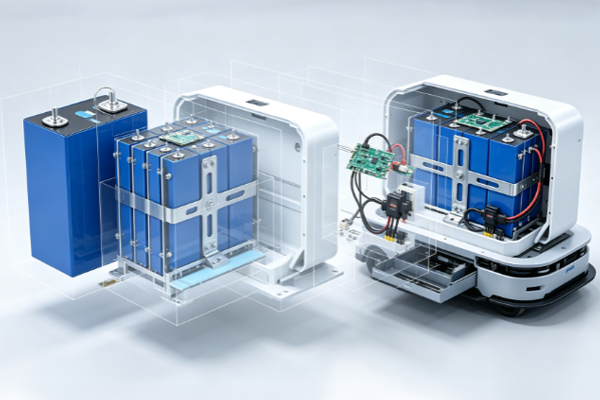
How to Choose a Logistics Robot Battery? Start With What the Robot Does Every Day
Not all logistics robots perform the same tasks. Some move shelves, some transport bins, while others need to pull or carry heavy loads over long distances. Battery workload changes with the robot’s daily tasks, so breaking down the actual work schedule is often more useful than simply comparing battery capacity.
Do Warehouse AGVs and AMRs Have the Same Battery Requirements?
Not necessarily. AGVs typically follow fixed routes and have relatively predictable operating patterns, while AMRs can plan routes autonomously according to system instructions and may receive different tasks throughout the day. Their battery configurations should not simply be treated as interchangeable.
- Shelf-moving robots
These robots frequently travel between shelves, conveyors, and workstations. Individual trips may not be very long, but the number of daily movements can be extremely high. The battery needs to handle frequent starts and stops rather than simply maximizing single-charge runtime.
- Bin-handling AMRs
These robots frequently receive tasks, wait, move, and reposition themselves. In addition to the drive system, navigation, sensors, and communication equipment continue to consume power, so actual runtime is closely related to task density.
- Heavy-load AGVs
When transporting pallets, metal materials, or large loads, the robot carries significantly more weight. Current demand can increase during startup, turning, and operation on ramps, so the battery needs sufficient output capability.
- Tugger logistics robots
A single robot may pull several carts or material units and travel relatively long distances. Instead of focusing only on capacity, buyers should pay more attention to voltage stability and continuous power output during extended operation.
Why Can’t Logistics Robots Choose Batteries Based Only on Rated Capacity?
Battery specifications often highlight figures such as amp-hours or kilowatt-hours, but capacity is only one part of the battery system. Two batteries with similar capacities may provide very different runtimes when installed on different robots. Motor efficiency, payload, driving speed, route slope, idle time, and warehouse temperature can all affect energy consumption.
A more useful reference is the robot’s actual daily task record. Tracking operating hours, average payload, idle periods, and peak operating time before selecting the battery can make the final configuration much more practical.
What Battery Configuration Fits Different Logistics Applications?
Different logistics environments have different operating patterns, and the battery needs to keep up with those patterns. The table below can be used as an initial reference when selecting a battery, while the final specifications should be determined by the robot’s actual power consumption and operating time.
| Logistics Application | Robot Operating Pattern | Key Battery Requirement | Common Application |
| Shelf handling | Frequent travel and frequent starts/stops | Cycle performance, stable output | Automated warehouses |
| Bin transportation | Dense tasks and changing routes | Runtime, low-battery management | E-commerce warehouses |
| Pallet handling | Higher payload | Continuous and peak output | Factory logistics |
| Production-line delivery | Scheduled delivery and fixed tasks | Reliable operation, charging efficiency | Smart factories |
| Cold-chain logistics | Low temperatures and continuous operation | Low-temperature performance, thermal design | Cold storage |
Does Your Logistics Robot Keep Running Out of Power? The Problem May Be Task Scheduling
When a robot has insufficient runtime, the first reaction is often to install a larger battery. But sometimes the battery itself is not the problem. The real issue may be that the robot is continuously operating under a heavy workload without enough opportunities to recharge. Battery capacity, charging, and task scheduling are closely connected.
Why Does a Robot Need to Return for Charging Even When It Still Has Power?
A logistics robot should not wait until the battery is almost completely empty before considering charging. Continuing a long-distance task at a low battery level may force the robot to leave the task halfway through. The problem becomes even more serious when the robot is carrying critical materials and suddenly needs to return for charging.
A practical approach is to establish suitable battery-level ranges:
- Use the high-battery range for major transportation tasks, reducing unnecessary charging interruptions during busy periods.
- Use the medium-battery range for opportunity charging, allowing the robot to recharge while waiting for the next task or returning to a workstation.
- Give low-battery robots charging priority, preventing them from accepting long-distance or high-load tasks when their remaining power is limited.
This approach reduces the need to constantly push the battery to its limit and helps prevent robots from unexpectedly leaving their assigned tasks.
Why Are Logistics Warehouses Paying More Attention to Opportunity Charging?
If a robot operates for more than ten hours a day, requiring it to stop for several hours of fixed charging can reduce equipment utilization. Opportunity charging uses short idle periods to replenish the battery instead.
When order volume is low, a robot can automatically move to a charging area. While waiting for the next task, it can receive a short charging session. During busy periods, unnecessary charging stops can be reduced. For warehouses operating large AMR fleets, this approach can make battery usage better aligned with task scheduling.
When Is a Spare Battery More Practical Than a Larger Battery?
Not every logistics center needs to install a very large battery pack. If robots need to operate continuously and battery replacement is convenient, keeping spare batteries can offer greater flexibility.
One battery can power the robot while another is charging. When the battery level becomes low, the operator or automated system can replace it quickly, reducing long waiting periods. This can be particularly useful for three-shift warehouses, continuous logistics lines, and periods of high order volume.
What Do Buyers Often Overlook When Purchasing LiFePO4 Batteries for Logistics Robots?
Logistics robots are mobile devices, which means their batteries move with the machines every day. Dust, temperature changes, vibration, impacts, and frequent charging and discharging can all place the battery under demanding operating conditions. LiFePO4 batteries can provide stable power for these applications, but the battery configuration still needs to match the actual operating environment.
Can the Warehouse Environment Affect Robot Battery Performance?
Yes. Standard warehouses, cold storage facilities, and high-temperature production areas can create very different battery operating conditions. Cold-chain logistics requires particular attention because lower temperatures can affect battery charging and discharge performance. A battery configuration designed for a normal-temperature warehouse should not simply be transferred to a cold-storage application.
When purchasing batteries, buyers should tell the supplier where the robots operate, how many hours they work each day, and whether they are exposed to low temperatures, high temperatures, humidity, or dust. The more accurate the environmental information, the easier it is to develop a suitable battery solution.
Why Does Robot Battery Weight Matter?
The battery itself becomes part of the robot’s total payload. Increasing battery capacity continuously to extend runtime can increase the robot’s overall weight and may even reduce its available payload capacity.
This creates a very practical trade-off: adding more battery capacity may increase runtime, but it may also reduce how much cargo the robot can carry. Small AMRs in particular often have limited internal space and payload capacity, so the battery needs to strike a suitable balance between runtime, weight, and installation space.
Why Is Battery Data Important for Logistics Robots?
Robots do not rely on operators to manually check battery conditions throughout the day. AGVs and AMRs usually need to transmit information such as SOC, voltage, temperature, and alarm status to the control system. This allows the fleet management platform to determine which robots can continue working and which ones need to return for charging.
If battery data is inaccurate, the system may show that a robot still has enough power when it actually has very little usable runtime left. It may also continue assigning tasks to a low-battery robot. For warehouses operating large robot fleets, accurate battery data can directly affect scheduling efficiency.
How Can You Avoid Buying Incompatible Logistics Robot Batteries in Bulk?
Replacing the battery on a single robot is relatively easy to manage. But when purchasing batteries for dozens or hundreds of logistics robots, unclear specifications can lead to problems with connectors, dimensions, communication, or runtime, making rework much more expensive. During the purchasing stage, it is better to provide the battery supplier with complete robot information and actual operating requirements rather than simply saying, “We need a battery with this capacity.”
What Robot Information Should Be Provided for a Bulk Battery Quote?
Battery suppliers usually need more technical information than buyers expect. The more complete the information, the faster the quotation and customization process can move forward.
- Robot model, total machine weight, and maximum payload.
- Original battery model, rated voltage, and capacity.
- Average operating power and maximum power.
- Daily operating hours and approximate number of tasks completed each day.
- Existing charger model and charging method.
- Battery installation location, external dimensions, and connector information.
Which Parts of a Custom Robot Battery Are Most Likely to Cause Rework?
Battery customization is not simply about changing capacity. In many projects, the biggest rework issues actually come from connectors and installation details.
- Connector mismatch: The battery may operate normally but cannot be directly connected to the robot.
- Dimensional differences: Battery length, height, or mounting-hole positions may not fit the available space.
- Communication protocol mismatch: The robot control system may not be able to read SOC or alarm information correctly.
- Incorrect charging parameters: The existing charger may not be able to charge the battery within the required parameters.
These issues should ideally be resolved during the sample stage. For large projects, confirming the battery structure and communication configuration after sample approval can prevent unnecessary problems during mass production.
How Should Logistics Robot Battery Samples Be Tested?
Sample testing should not stop at checking whether the robot can power on. The more important test is how the battery performs after completing a real operating cycle, including loaded transportation, continuous operation, automatic charging, low-battery return, and re-entry into service.
Key data to monitor includes:
- Remaining battery level after full-load operation.
- Changes in voltage and temperature after several hours of continuous operation.
- Whether abnormal power drops occur during frequent starts and stops.
- How long the robot takes to return to normal operation after automatic charging.
- Whether the SOC displayed by the robot control system is accurate.
- Whether BMS alarm information can be transmitted correctly.
If sample testing covers real warehouse operating conditions, the subsequent bulk purchasing process becomes much more reliable. For AGV and AMR projects that require long-term operation, DELIGREEN provides LiFePO4 batteries, battery packs, DIY battery boxes, BMS accessories, and scalable energy storage solutions. Battery configurations can also be developed around the robot’s operating conditions, installation space, and power requirements, helping buyers get a battery that is not only compatible but genuinely suited to daily logistics operations.