As AGVs, AMRs, material-handling robots, and mobile equipment become more common on production lines, robot batteries are no longer just a basic component. They can directly affect production efficiency. How long can a robot run each day? How far can it travel on one charge? What happens when the battery is low? Is battery swapping practical? These questions are closely tied to the battery solution. Many companies only compare voltage and capacity during purchasing, then discover after installation that the battery size, discharge current, BMS communication, or connector does not match. For factories with continuous production, choosing the right robot battery is essential for stable operation.
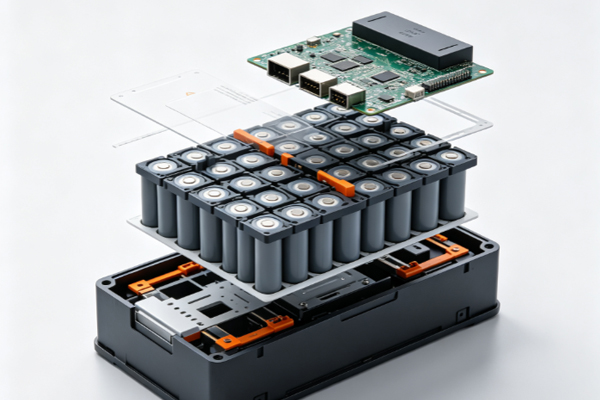
How to Choose a Battery for an Assembly Line Robot? Start with Capacity and Voltage
Robot batteries cannot be selected based on one fixed capacity. Short-distance transport, long operating hours, frequent starts and stops, and heavy-load applications all create different battery requirements. The best approach is to look at the robot’s actual work cycle and choose a capacity that meets the operating needs without making the battery unnecessarily large.
How Many Hours Does the Robot Work Each Day?
If a robot only operates for a few hours per day, the battery can be sized around a single work shift. For robots that operate continuously for 8, 12, or more hours, runtime and charging opportunities need to be considered together.
Key operating data should include:
- Actual operating hours per day
- Travel distance per task
- Number of starts and stops per hour
- Average material load
- Number of tasks completed each day
These figures provide a much clearer basis for battery selection. A battery that is too small may force the robot to return for charging frequently, while an oversized battery adds unnecessary cost, weight, and installation requirements.
What Batteries Are Commonly Used for Different Assembly Line Robots?
| Robot Type | Typical Application | Key Battery Considerations |
| AGV | Material handling and warehouse transport | Capacity, cycle life, automatic charging |
| AMR | Smart logistics and flexible material handling | BMS communication, discharge capability |
| Palletizing Robot | Palletizing and material handling | Peak power, stable power supply |
| Loading/Unloading Robot | Machine loading and unloading | Start-stop frequency, instantaneous current |
| Mobile Robot | Inspection and mobile operations | Weight, dimensions, runtime |
Although different robots can use lithium batteries, their operating conditions vary considerably. When requesting a battery solution, it is better to provide the robot’s power requirements, operating hours, existing battery specifications, and battery compartment dimensions so the battery pack can be designed around the actual equipment.
How Do You Choose Between a 24V and 48V Robot Battery?
24V and 48V are both common voltage configurations for robotic equipment. Smaller mobile robots and some AGVs may use 24V systems, while higher-load equipment may use 48V systems. The battery voltage must match the robot’s motor controller, drive system, and overall electrical design. Increasing the voltage simply to obtain longer runtime is not a suitable solution.
Capacity determines how long the robot can operate, voltage determines electrical compatibility, and discharge current affects whether the robot can receive stable power during startup, acceleration, and changing loads. These specifications should be evaluated together.
How Much Discharge Power Does a Robot Battery Need? What Does the BMS Do?
Robots on production lines do not operate at the same power level all the time. Starting, accelerating, climbing ramps, turning, or suddenly carrying a heavier load can cause current demand to rise significantly. A battery may have enough capacity on paper but still perform poorly if its discharge capability is insufficient. BMS configuration is also an important part of the battery solution.
How Does Frequent Starting and Stopping Affect a Robot Battery?
AGVs and AMRs often start, stop, turn, and accelerate repeatedly during daily operation. These frequent changes create continuous load fluctuations for the battery.
When selecting a battery, check the following:
- Whether the continuous discharge current meets the robot’s requirements
- Whether peak discharge capability can handle startup current
- Whether the battery supports frequent charge and discharge cycles
- Whether stable output can be maintained at low battery levels
If the battery cannot provide enough discharge current, the robot may experience weak startup performance, abnormal acceleration, or premature shutdown at low battery levels. Heavy-load AGVs should not be evaluated only from no-load operating data.
Why Is the BMS Important for Robot Batteries?
Robot batteries are often used for frequent daily cycling. The Battery Management System (BMS) monitors and protects the battery pack while also providing information such as voltage, current, temperature, and state of charge (SOC) to the robot control system.
A robot battery BMS should typically support:
- Overcharge, over-discharge, and overcurrent protection
- Cell voltage and temperature monitoring
- Short-circuit and abnormal-condition protection
- SOC monitoring and reporting
- CAN, RS485, or other communication functions
If the robot’s control system needs to read battery information, the BMS communication protocol needs to be confirmed before purchasing. A battery may supply power normally but still fail to integrate properly if the robot cannot accurately read its battery status.
Is LiFePO4 Suitable for Assembly Line Robots?
For robots that operate and cycle every day, LiFePO4 batteries offer advantages such as good cycle performance, thermal stability, and relatively low maintenance requirements. The actual battery pack should still be selected based on the robot’s load, charging frequency, operating environment, and available installation space.
How Should Assembly Line Robots Be Charged? Automatic Charging or Spare Batteries?
The efficiency of a robot battery depends not only on how long it can run but also on how quickly the robot can return to work after the battery is low. If every robot requires an operator to remove the battery, carry it to a charging area, and reinstall it, manual handling can quickly become inefficient when many robots are operating at the same time. Automatic charging, opportunity charging, and spare battery systems are all practical options depending on the production schedule.
Is Automatic Charging Suitable for Long-Running Robots?
For AGVs and AMRs, charging stations can be installed at designated locations. The robot can automatically return to the charging point after completing a task or use idle periods to recharge.
Common approaches include:
- Automatically returning to the charging station after completing tasks
- Searching for a charging point when battery capacity falls below a set level
- Charging multiple robots in scheduled batches
- Using task gaps for short charging periods
For factories operating a large number of robots every day, automatic charging can simplify battery management and reduce downtime caused by missed manual charging.
When Should You Use Spare Robot Batteries?
If a robot needs to operate continuously but a single battery cannot cover the entire working period, spare batteries can be prepared. When the battery level becomes low, a fully charged battery can be installed so the robot can continue working while the removed battery goes through the charging process.
This approach works well for factories where production downtime is costly. However, the spare battery must match the original battery in dimensions, connector configuration, communication protocol, and mounting method. Otherwise, battery replacement may not be as straightforward as expected.
Can Fast Charging Reduce Robot Downtime?
Fast charging can shorten charging downtime, but the charging current must match the battery cells, BMS, and charger specifications. For robots that operate frequently every day, charging time, operating time, and battery cycle requirements should be evaluated together instead of simply choosing the highest possible charging current.
Why Do Robots Need Battery Communication?
Smart robots need to know how much battery power remains so they can decide when to return for charging, swap batteries, or continue a task. Through CAN and other communication methods, the BMS can send battery status information to the robot’s main control system, helping the equipment make more accurate decisions about battery level and operating status.
What Should You Check When Buying Robot Batteries in Bulk?
Once a robot battery project moves from samples to mass production, the focus changes from simply asking whether the battery works to asking whether it can remain stable over long-term use. When dozens or hundreds of robots are deployed on a production line, batteries need consistent specifications, dimensions, connectors, and performance. Future replacement and additional purchases also need to be considered.
Why Should You Test Samples Before Bulk Purchasing?
Samples should ideally be installed on the actual robot rather than tested only as standalone batteries. Real-world testing can reveal issues related to load, temperature, runtime, and communication.
Key tests should include:
- Actual runtime under full load
- Peak current during startup and acceleration
- Battery temperature after extended operation
- Low-battery alarm and protection performance
- BMS data after charging is completed
Testing the battery on the actual robot before mass production can significantly reduce the risk of discovering compatibility problems after a large batch has already been produced.
Why Should Battery Dimensions and Connectors Be Confirmed in Advance?
Robot battery compartments are usually designed around a specific battery. Even a small increase in battery dimensions may make installation impossible.
Before purchasing, confirm:
- Battery length, width, and height
- Mounting holes and installation method
- Power connector model
- Connector orientation and cable length
Confirming these details early can save considerable time during installation and commissioning.
Why Does Batch Consistency Matter?
Robot projects may purchase batteries in several batches. If different batches use different cells, BMS configurations, or connectors, batteries with the same model number may not be interchangeable. For long-term projects, it is better to lock in the cell specification, BMS configuration, communication protocol, and enclosure dimensions so future replacement batteries remain compatible.
Why Should You Look Beyond the Battery Unit Price?
A lower unit price does not necessarily mean a lower total cost. Battery cycle life, BMS functions, customization costs, technical support, sample testing, and long-term supply capability can all affect the actual project cost. For large-scale robot deployments, it is also important to confirm whether the supplier can continue providing batteries with the same specifications.
DELIGREEN provides LiFePO4 batteries, battery packs, DIY battery boxes, and BMS accessories for assembly line AGVs, AMRs, and other mobile robots. Battery solutions can be matched to the equipment’s voltage, capacity, dimensions, connectors, and communication requirements, making them suitable for projects that start with sample testing and move toward bulk purchasing.
The right robot battery is not simply about achieving a certain number of operating hours. It needs to fit the entire production cycle. Voltage and capacity determine basic runtime, discharge capability affects startup and load changes, the BMS handles protection and battery data, charging methods influence downtime, while dimensions, connectors, and batch consistency affect long-term deployment. Getting these details right before purchasing can turn the robot battery into a reliable part of the production system rather than another source of downtime.