Golf carts are no longer used only on golf courses. They are also widely used in resorts, hotels, scenic areas, parks, communities, airports, and large venues. As golf carts gradually transition from traditional lead-acid batteries to LiFePO4 batteries, chargers also need to be upgraded accordingly. Different battery capacities, voltage platforms, charging currents, operating environments, and protection requirements require different charging solutions. If the charger parameters are not selected properly, it may result in longer charging times in mild cases, or affect battery life and normal vehicle operation in more serious cases. For lithium battery products used in golf carts, a dedicated high-power charger solution with an aluminum alloy heat dissipation structure and a high protection rating can be adopted. For example, a charger with a 66V voltage, 35A current, and approximately 1.8KW power can serve as a reference option for some golf cart lithium battery systems. The actual configuration still needs to be confirmed according to the battery pack parameters.
Charger Requirements for Golf Cart Lithium Batteries
Charging Voltage Needs to Match the Battery System
The lithium batteries used in golf carts are available in various voltage specifications. Common solutions include 24V, 36V, 48V, 51.2V, 60V, and 72V. The nominal voltage and fully charged voltage of LiFePO4 batteries are not the same, so a charger cannot be purchased simply based on names such as “48V battery” or “60V battery.” For example, a 51.2V LiFePO4 battery pack is typically composed of sixteen 3.2V cells connected in series, and its fully charged voltage will be higher than the nominal voltage. Therefore, the charger’s output parameters need to be determined according to the charging requirements of the entire battery pack. If the battery pack belongs to a higher-voltage platform, a 66V charger can be an application option for some golf cart battery systems. Whether it is suitable specifically needs to be confirmed based on the number of cells in series, BMS parameters, and the charging cutoff voltage set by the manufacturer.
Charging Current Affects Charging Speed
Golf carts are often used intensively. For example, vehicles on golf courses may operate multiple times a day, while vehicles in hotels and scenic areas may also need to be recharged within a short period. Among them, a 1.8KW, 35A, 66V specification is suitable for application scenarios that require relatively fast recharging. However, charging speed is not determined solely by the charger’s current. Battery capacity, BMS limitations, the battery’s current state of charge, and the charging stage all affect the actual charging time.
| Item | Common Selection | Function |
| Output Voltage | Determined According to the Battery Pack | Determines Whether Charging Can Be Completed Normally |
| Output Current | 10A–35A and Above | Affects Charging Speed |
| Output Power | Determined by Voltage and Current | Affects Overall Charging Efficiency |
| Protection Rating | IP65, IP66, etc. | Suitable for Complex Outdoor Environments |
| Heat Dissipation Structure | Aluminum Alloy Housing, Air Cooling, etc. | Reduces Heat Generated During Long-Term Operation |
Outdoor Waterproofing and Durability
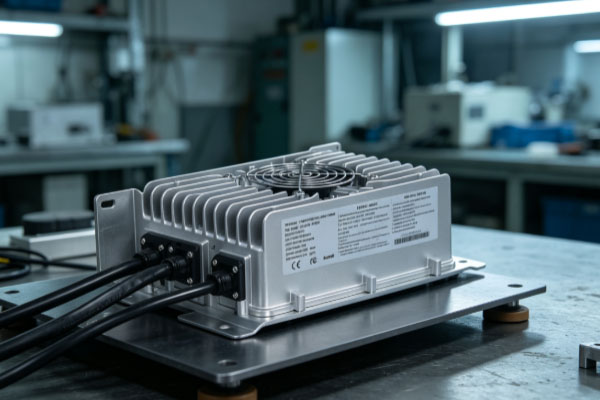
Golf carts are typically used outdoors and may encounter rainwater, mud, dust, and temperature fluctuations. If the charger does not have sufficient protection, long-term use can easily be affected by the environment. Therefore, for chargers used on golf courses, in scenic areas, and in parks, products with a relatively high protection level can be prioritized. An IP66 protection solution can reduce the impact of dust ingress and water spray, making it more suitable for outdoor charging scenarios. At the same time, the charger housing can adopt an aluminum alloy structure, which is beneficial for heat dissipation while also improving the mechanical strength of the equipment. For vehicles that are used for long periods every day, this design is more practical.
Introduction to Dedicated Lithium Battery Charger Solutions for Golf Carts
Determine the Charger Starting from Battery Parameters
When customizing a charger, it is recommended to first confirm several basic battery pack parameters, including battery type, nominal voltage, battery capacity, maximum allowable charging current, and BMS charging limitations. Taking a LiFePO4 battery as an example, if the battery pack adopts a 16-series configuration, its nominal voltage is typically 51.2V. If a different number of cells is connected in series, the charger’s output voltage will also change accordingly. Therefore, even for the same golf cart, chargers cannot be directly shared when different battery packs are used. Providing the battery nameplate, BMS parameters, or battery pack specifications before purchasing can help the manufacturer determine the solution more accurately.
Select Charging Power According to Usage Frequency
For golf carts that are used relatively infrequently each day, a relatively conventional charging current can be adopted to meet overnight slow-charging requirements. For vehicles used at high frequency, a higher-power charger can be considered. For example, a 1.8KW, 35A, 66V solution can be used for golf carts requiring faster recharging when permitted by the battery system. It is particularly important to note that a high-power charger cannot be used independently of the battery specifications. If the battery pack or BMS specifies a maximum charging current lower than 35A, the charging current should be determined again according to the allowable range of the battery rather than forcing the use of a high-current solution.
Enable the Charger to Work Together with the BMS
The charging methods of lithium batteries and lead-acid batteries are different. LiFePO4 batteries generally require the charger to operate according to a preset charging curve, while the BMS is responsible for cell protection, overcharge protection, overcurrent protection, temperature monitoring, and other functions. A stable golf cart charging system generally requires good coordination among the charger, battery pack, and BMS. The charger provides stable electrical energy, while the BMS monitors the battery status. Together, they help ensure the charging process.
Charger Selection for Different Golf Cart Applications
Golf Course Vehicles
Golf carts on golf courses usually need to operate multiple times a day, and the number of vehicles may also be relatively large. In this scenario, chargers need to consider not only charging speed but also long-term continuous operating stability. If the vehicle uses a high-voltage LiFePO4 battery, a charging current of around 35A can be selected according to the battery’s allowable parameters. For some high-voltage systems, a 1.8KW, 66V specification can be evaluated as a dedicated solution. At the same time, the charger’s heat dissipation, waterproofing, and plug connection method also need to be considered because the equipment is often repeatedly used in a fixed charging area.
Vehicles in Hotels, Scenic Areas, and Parks
Golf carts in hotels, scenic areas, resorts, and industrial parks are often operated outdoors. Rain, dust, and high and low temperature changes may all increase the operating pressure on charging equipment. Chargers with good protection capabilities are more suitable for these scenarios, with the charging current determined according to the actual battery capacity of the vehicle. If vehicles need to be put back into operation quickly for the next round of work, a higher-power solution can reduce waiting time.
Batteries with Different Capacities Require Different Charging Times
Suppose two golf carts use 60Ah and 100Ah batteries respectively. Even if their voltages are similar, the charging times required by the two battery systems will not be exactly the same. A larger-capacity battery stores more energy and therefore requires more energy to be replenished. If the charging current is the same, a larger-capacity battery generally requires more time to complete charging. Therefore, when purchasing a charger, do not only consider voltage and price. Battery capacity and daily operating time should also be taken into account.
Implementation Solution for Customized Golf Cart Lithium Battery Chargers
Select the Appropriate Charger According to the Battery
For golf cart projects, confirmation can be carried out in the order of “battery parameters—charger—interface—protection—testing.” Customers can provide the battery pack model, rated voltage, capacity, BMS specifications, charging interface, and vehicle operating environment. The manufacturer can determine the output voltage, current, power, and charging method based on this information. For projects involving the conversion of existing vehicles to lithium batteries, the original charging interface and vehicle electrical system also need to be confirmed to avoid inconsistent interfaces or unsuitable charging parameters.
Recommend a High-Power Outdoor Solution
For some high-voltage golf cart lithium battery systems, a charger solution featuring 1.8KW, 35A, 66V, and IP66 protection rating can be recommended. This type of product uses an aluminum alloy housing combined with a heat dissipation structure, which helps control temperature rise when the equipment operates for extended periods. The IP66 protection design is more suitable for outdoor environments. For golf carts that require fast recharging, it can be evaluated as a practical product solution. It should be noted that 66V is not suitable for every golf cart. The final output voltage and current still need to be determined according to the actual requirements of the battery pack and BMS.
Support OEM/ODM Customization
If customers require bulk purchasing, the charger output parameters, connectors, charging cable length, housing structure, labels, and packaging methods can be further customized.
| Customization Item | Confirmable Content |
| Electrical Parameters | Output Voltage, Output Current, Power |
| Appearance & Structure | Aluminum Alloy Housing, Dimensions, Installation Method |
| Interface Configuration | Charging Plug, Cable Length, Interface Type |
| Protection Requirements | Dustproof, Waterproof, and Outdoor Operating Requirements |
| Branding Services | LOGO, Labels, Packaging |
| Bulk Services | Sample Testing, OEM/ODM, Mass Production |
For overseas purchasers, the required compliance documents can also be confirmed according to the target market, including relevant documents such as CE, FCC, and RoHS, as well as transportation test summaries, safety data sheets, and other documents required for specific projects.
Frequently Asked Questions
Can a 66V charger be used for all golf carts?
No. 66V is only one of the charger’s output parameters and needs to match the actual charging voltage of the battery pack. It is recommended to provide the battery specifications and BMS information for confirmation before purchasing.
Does a 35A charger mean that the faster the charging, the better?
No. 35A can provide a relatively high charging current, but the battery itself also has an allowable charging current. If the battery or BMS only permits a lower current, a charger with the corresponding specification should be selected.
Is IP66 suitable for outdoor use on golf courses?
IP66 provides good protection against dust and water spray and is suitable for many outdoor applications. However, the specific installation location should still avoid prolonged exposure to standing water, direct sunlight, and extreme environments.
Can golf cart chargers be customized?
Yes. Charging solutions can be designed according to battery voltage, capacity, BMS, interface, operating environment, and purchase quantity, and OEM/ODM services can also be provided.
We specialize in the R&D, production, and sales of LiFePO4 battery cells, battery packs, BMS, and energy storage systems, and can provide supporting batteries and charging solutions for golf carts, park vehicles, scenic area vehicles, and other applications. Relying on production equipment and quality control systems, we provide one-stop OEM/ODM services to customers worldwide. We can provide applicable access certificates, transportation test summaries, safety data sheets, and compliance reports for suitable battery models, and confirm the required documents according to the target market.
If you are preparing to purchase lithium battery chargers for golf carts or are upgrading from lead-acid batteries to LiFePO4 batteries, you can contact us directly. We can provide not only individual charger solutions, but also supporting services covering cells, battery packs, BMS, and complete power systems, helping you reduce selection and communication difficulties and making product procurement and subsequent use more convenient.
WhatsApp: +86 15074995718
Email: info@deligreen.net