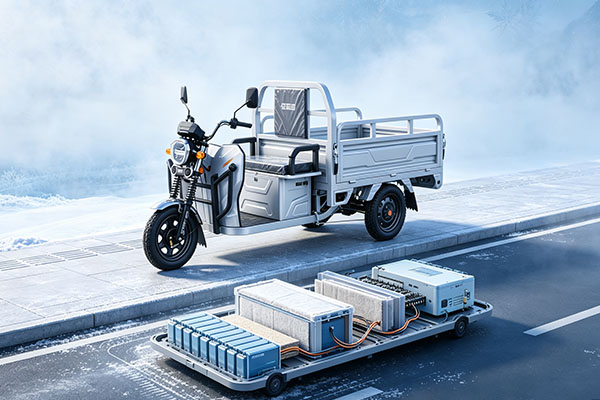
As electric three-wheelers are increasingly used for logistics delivery, agricultural transportation, express delivery, urban services, and short-distance cargo transportation, they are often required to operate in increasingly challenging environments. In northern winters, high-altitude regions, and cold storage environments, low temperatures can significantly affect the charging performance, discharge capability, driving range, and service life of lithium batteries for electric three-wheelers.
For electric three-wheelers that need to operate reliably in cold weather, simply increasing battery capacity is not always enough. A more effective approach is to optimize the battery system through proper cell selection, battery capacity design, BMS configuration, heating management, insulation, and charging strategies.
How Does Low Temperature Affect Electric Three-Wheeler Batteries?
Reduced Available Battery Capacity
When temperatures drop, the electrochemical reactions inside a battery slow down. As a result, available battery capacity and discharge performance may decrease.
For an electric three-wheeler, this means that the actual driving range in winter may be shorter than under normal-temperature conditions, even when the battery is fully charged.
For delivery and transportation vehicles, reduced range can directly affect daily operating efficiency. Therefore, battery capacity should be properly designed with the local winter temperature and expected operating conditions in mind.
Reduced Discharge Power
Electric three-wheelers require relatively high current during starting, acceleration, and hill climbing. At low temperatures, increased internal resistance can reduce the battery’s ability to provide instantaneous power.
For cargo three-wheelers operating under heavy loads, insufficient low-temperature discharge performance may result in slower acceleration, weaker climbing performance, or reduced overall vehicle responsiveness.
Low-Temperature Charging Requires Special Attention
Compared with discharging, lithium battery charging requires greater attention at low temperatures. Charging a lithium battery with a high current when the battery temperature is too low may increase the risk of lithium plating and other battery performance issues.
Therefore, a complete low-temperature battery solution needs to address not only how the battery discharges in cold conditions, but also how it can be charged safely.
How to Design a Low-Temperature Battery Solution for Electric Three-Wheelers?
Select Battery Cells Suitable for Cold Environments
Battery cells are the foundation of the entire battery system. For electric three-wheelers used in cold regions, battery cells should be selected according to the minimum operating temperature, charge and discharge rate, range requirements, and frequency of use.
LiFePO4 batteries offer good safety and cycle life, but their low-temperature performance still depends on the specific cell design and battery system. For applications requiring better low-temperature performance, high-rate operation, or fast charging, LTO battery technology can also be evaluated.
Increase Battery Capacity When Necessary
Actual usable battery capacity may decrease in cold weather. Therefore, battery capacity should be selected according to the local minimum temperature, daily driving distance, vehicle load, and operating schedule.
For example, electric three-wheelers used for logistics delivery may operate for many hours every day. A higher-capacity battery pack can provide additional energy reserves and help compensate for reduced winter performance.
Configure a Low-Temperature Protection BMS
The Battery Management System plays an important role in cold-weather battery applications. An intelligent BMS can monitor cell temperature, voltage, and current while adjusting charging and discharging strategies according to battery conditions.
When the battery temperature falls below the predefined charging range, the BMS can limit or temporarily stop charging. Charging can resume once the battery reaches a suitable temperature, helping improve low-temperature charging safety.
Key Components of a Low-Temperature Battery Solution
| Solution | Main Function | Application Scenario |
| Low-Temperature Battery Cells | Improve cold-weather charging and discharging performance | Transportation in cold regions |
| High-Capacity Battery Pack | Provide greater energy reserves | Long-distance delivery |
| Intelligent BMS | Monitor temperature, voltage, and current | All-season operation |
| Battery Heating System | Increase battery operating temperature | Extremely cold regions |
| Insulated Battery Enclosure | Reduce the impact of low ambient temperatures | Outdoor transportation |
| Temperature-Controlled Charging | Reduce risks associated with low-temperature charging | Frequent winter charging |
Why Is a Battery Heating System Important?
Increase Battery Operating Temperature
For electric three-wheelers operating in extremely cold environments, a heating element can be integrated into the battery pack.
When the battery temperature becomes too low, the BMS can activate the heating system to gradually bring the battery into a suitable operating temperature range.
This approach is particularly useful for logistics vehicles that are parked outdoors for long periods during winter.
Reduce the Impact of Low Temperature on Driving Range
Maintaining the battery within a suitable operating temperature range can improve charging and discharging performance and reduce the impact of cold weather on driving range and power output.
However, the heating system itself consumes energy. Therefore, the design should consider heating power, heating time, battery capacity, ambient temperature, and the vehicle’s actual operating conditions.
What Else Should Be Considered for Low-Temperature Electric Three-Wheeler Batteries?
Battery Enclosure Design
The battery enclosure not only protects the cells but also affects the thermal management of the battery system.
For cold-weather applications, the enclosure can be designed with appropriate insulation while also providing protection against dust, water, vibration, and mechanical impact.
Charging Environment
Whenever possible, electric three-wheelers should avoid charging immediately after being exposed to extremely low temperatures for an extended period.
Indoor parking, battery preheating, and temperature-controlled charging can help create more suitable charging conditions during winter.
Match the BMS with the Complete Vehicle System
A low-temperature battery solution should be properly integrated with the motor, controller, and charger.
BMS temperature protection parameters, charging current, discharge current, and communication protocols should be configured according to the battery chemistry and vehicle requirements.
Battery Solutions for Different Cold-Weather Applications
Electric three-wheelers can operate in different low-temperature environments, so battery requirements are not always the same.
For urban delivery during a normal winter, increasing battery capacity and improving low-temperature protection may be sufficient. For vehicles operating continuously in extremely cold regions, battery heating and insulation systems may be necessary.
For high-frequency logistics vehicles, cycle life, low-temperature charging and discharging performance, and recovery time are particularly important. Agricultural transportation vehicles may need to address low temperatures together with heavy loads and challenging road conditions.
Customized Low-Temperature Lithium Battery Solutions
Standard battery products may not fully meet the requirements of every electric three-wheeler operating in cold environments.
A customized battery solution can be designed according to vehicle voltage, battery capacity, installation dimensions, minimum operating temperature, daily operating hours, and charging conditions.
Deligreen provides lithium batteries, battery packs, BMS systems, and OEM/ODM customization services. For electric three-wheelers operating in cold environments, the battery cells, BMS, enclosure structure, and thermal management system can be designed together to create a more reliable power solution.
The core of a low-temperature battery solution for electric three-wheelers is not simply increasing battery capacity. Instead, it requires a comprehensive approach to address the effects of cold temperatures on battery cells, driving range, power output, and charging performance.
By selecting suitable low-temperature battery cells, configuring an intelligent BMS, adding appropriate insulation or battery heating systems, and optimizing charging strategies, electric three-wheelers can achieve improved operating stability in cold weather.
For urban delivery, agricultural transportation, logistics, and outdoor operations, the battery system should be designed according to the actual minimum temperature, vehicle payload, daily mileage, and charging conditions.
With a professionally designed lithium battery system, electric three-wheelers can maintain more reliable range, power output, and operating performance even during winter and in low-temperature environments.