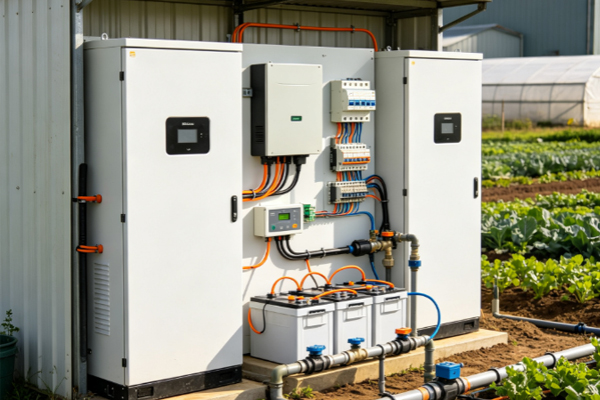
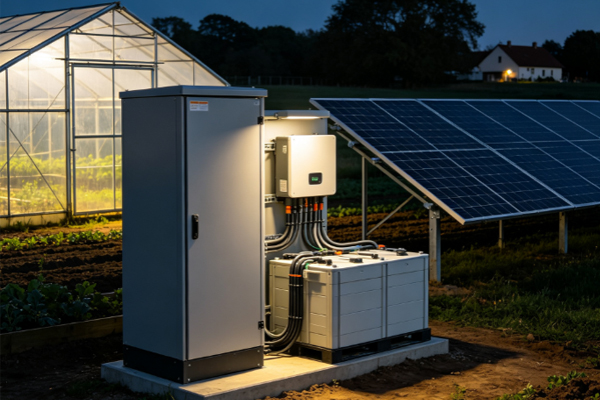
Solar power may be available during the day, but a farm still needs electricity after sunset. Ventilation fans, water pumps, automatic feeders, security cameras, and lighting do not stop working just because it gets dark. For many farms, the real headache comes at night: there is not enough stable power, or a diesel generator has to run for several hours, bringing fuel costs, noise, and maintenance work with it. A LiFePO4 battery energy storage system can store electricity during the day and release it at night, giving farms a more practical way to keep essential equipment running after sunset.
What Uses Electricity on a Farm at Night? How Long Does the Battery Need to Run?
When designing a farm nighttime power solution, looking at the farm’s total daily electricity consumption is not enough. The more useful question is which equipment actually runs at night and for how long. Some farms mainly need power for poultry house ventilation, while others need water pumps, lighting, monitoring systems, and automatic feeding equipment to operate throughout the night. These different operating patterns directly affect battery capacity and runtime.
What Equipment Uses Power at Night on a Farm?
Nighttime loads are usually spread across several types of equipment. Some devices run continuously, while others only start occasionally. Listing the actual equipment first makes it much easier to estimate the battery capacity needed for each night.
- Poultry house fans and ventilation equipment
- Water pumps and circulation pumps
- LED lighting, pathway lights, and work-area lighting
- Security cameras, alarms, and network equipment
- Automatic feeding and temperature-control equipment
How Do You Calculate Farm Nighttime Energy Consumption?
A simple way to estimate energy use is to multiply equipment power by the number of operating hours per night. For instance, a 500W device running for eight hours uses 4kWh in theory. Add the nighttime consumption of lighting, pumps, monitoring systems, and other equipment to get the estimated total.
| Nighttime Equipment | Reference Power | Runtime per Night | Theoretical Energy Use |
| Poultry house fan | 500W | 8 hours | 4kWh |
| Water pump | 750W | 3 hours | 2.25kWh |
| LED lighting | 300W | 6 hours | 1.8kWh |
| Monitoring equipment | 100W | 10 hours | 1kWh |
| Automatic feeder | 800W | 1 hour | 0.8kWh |
Actual energy demand will also be affected by inverter efficiency, equipment startup current, and the fact that batteries should not be operated at maximum output continuously. In this example, theoretical nighttime consumption is around 9.85kWh. Installing a battery with exactly 10kWh of nominal capacity may leave little room for real-world operating conditions, so some additional capacity is usually more practical.
Is a 10kWh Battery Suitable for a Farm?
A battery around 10kWh can be suitable for a small farm, greenhouse, or livestock operation with relatively moderate nighttime loads. Farms running several ventilation fans, pumps, or other equipment at the same time may need more capacity, particularly when longer overnight runtime is required.
Why Does Farm Nighttime Storage Need Strong Continuous Discharge Capability?
Many buyers focus heavily on Ah and kWh when choosing batteries, but one important specification can easily be missed: discharge capability. Farm equipment does not always consume power at a steady rate. Pumps, fans, blowers, and compressors may require significantly more power when starting than they do during normal operation. If the battery cannot handle the demand, the inverter may trigger an alarm or the equipment may fail to start.
What Should You Check When Farm Pumps and Fans Start?
Motor-driven equipment deserves special attention. Water pumps, ventilation fans, blowers, and similar loads can create a short but significant power surge when they start. The battery and inverter need to be capable of handling this demand together.
- Check both rated power and startup power
- Confirm the inverter’s peak output capability
- Check the battery’s maximum continuous discharge current
- Calculate loads that may start at the same time
Using only the rated power shown on an equipment label can underestimate the real demand. Farms with several motors starting simultaneously need enough output capacity in both the battery and inverter to handle these short-term peaks.
Are LiFePO4 Batteries Suitable for Repeated Nighttime Cycling?
Farm energy storage often follows a simple cycle: charge during the day, discharge at night, and recharge the next day. This means the battery may go through repeated charge and discharge cycles. LiFePO4 batteries are well suited to this type of energy storage application, especially when paired with a properly designed BMS that monitors battery operating conditions.
What Does the BMS Do in a Farm Nighttime Power System?
Nobody wants to stand beside the battery cabinet all night checking its condition. A reliable BMS can monitor important battery parameters and help keep the system under control even when the farm is unattended.
- Protects against overcharging and over-discharging
- Monitors battery temperature
- Tracks individual cell voltage conditions
- Activates protection when abnormal conditions occur
A farm energy storage system should not only be selected for how much energy it can store. Nighttime reliability matters just as much. This is particularly important for remote farms where maintenance personnel may not be able to reach the site immediately when a problem occurs.
How Does the Battery Recharge for the Next Night?
One of the biggest benefits of nighttime energy storage is the ability to store electricity during the day and use it after sunset. The battery then needs to recover enough energy during the following day to prepare for the next night. For farms with solar panels, charging performance, available solar generation, and actual daily electricity use all affect how quickly the battery can be restored.
What Happens When Solar Power Is Not Enough During the Day?
Solar generation can fall during cloudy weather, rainy periods, or seasons with shorter daylight hours. If the farm relies entirely on solar power to recharge its battery, several days of low solar production may gradually reduce the energy available for nighttime use.
A practical solution is to provide an additional charging source, such as grid power or a generator. When solar generation is insufficient, the battery can be topped up without forcing the entire farm to depend on a single energy source.
Does the Farm Need to Fully Charge the Battery Every Day?
Not necessarily. The important factor is how much energy the farm needs the following night and how much usable energy is available during the day. If nighttime demand is relatively low, constantly targeting 100% battery capacity may not be necessary. A suitable charge and discharge strategy can make long-term operation easier to manage.
What If the Farm Adds More Equipment Later?
Farms often expand by adding poultry houses, water pumps, ventilation equipment, or automated systems. A storage system designed with no room for growth can become restrictive when the electrical load increases.
A modular battery configuration can provide more flexibility:
- Start with basic storage capacity for a smaller farm
- Add battery modules as equipment and energy demand increase
- Upgrade the inverter and distribution system when nighttime loads grow
This approach works well for expanding farms. It avoids unnecessary investment in oversized storage from the beginning while leaving room for future equipment and higher energy demand.
How Should You Choose a Battery for Farm Nighttime Power?
When purchasing a battery for farm nighttime power, it is better to give the supplier a complete list of nighttime equipment, daily operating hours, equipment startup power, and available daytime charging conditions instead of simply saying, “I need a 10kWh battery.” The supplier should also know the installation environment, inverter specifications, communication requirements, and expected charge-discharge pattern before recommending a suitable battery system. DELIGREEN provides LiFePO4 batteries, battery packs, DIY battery boxes, BMS accessories, and scalable energy storage solutions that can be configured according to farm nighttime loads, voltage, capacity, and available installation space.
The real purpose of a farm nighttime power solution is simple: where does the electricity come from after the sun goes down? By storing energy in LiFePO4 batteries during the day and using it at night, farms can keep ventilation fans, pumps, lighting, monitoring systems, and automated equipment running while recharging the battery during the following day. For farms looking to reduce diesel generator use and improve nighttime power reliability, choosing the right storage capacity and discharge capability is more useful than simply buying the largest battery available. Hospital battery energy storage also focuses on continuous and stable power, while farm nighttime storage places greater emphasis on repeated cycling, equipment startup loads, and smooth day-to-night energy management.