When drones perform aerial photography, surveying and mapping, inspection, agricultural operations, and logistics transportation, the power system directly affects flight time, payload capacity, and mission stability. High-current output over short periods, frequent takeoffs and landings, and varying ambient temperatures all place higher demands on battery performance. For drone manufacturers and battery procurement customers, the power solution also needs to be planned comprehensively based on the mission type, overall aircraft structure, and operating environment. This ensures that the battery can adapt to load changes during different flight stages while facilitating subsequent installation, testing, and maintenance.
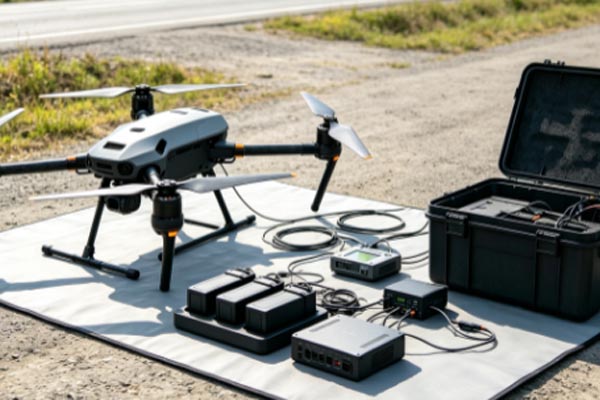
Drone Power Solutions Need to Match Actual Flight Requirements
Different drones vary significantly in model, payload, and mission duration. Power configurations need to be designed around actual operating conditions.
Cell Selection Must Balance Energy and Power
Drone batteries need to provide sufficient endurance while also meeting the instantaneous power demands during takeoff, climbing, and acceleration. Key selection factors include:
- Energy density: Provides more usable energy within a limited weight range.
- Discharge capability: Meets the requirements for rapid motor response and high-load operation.
- Cycle performance: For high-frequency use, attention should be paid to capacity retention after long-term charging and discharging.
- Consistency: For multi-series battery packs, differences in voltage, capacity, and internal resistance need to be controlled.
A suitable cell combination can achieve a more reasonable balance between endurance, power output, and overall aircraft weight.
Determine Power Priorities Based on the Application
Different applications have different requirements for drone power systems. These requirements can be distinguished as follows:
- Surveying and mapping drones: Focus more on flight endurance, overall weight, and stable power supply during long-term operation.
- Agricultural spraying drones: Typically require strong continuous output capability to accommodate frequent operations and load changes.
- Logistics drones: Place greater emphasis on battery capacity, safety, reliability, and stable power delivery.
- Inspection drones: Need to balance endurance, equipment power supply, and operational stability in complex environments.
Once the mission scenario is clearly defined, the power parameters can be matched more easily with the overall aircraft requirements, reducing the risk of incompatibility between battery performance and actual drone operating conditions.
Drone Power Management Must Address Weight, Space, and Power Stability
The internal space of a drone is limited, while battery weight directly affects payload capacity and flight efficiency. The power system must therefore be arranged efficiently within the available space.
Battery Dimensions and Weight Require Precise Matching
Customized power solutions are generally designed according to the battery compartment and overall aircraft structure. Key considerations include:
- Overall dimensions: Adjust the length, width, and height according to the available installation space.
- Weight control: Configure the cells, BMS, connectors, and housing appropriately to avoid unnecessary structural weight.
- Center-of-gravity layout: Optimize the battery installation position to minimize its impact on the drone’s flight attitude.
Matching the dimensions, weight, and installation method can improve assembly efficiency and facilitate subsequent replacement and maintenance.
Interfaces and Power Parameters Need to Be Standardized
Drone power systems typically need to work with motors, electronic speed controllers, flight controllers, and charging equipment. The voltage platform, continuous current, peak current, connectors, and communication interfaces should all be clearly defined during the design stage. Standardizing the parameters and interfaces can reduce the development costs associated with rewiring, structural modifications, and repeated adaptation at later stages.
BMS and Thermal Management Improve Drone Power Reliability
During flight, drone loads can change rapidly, while battery conditions also vary with current and ambient temperature. A comprehensive management system can provide greater visibility into the power system status.
The BMS Should Cover Core Protection Functions
The BMS is an important part of drone battery management and can be configured around the following functions:
- Cell voltage monitoring: Tracks the operating status and voltage differences of individual cells.
- Overcharge and over-discharge protection: Reduces the risk of cells entering abnormal voltage ranges.
- Overcurrent protection: Establishes appropriate protection strategies for high-power output.
- Temperature monitoring: Tracks changes in battery pack temperature in real time.
- Balancing management: Reduces the expansion of differences between cells during long-term cycling.
A comprehensive BMS helps users monitor battery status in a timely manner and provides a foundation for the stable operation of the drone.
Thermal Management Should Reflect Flight Conditions
High-rate discharge generates heat, while high summer temperatures can also increase heat dissipation pressure. Thermal management can be optimized in the following ways:
- Heat dissipation structure: Reserve suitable heat dissipation conditions according to battery power and installation space.
- Temperature sensors: Monitor the temperature of cells, connection areas, and other critical locations.
- High-temperature protection: Trigger alarms or protection mechanisms promptly when the temperature exceeds the specified range.
- Operating-condition adaptation: Adjust management strategies according to continuous flight, frequent takeoffs and landings, and high-load operations.
- Structural optimization: Optimize heat dissipation paths for high-power drones to reduce heat accumulation.
Proper thermal management helps the battery maintain a more stable operating condition during continuous operations.
Drone Power Customization Requires a Complete Delivery Process from Parameter Confirmation
For drone manufacturers and bulk procurement customers, the value of a power management solution is also reflected in customization efficiency, sample validation, and batch-to-batch consistency.
What Parameters Need to Be Confirmed Before Customization
The more complete the information provided by the customer, the more accurately the power solution can be matched. Common requirements include:
| Parameter | Information Required from the Customer | Main Impact |
| Voltage | Operating voltage platform | Matches the motor, ESC, and flight controller |
| Capacity | Target capacity and flight endurance | Affects flight time and weight |
| Current | Continuous and peak current | Affects power output capability |
| Dimensions | Available battery compartment space | Determines the battery pack structure |
| Weight | Overall aircraft payload limit | Affects flight efficiency and payload |
| BMS | Protection and communication requirements | Affects safety management and data interaction |
| Interface | Connector and wiring specifications | Affects aircraft installation and power connection |
Once these basic parameters are confirmed, the cells, series-parallel configuration, BMS, structure, and interfaces can be matched according to the overall aircraft requirements.
Sample Testing and Mass Production Need to Remain Consistent
After the sample is completed, it should be installed on the actual drone for flight validation. Key factors to observe include takeoff current, continuous output, temperature rise, flight endurance, communication status, and battery fixation. During mass production, cell screening, capacity testing, internal resistance testing, and finished-product testing should also be strengthened. Standardized validation and production processes help identify compatibility issues in a timely manner and reduce performance deviations between different product batches.
By properly configuring the cells, BMS, structural components, and connection interfaces, drone batteries can better adapt to different mission environments. After sample validation, flight testing, and batch inspection, the power system can maintain strong overall performance in terms of endurance, power response, temperature control, and operational safety, providing stable support for aerial photography, surveying and mapping, inspection, agricultural spraying, logistics, and other applications.