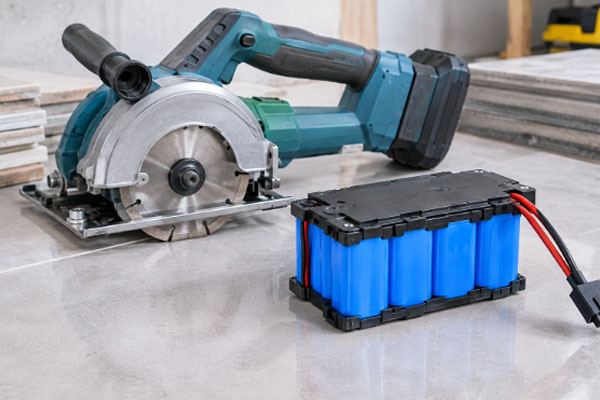
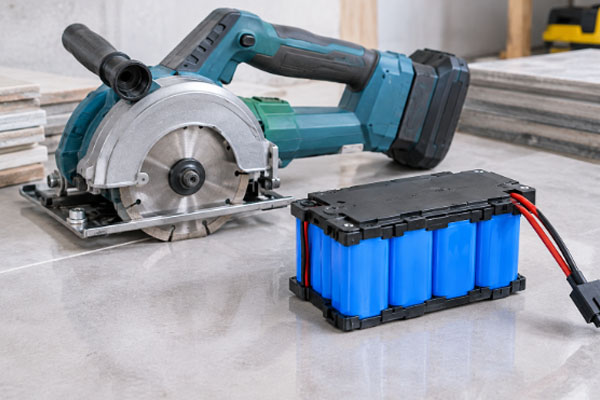
Electric tile cutters are mainly used for cutting tiles, ceramics, marble, granite, and other materials, and are widely used in renovation, construction projects, home remodeling, and stone processing. Compared with traditional corded cutting machines, cordless electric tile cutters do not need to remain connected to a power source, allowing workers to move the equipment during operation. They are especially suitable for construction sites with complex environments, distant power outlets, or situations where the working position needs to be changed frequently. During the cutting process, the blade of an electric tile cutter is continuously subjected to material resistance, and the motor needs to output relatively high power within a short period. If the battery pack does not have sufficient discharge capability, problems such as weak startup, reduced cutting speed, and sudden shutdown under load may occur. If the battery capacity is too small, the operating time of the equipment will be limited; if the battery capacity is too large, the overall equipment weight may increase and affect long-term use by construction workers. Therefore, electric tile cutters need to be customized according to motor power, operating current, operating time, installation space, and charging method.
Why Do Electric Tile Cutters Need Dedicated Lithium Battery Packs?
Cutting Operations Have Relatively High Battery Output Requirements
When an electric tile cutter operates without load, the motor’s power consumption is relatively stable. However, once the blade actually cuts into tiles or stone, it encounters significant resistance, and the motor needs more current to maintain its speed. If the battery pack can only provide a relatively small continuous current, the equipment may operate normally during no-load operation but experience reduced speed once cutting begins. This becomes even more noticeable when cutting thicker tiles or harder stone materials. Therefore, when customizing a battery pack, it is not enough to look only at “how many Ah.” It is also necessary to consider how much continuous current the battery pack can provide and whether it can withstand the equipment’s startup and heavy-load operation for short periods.
Capacity Determines How Long the Equipment Can Operate
Battery runtime is also an important performance indicator for electric tile cutters. Tile cutters need to be moved frequently during construction. If the battery needs to be recharged after a relatively short period of use, it will not only affect construction progress but may also increase the number of spare batteries required.
The common battery pack capacity can be estimated according to the actual power and operating time of the equipment:
Battery Energy (Wh) ≈ Battery Voltage (V) × Battery Capacity (Ah)
For example, a 24V, 10Ah battery theoretically stores approximately 240Wh of energy. In actual use, factors such as motor efficiency, load size, controller efficiency, and ambient temperature will also affect performance, so the actual operating time is usually lower than the theoretical calculation.
Safety of Using Lithium Iron Phosphate Cells
If the product is positioned as a professional electric tool for long-term use, lithium iron phosphate cells can be considered. Lithium iron phosphate batteries offer good thermal stability and long cycle life. Under proper design and correct use, they can help reduce the costs associated with frequently replacing battery packs. Different equipment has different voltage and current requirements, so a single battery specification cannot simply be applied to all products. Common customization parameters can include:
| Common Customization Content | |
| Battery Type | Lithium iron phosphate battery |
| Voltage | 12V, 18V, 24V, 36V, 48V, etc. |
| Capacity | Customized according to runtime requirements |
| Cells | High-quality lithium iron phosphate cells |
| BMS | Overcharge, over-discharge, overcurrent, short-circuit, and temperature protection |
| Housing | Plastic housing, tool battery housing, or customized structure |
| Interface | Customized according to the equipment interface |
| Charging Method | Dedicated matching charger |
| Connection Method | Removable or fixed installation |
The actual specifications need to be confirmed according to the motor power and equipment structure rather than simply selected based on voltage or capacity.
How to Customize Lithium Battery Packs for Electric Tile Cutters
Determine Battery Voltage According to Motor Power
Battery voltage directly affects the motor’s operating condition. The higher the power of the electric tile cutter, the higher the voltage and stronger output capability generally required. For example, small household tile cutting equipment may use a lower-voltage solution, while professional construction equipment may use 24V, 36V, or even 48V battery packs. Increasing the voltage can reduce the required current at the same power level, helping reduce heat generation in the battery pack and wiring.
For example, if the equipment power is 720W:
720W ÷ 24V ≈ 30A
If 36V is used:
720W ÷ 36V ≈ 20A
This is only a theoretical calculation. Actual design also needs to consider motor startup current and load changes. Therefore, the battery supplier needs to determine the cell quantity, series configuration, and BMS specifications based on the actual operating data of the equipment.
Determine Battery Capacity According to Construction Time
Battery capacity should not simply be maximized. As capacity increases, the weight and volume of the battery pack generally increase as well. For handheld tile cutters, an excessively heavy battery can increase the burden on construction workers during extended operation. Therefore, a practical approach is to determine capacity according to how long the equipment needs to be used for each operation. For example, if the product is expected to operate continuously for approximately one hour, the required energy should be calculated based on the equipment’s average power, with a certain margin reserved. For professional tools, two capacity specifications can also be designed, such as a standard version and a high-capacity version, allowing customers to choose according to their construction time requirements.
Design the Battery Structure According to Installation Space
The battery of an electric tile cutter is usually installed at the rear of the machine body, near the handle, or at the bottom. If the battery pack dimensions are unsuitable, it cannot be installed even if the electrical parameters are correct. Therefore, customization requires the length, width, height, interface position, and fixing method of the battery compartment. For equipment produced in batches, the battery pack structure can also be redesigned according to the product housing so that the battery integrates better with the complete machine.
When customizing a battery pack, it is recommended to provide the following information in advance:
- Rated power and maximum power of the tile cutter
- Rated voltage of the motor
- Normal operating current and maximum operating current
- Expected operating time per use
- Battery compartment dimensions and installation method
With this information, the cell configuration, capacity, BMS, and housing solution can be determined more accurately.
BMS and Battery Pack Safety Design
The BMS Protects the Battery Pack
Electric tile cutters are high-load tools, and the current changes according to material resistance during cutting. If the blade becomes stuck, the motor stalls, or a circuit abnormality occurs, the battery may suddenly experience a large current. Therefore, the battery pack needs to be equipped with an appropriate BMS to monitor the battery operating condition. The BMS can provide overcharge protection, over-discharge protection, overcurrent protection, short-circuit protection, and temperature protection. When an abnormal condition is detected, it can promptly limit further battery output and reduce the risk of problems caused by improper use of the battery pack.
Continuous Discharge Capability
An electric tile cutter may remain under load for an extended period during cutting, so the BMS rated current cannot be selected based only on the equipment’s normal operating current. For example, if the equipment’s normal operating current is approximately 25A, this does not necessarily mean that a 25A BMS is appropriate. Actual design also needs to consider startup current, instantaneous loads, and ambient temperature, with a reasonable margin based on equipment test results. At the same time, the cells themselves also need to have the corresponding discharge capability. If the BMS can output a large current but the cells are not suitable for high-load operation, the entire battery pack will still be unable to achieve the expected performance.
Temperature Control
The battery generates a certain amount of heat during operation, and the higher the current, the more noticeable the heat generation generally becomes. When electric tile cutters are used for construction in summer, on high-temperature construction sites, or for long periods of continuous operation, greater attention needs to be paid to battery temperature. Therefore, temperature detection can be configured according to the equipment’s operating environment during battery pack customization, with protection provided through the BMS. The positions of the cells, wiring, and protection board inside the battery housing should also be arranged properly to avoid localized poor heat dissipation. For equipment used on construction sites over long periods, dust, vibration, and frequent insertion and removal should also be considered to improve the overall structural reliability of the battery pack.
Electric Tile Cutter Battery Customization and Testing
Sample Testing
If an equipment manufacturer is developing a cordless electric tile cutter for the first time, it is recommended not to proceed directly to large-scale battery production. Instead, samples can be produced first for testing. During testing, it is possible to observe whether the equipment starts smoothly, whether the power remains stable during cutting, whether battery temperature rise is normal, and how much work can be completed on a single charge. If the equipment experiences speed reduction under load, the cell discharge capability, BMS current settings, motor controller, and wiring specifications should be checked further rather than simply increasing battery capacity.
Confirm the Solution Through Actual Cutting Tests
Laboratory no-load testing cannot fully represent actual construction-site conditions. By directly using actual tiles, floor tiles, or stone materials for cutting, different materials can be tested, including thin tiles, thick tiles, and harder materials. The operating current, battery temperature, and remaining battery level under different loads can be recorded. For manufacturers producing tools in batches, this type of test data can help battery suppliers further adjust the cell configuration and BMS parameters, making the final battery more closely matched to the equipment’s requirements.
From Samples to Mass Production
After testing is completed, the final battery specifications, housing structure, interface, labels, and packaging method can be determined. During mass production, cell consistency testing, battery assembly, welding quality inspection, BMS testing, charge and discharge testing, and finished product inspection also need to be properly performed. If the product needs to be exported, the target market’s requirements for battery transportation and compliance documentation should also be confirmed in advance.
Frequently Asked Questions
Q: Does a larger battery capacity mean the tile cutter will operate for longer?
In general, increasing capacity can increase stored energy, but actual runtime is also related to motor power, cutting materials, operating methods, and battery condition. Increasing capacity also increases weight, so an appropriate specification needs to be found between runtime and portability.
Q: Can I purchase a battery directly based on voltage?
Not recommended. Even if the voltage is the same, different tile cutters may have different operating currents, interfaces, installation dimensions, and BMS requirements. It is best to provide the equipment parameters and battery compartment dimensions before customization.
Q: Can you customize the battery according to a prototype?
Yes. For tool manufacturers, the battery pack can be designed according to motor parameters, the original battery sample, battery compartment dimensions, and overall equipment requirements. After sample testing, the mass production solution can then be finalized.
The battery performance of an electric tile cutter should not be evaluated based solely on capacity. The battery pack’s weight, power output during cutting, continuous operating time, and long-term performance stability are also important. A reasonable balance should be achieved between output performance, runtime, structural dimensions, and portability to ensure stable operation of the tile cutter and meet actual construction requirements. If you are developing an electric tile cutter or planning to upgrade a corded machine to a cordless version, you can provide parameters such as equipment power, voltage, operating current, runtime requirements, and battery compartment dimensions. Our technical team can evaluate these requirements and develop a lithium iron phosphate battery pack solution that better matches your needs.
If you have not yet determined the battery specifications, you can also send our team the motor power, voltage, operating current, runtime requirements, and battery compartment dimensions of your electric tile cutter, and we can help evaluate a suitable battery solution.
WhatsApp: +86 15074995718
Email: info@deligreen.net