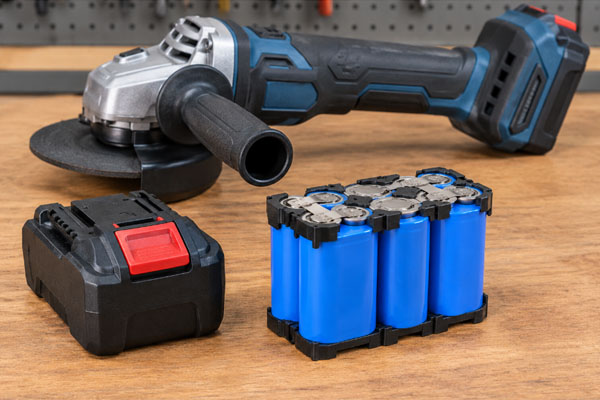
Angle grinders are common power tools widely used for metal cutting, grinding, rust removal, polishing, and construction work. As cordless power tools become increasingly popular, traditional corded angle grinders are gradually being replaced by cordless products. Without the limitations of a power cord, workers can use them directly on construction sites, for outdoor maintenance, steel structure processing, and other environments, making operation more convenient. The battery of a cordless angle grinder is an important component that determines the tool’s operating time, output power, startup speed, and user experience. In particular, when a high-power angle grinder starts, the motor usually requires a relatively large instantaneous current. If the battery output capacity is insufficient, problems such as weak startup, reduced speed, frequent protection activation, or even battery overheating may occur. Therefore, high-power angle grinders need a lithium battery solution that can withstand high current, provide good safety performance, and be customized according to the tool structure. Lithium iron phosphate batteries offer good safety performance, long service life, and stable discharge performance, making them suitable for some power tool products with high safety and service life requirements. Actual battery selection also needs to be designed according to parameters such as the angle grinder’s motor power, operating time, working current, and installation space.
Why Do Angle Grinders Need High-Power Lithium Batteries?
High-Power Motors Require Stable Output
When an angle grinder is cutting or grinding metal, the motor load increases significantly. During no-load operation, the pressure on the battery output may not be obvious, but once the grinding wheel contacts the workpiece, the motor requires more current to maintain its speed. If the battery itself does not have sufficient discharge capability, the tool can easily experience reduced power under heavy-load operation. High-power lithium batteries need to focus on both continuous discharge capability and instantaneous discharge capability. The battery must not only allow the angle grinder to start normally but also maintain relatively stable voltage output during continuous cutting, grinding, and other operations.
Voltage Determines the Basic Output of the Tool
Common cordless angle grinder batteries use different voltage platforms according to product power, such as 18V, 20V, 24V, 36V, 40V, or 48V. The specific voltage needs to be determined according to the motor design and overall tool solution. In general, increasing the battery pack voltage can reduce the operating current at the same power level, helping reduce the current load on the connecting wires and battery pack. However, higher voltage is not always better. It is also necessary to consider whether the motor, controller, battery compartment, and charger are compatible.
| Common Application Characteristics of Angle Grinder Battery Design | ||
| 18V/20V level | Light-duty angle grinders, household repairs | Lightweight, portability |
| 24V level | Medium-power tools | Balance between runtime and power |
| 36V/40V level | Higher-power angle grinders | High-current output, heat dissipation |
| 48V level | High-power, professional tools | Cell configuration, BMS, and safety design |
How to Choose Battery Capacity
Battery capacity is usually expressed in Ah. A higher capacity can provide longer operating time under the same working conditions, but battery weight and size will also increase. Angle grinders are high-power tools, so capacity should not simply be maximized. For example, adding a large number of cells to extend runtime may make the battery too heavy, affecting workers who need to hold the tool for extended periods. Therefore, a more appropriate approach is to determine the capacity according to actual operating time and achieve a suitable balance between power, weight, and runtime.
How to Design Lithium Batteries for High-Power Angle Grinders
Determine Battery Specifications According to Motor Parameters
When customizing lithium batteries for angle grinders, it is recommended to provide the motor’s rated power, operating voltage, normal operating current, maximum operating current, and desired operating time. The supplier can calculate the required number of cells and capacity of the battery pack based on these parameters. At the same time, after the battery pack design is completed, actual load testing is also required rather than judging the solution solely based on theoretical data. This is because the motor load continuously changes when the angle grinder cuts different materials, and actual operating conditions can differ significantly from no-load testing.
What Requirements Are Lithium Iron Phosphate Cells Suitable For?
Lithium iron phosphate cells offer good thermal stability and cycle life and have application value in products requiring higher safety and longer service life. For tool products that require frequent charging and discharging, stable battery performance can also help reduce maintenance requirements later. However, angle grinders are also sensitive to battery weight and power density. Therefore, during actual product development, the appropriate cell needs to be selected according to the tool’s positioning rather than directly applying the same type of cell to every angle grinder. If the product emphasizes lightweight design, high speed, and portability, other lithium battery chemistries can also be evaluated according to the overall tool solution. Professional battery manufacturers can generally help customers select a suitable cell solution based on tool parameters.
The BMS Needs to Adapt to High-Current Operation
The BMS is an important protection component in a battery pack. It can monitor and protect against conditions such as overcharging, over-discharging, overcurrent, and temperature. When a high-power angle grinder starts or operates under heavy load, the instantaneous current may increase significantly. If the BMS parameters are set too low, the tool may frequently trigger protection during normal operation; if the protection capability is insufficient, it may not adequately ensure battery safety. Therefore, the BMS needs to be designed according to the cell specifications, maximum angle grinder current, and operating environment. For customized batteries, protection parameters, temperature detection methods, and communication functions can also be adjusted according to the customer’s product requirements.
Safety and Durability Design of Angle Grinder Batteries
Control Internal Battery Temperature Rise
When an angle grinder performs cutting or grinding for extended periods, the motor itself generates heat, and the battery may also experience temperature increases due to high-current discharge. If the battery has poor heat dissipation conditions, prolonged high-load operation can affect cell service life. During battery pack design, the distance between cells, connection structure, and housing space need to be arranged properly, while temperature detection can be incorporated for protection. For professional-grade angle grinders, actual continuous load testing can also be conducted to confirm temperature changes under different operating conditions.
Connection Structure
The internal connections of high-power batteries carry relatively high current. Connection tabs, wires, welding points, and protective board interfaces can all affect the actual output capability of the battery. Therefore, during battery production, welding quality, circuit connections, cell consistency, and finished product voltage need to be inspected. For bulk orders, cell sources and manufacturing processes should also remain stable to avoid significant performance differences within the same batch of products.
Provide Complete Factory Testing
A qualified angle grinder lithium battery should not only undergo simple charge and discharge testing. Depending on the product type, capacity testing, internal resistance testing, overcurrent protection testing, short-circuit protection testing, temperature protection testing, and actual load testing can also be performed. For products that need to be exported, relevant documents also need to be prepared according to the transportation and regulatory requirements of the target market. For example, customers may be concerned about battery transport test summaries, safety data sheets, and relevant compliance documents.
How to Complete Customization from Samples to Mass Production
Confirm the Actual Tool Parameters
Angle grinder battery customization usually starts with the tool parameters. Customers can provide an angle grinder prototype, battery compartment dimensions, original battery specifications, or motor parameters. Based on this information, the supplier designs the battery dimensions, cell configuration, and interface position. If the battery needs to be installed beneath the handle, the overall weight and center of gravity also need to be controlled. If the battery is installed at the rear of the tool, particular attention needs to be paid to the fixing method and shock-resistant design.
Proceed to Mass Production After Sample Testing
It is not recommended to skip the sample stage for customized products. After the first version of the battery is completed, it needs to be installed on the angle grinder for startup, no-load, cutting, and continuous load testing. During testing, the tool’s startup speed, power changes, battery temperature, and protection status can be observed. If insufficient capacity, excessive weight, or frequent protection activation under heavy load is detected, the cell configuration and BMS parameters can be adjusted in time.
Maintain Consistency During Mass Production
After the sample is approved and the product enters mass production, the manufacturer needs to control cell batches, welding processes, BMS installation, and finished product testing procedures. For OEM/ODM customers, the battery housing, LOGO, labels, and packaging can also be designed according to the product appearance. A complete high-power angle grinder battery customization service generally includes cell selection, battery structure design, BMS configuration, sample production, performance testing, mass production, and export documentation support.
Frequently Asked Questions
Q: Is a larger capacity always better for an angle grinder lithium battery?
Not necessarily. A larger capacity generally means longer runtime, but battery weight and size may also increase. Angle grinders require long periods of handheld operation, and an excessively heavy battery can affect the user experience. Therefore, capacity should be determined according to operating time and tool weight requirements.
Q: Why do high-power angle grinders tend to cause battery heating?
High-current discharge generates a certain amount of heat, especially during continuous cutting and heavy-load operation. If the cell discharge capability is insufficient, internal connection resistance is high, or heat dissipation space is inadequate, the temperature rise may become more noticeable. Therefore, improvements need to be made through cell, BMS, connection structure, and housing design.
Q: Can a regular power tool battery be directly modified for use?
Direct modification is not recommended. Different angle grinders may have different operating voltages, currents, battery interfaces, and BMS protection parameters. The battery needs to work together with the tool controller and charger, and customized production provides greater stability.
Q: Can an angle grinder battery be manufactured based on a sample?
Yes. Customers can provide an original battery sample, battery compartment dimensions, tool parameters, or battery photos. The manufacturer can use this information to evaluate the cell configuration, capacity, interface, and housing structure before producing samples for testing.
Professional Lithium Iron Phosphate Battery Manufacturer
We specialize in the R&D, production, and sales of lithium iron phosphate battery cells, battery packs, battery management systems (BMS), and energy storage systems. We can provide OEM/ODM customization services according to angle grinder power, operating time, battery compartment dimensions, and other requirements. From cell selection to battery pack production and finished product testing, we pay attention to every stage of production and provide stable battery products to customers worldwide. We provide applicable documentation for the required battery model, including access certificates, transport test summaries, safety data sheets, and compliance reports. The required documents may differ depending on the country and application scenario. You are welcome to contact our team to confirm your product, target market, and application requirements. We can provide lithium iron phosphate batteries, battery packs, DIY battery boxes, BMS accessories, and scalable energy storage solutions for buyers worldwide.
If you are looking for a high-power lithium battery supplier for angle grinders, you can directly provide the battery voltage, capacity, angle grinder power, battery compartment dimensions, or an existing battery sample. We can evaluate the cell configuration, BMS, and battery structure according to the actual application requirements and provide sample testing and OEM/ODM customization services.
Contact us now for a free consultation and customized solution.
WhatsApp: +86 15074995718
Email: info@deligreen.net