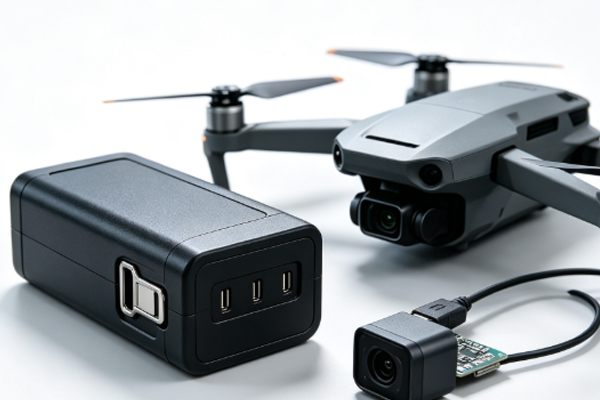
When security drones perform tasks such as park patrols, perimeter monitoring, emergency searches, and nighttime inspections, they typically need to carry high-definition cameras, thermal imaging equipment, or other sensors. Compared with standard aerial photography applications, security missions place greater emphasis on flight endurance, power response, payload power supply, and adaptability to complex environments. Battery solutions should also be matched to the drone’s body structure, interface specifications, charging method, and drone dock management requirements to reduce compatibility issues during equipment deployment and daily operation.
Security Drone Batteries Must Meet High-Load Flight Requirements
When security drones perform patrol missions, changes in payload and flight status affect battery power requirements, so cell selection should be aligned with actual mission needs.
Cell Performance Must Balance Endurance and Power
Different security platforms have different battery requirements. The following indicators should be considered:
- Energy density: Provides more usable power while controlling battery weight.
- Discharge rate: Requires stable high-current output during fully loaded takeoff, rapid climbing, and flight against wind.
- Cycle performance: Requires good capacity retention for high-frequency patrols and repeated charging and discharging.
- Consistency: Requires control of performance differences between individual cells in multi-series battery packs.
A reasonable cell combination can achieve a balance between flight endurance and instantaneous power.
Battery Capacity Should Be Determined Based on Mission Duration
Security drones do not simply pursue higher capacity, as increased capacity also adds weight. Solution design should consider the duration of a single patrol, flight radius, return-to-home requirements, and the power consumption of payloads such as cameras and thermal imaging equipment. The appropriate capacity should be determined according to the mission model to prevent excessive battery weight from affecting flight efficiency.
Security Drone Batteries Must Adapt to Complex Environments
Outdoor security missions may involve high temperatures, low temperatures, humidity, high altitudes, and other conditions. The battery’s temperature adaptability can affect flight performance. Conditions such as low temperature and low air pressure may change the thermal characteristics of lithium batteries, so targeted insulation and heating designs are required.
Thermal Management Affects Battery Output Stability
Designs for different environments can focus on the following aspects:
- Low-temperature heating: Helps the battery reach a suitable operating state in cold environments.
- High-temperature heat dissipation: Reduces heat accumulation caused by continuous high-current operation.
- Temperature monitoring: Collects temperature data from key locations in real time to support BMS control.
When thermal management is properly matched with cell performance, battery operating stability under changing environmental conditions can be improved.
Structural Protection Must Consider Outdoor Operations
Security drones may operate outdoors for extended periods, so the battery pack structure can be reinforced according to the actual platform:
- The housing should provide a certain level of impact resistance;
- Connectors and wiring harnesses should meet reliable connection requirements;
- The internal structure should reduce the impact of vibration on connection components.
A reasonable structural design helps reduce the impact of frequent takeoffs and landings and outdoor flights on the battery system.
The BMS Is an Important Part of Security Drone Battery Management
Security drones need to perform missions frequently. The BMS should continuously monitor battery status and provide protection during charging and discharging.
The BMS Must Cover Key Operating Data
The battery management system should focus on the following:
- SOC: Monitors the remaining battery capacity and provides a reference for return-to-home and mission duration decisions.
- SOH: Monitors battery health and provides a basis for maintenance and replacement.
- Cell voltage: Identifies voltage differences between individual cells.
- Temperature data: Monitors temperature changes during charging and discharging.
- Abnormality protection: Establishes protection strategies for overcurrent, overvoltage, over-discharge, and abnormal temperatures.
Comprehensive data management improves battery status visibility and facilitates maintenance by operators.
Fast Charging Must Also Consider Battery Life
Security drones often require frequent takeoffs and continuous operation. Fast recharging can shorten waiting times, but the charging strategy must still be matched with cell specifications, temperature conditions, and BMS protection logic. Unattended drone docks can improve automated drone operation efficiency by identifying battery temperature, stopping charging in abnormal conditions, and scheduling charging. Proper control of charging current and temperature helps balance mission turnaround efficiency and battery service life.
Security Drone Battery Customization Must Focus on Overall System Compatibility
For drone manufacturers, security equipment companies, and bulk procurement customers, battery solutions should extend from sample design to testing, mass production, and after-sales service to reduce compatibility issues during actual deployment.
Core Parameters Must Be Confirmed Before Customization
Customers can provide the following information:
| Item | Information to Confirm | Main Purpose |
| Voltage platform | Operating voltage of the drone system | Match the power system |
| Capacity | Target flight time | Meet endurance requirements |
| Discharge rate | Continuous and peak current | Meet takeoff, climbing, and other operating conditions |
| Payload | Power consumption of cameras, thermal imaging equipment, and other devices | Calculate actual energy requirements |
| Dimensions and weight | Battery compartment space and total drone payload | Complete structural adaptation |
| Operating environment | High temperature, low temperature, humidity, and altitude | Develop an environmental adaptability solution |
The more complete the parameters, the higher the level of compatibility among the cells, BMS, structure, and connectors.
Sample Verification Should Reflect Actual Security Missions
After the battery sample is completed, it should be tested together with the actual drone:
- Flight testing: Observe voltage and temperature changes during fully loaded takeoff, hovering, climbing, cruising, and return-to-home.
- Environmental testing: Verify performance under high-temperature, low-temperature, and complex outdoor conditions based on the actual operating area.
- Cycle testing: Observe capacity retention and consistency changes after repeated charging and discharging.
- Communication testing: Confirm that BMS data can communicate reliably with the drone control system or dock system.
Testing under conditions that closely reflect real missions can identify issues related to endurance, power, thermal management, and communication in a timely manner, providing a basis for mass delivery.
Security drone battery solutions should be designed around patrol, monitoring, emergency response, and unattended operation requirements. By properly configuring cell capacity, discharge rate, BMS, thermal management, and structural protection, and completing testing based on actual payloads and flight environments, the drone’s endurance stability, mission response capability, and long-term operating performance can be improved. This also helps reduce subsequent compatibility costs and provides reliable energy support for continuous deployment and high-frequency operations.