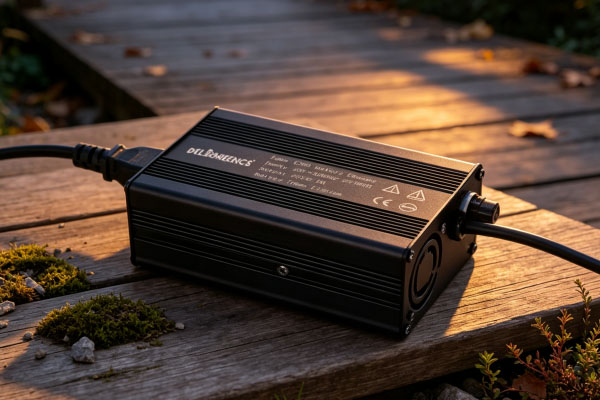
Electric scooters are compact and convenient to use, and have been widely used for short-distance urban travel, commuting within parks, shared mobility, and personal transportation. As scooter power, range, and usage frequency continue to increase, whether the supporting charger has an appropriate charging speed, stable output, durable housing, and a plug that complies with local standards will directly affect the user experience. If a standard universal charger is used, it is easy to encounter problems such as unsuitable output parameters, inconsistent interfaces, excessive charging time, noticeable heat generation, or the inability to adapt the product to different sales markets. Therefore, customizing the charger according to the lithium battery pack used by the scooter makes it easier to maintain stable operation of the entire vehicle. The reason for using an aluminum housing is that aluminum is relatively lightweight while offering good heat dissipation and structural strength, which can reduce heat accumulation generated during long-term charger operation and improve the overall product quality. For different battery capacities, voltages, operating environments, and sales countries, the charger can be comprehensively designed from charging parameters, housing structure, interface, and protection functions to certification documents, providing electric scooter brands with a more complete charging solution.
Determine the Charger Solution Based on Battery Parameters
The lithium batteries used in electric scooters are not limited to one specification. Different battery packs vary in rated voltage, battery capacity, and charging requirements. Therefore, a charger cannot be selected simply based on the appearance of the scooter or motor power, but needs to be determined according to the actual battery pack parameters.
Battery Voltage Determines Charger Output
Common electric scooters use lithium battery packs with different voltage levels, such as 36V and 48V. It should be noted that the 36V or 48V marked on a battery pack usually refers to the operating voltage, while the charger’s output voltage needs to be designed according to the actual fully charged voltage of the corresponding battery pack. For example, a common 36V lithium battery pack typically has a voltage higher than 36V when fully charged, so a power supply with a 36V output cannot be directly used for charging. When purchasing a charger, the battery pack model, number of cells connected in series, and battery chemistry should be provided to the manufacturer so that engineers can confirm the specific charging voltage.
Battery Capacity Affects Charging Time
Battery capacity is usually expressed in Ah. At the same voltage, the larger the battery capacity, the longer the required charging time will generally be. If the customer wants to shorten the charging time, the charging current can be increased appropriately, but a higher current is not always better. The charging current needs to be selected within the range permitted by the battery; otherwise, it may cause increased battery heat generation and also affect long-term service life.
| Common Battery Pack SpecificationsCharger Design ContentCommon Applications | ||
| 36V small-capacity lithium battery | Output voltage, charging current, interface | Urban commuting scooters |
| 36V large-capacity lithium battery | Charging time, heat dissipation capability | Long-range scooters |
| 48V lithium battery | Output voltage accuracy, protection functions | High-power electric scooters |
| Customized LiFePO4 battery pack | Battery chemistry and charging parameters | Special-purpose models |
Confirm the Battery Type in Advance
If the scooter uses a conventional ternary lithium battery, LiFePO4 battery, or another lithium battery chemistry, the charging requirements are not exactly the same. In particular, LiFePO4 battery packs have different charging voltages from common lithium batteries. Therefore, when providing battery pack specifications, customers are advised to also provide the cell type, number of cells connected in series, capacity, BMS parameters, and original charger information. The more complete the information, the easier it is to determine the customized charger correctly the first time.
Aluminum Housing and Charging Safety Design
After determining the electrical parameters, the charger housing and operating environment also need to be considered. Electric scooters are often charged at home, in offices, garages, and outdoor environments, and chargers may be frequently handled and moved. Therefore, the housing design should not focus solely on low cost.
Why Use an Aluminum Charger Housing
Aluminum housings offer the advantages of relatively low weight, good structural strength, and good heat dissipation performance. Chargers generate a certain amount of heat during operation. If the internal heat cannot be dissipated in time, it may affect the stability of electronic components. Through reasonable design of aluminum housing thickness, heat dissipation structures, and internal layout, heat can be transferred to the housing more quickly and then released into the air. This design is particularly valuable for electric scooter chargers that need to operate for extended periods. Aluminum housings can also be surface-treated according to brand requirements, such as coating, anodizing, or other finishing processes, allowing the charger to maintain a consistent overall product style with the scooter.
Add Necessary Protection Functions
Electric scooter chargers need to handle operating conditions such as overvoltage, overcurrent, short circuits, and overheating. Through reasonable protection design, the risk of damage to the charger and battery can be reduced when abnormal conditions occur.
Common designs include: Overvoltage protection, overcurrent protection, and short-circuit protection; Reducing output or stopping operation when the temperature is abnormal; Providing timely protection when an abnormal condition occurs at the output end; Working together with the battery BMS to reduce abnormal charging conditions.
These functions are not intended to make the product specifications appear complicated, but to give users greater peace of mind during daily charging.
Customize Interfaces and Cables
Different electric scooter brands may use different charging interfaces, and cable lengths, plug types, and connection methods may also vary. For export products, an appropriate AC plug also needs to be selected according to the target country.
Therefore, the following can be confirmed during customization:
| Customization ItemsCustomization Content | |
| Charging interface | DC barrel connector, aviation connector, etc. |
| Cable length | Customized according to scooter structure |
| AC plug | Selected according to target market |
| Housing | Aluminum housing, customized dimensions |
| Appearance | Logo, color, surface treatment |
| Indicator light | Power, charging, fully charged status indication |
Customized Production for Electric Scooter Brands
Scooter brands usually sell chargers as important supporting accessories together with complete scooters. Therefore, chargers need to provide not only basic charging functions, but also maintain consistency with the battery pack, vehicle structure, and overall product positioning. Before mass production, it is also necessary to comprehensively confirm the housing material, dimensions, interface, cable length, Logo markings, packaging method, and instruction manual content. At the same time, for products sold in different countries and regions, local plug specifications, testing standards, and compliance document requirements should be understood in advance to reduce subsequent modifications and delivery delays.
Confirm Parameters Starting with Samples
Before mass production, the solution can first be confirmed based on the battery pack information provided by the customer, followed by sample production for actual testing. During the sample stage, it is possible to check whether the charger connects properly to the battery pack, whether the charging time meets requirements, whether the operating temperature is reasonable, and whether the charger can stop normally or enter the corresponding state after charging is completed. If the customer already has an original charger, its parameters can also be provided as a reference. The manufacturer can redesign the product according to actual requirements rather than simply copying the original product.
Support Different Brands and Models
If a customer sells multiple electric scooter models at the same time, different charger specifications can be established for different battery packs. For example, if the same brand has both 36V and 48V models, corresponding charging solutions can be configured separately. For OEM/ODM customers, the housing dimensions, interface, cable length, Logo, packaging, and labels can also be adjusted according to brand requirements, allowing the charger to become part of the complete scooter product rather than a universal accessory.
Prepare Documentation in Advance for Export Markets
If electric scooter chargers are sold to different countries, corresponding safety and compliance requirements generally need to be confirmed according to the target market. Different countries and regions may have different requirements for electrical product plugs, testing, and related documentation. Therefore, confirming the sales countries at the beginning of the project can reduce the need to modify products later. For batch export projects, applicable testing materials, product specification documents, and transportation-related documents can be prepared in advance.
Quality Control and Procurement Service Solution
A suitable charger needs not only correct parameters, but also consistent performance between batches. For electric scooter brands with long-term procurement needs, maintaining consistency between different batches of the same model is more important than simply pursuing the lowest purchase price.
Conduct Inspections During Production
Corresponding inspection procedures can be established for everything from electronic components and circuit boards to housings, cables, and finished products. Finished products need to undergo tests for output voltage, output current, load operation, protection functions, and other parameters. For aluminum housings, housing dimensions, interface positions, assembly conditions, and surface quality also need to be checked to avoid problems such as burrs, looseness, or interface position deviations.
Develop Solutions Based on Purchase Quantity
Small-batch customers can first conduct sample verification and then gradually increase purchase quantities. For large-volume electric scooter brand projects, production can be arranged in advance according to annual purchasing plans.
| Customer TypeRecommended Cooperation MethodService Focus | ||
| New electric scooter brand | Sample + parameter confirmation | Product verification |
| OEM customer | Customized production | Appearance, interface, packaging |
| Bulk purchaser | Bulk supply | Stability, lead time |
| Export brand | Compliance solution | Documents, plugs, testing |
| Battery manufacturer | Supporting development | Battery and charger coordination |
Procurement Process
Customers do not need to research complicated charger parameters themselves. They only need to provide basic information such as battery pack voltage, capacity, cell type, interface pictures, and target market. The engineering team can then communicate and confirm the solution according to the actual application. If the customer has not yet determined the specific parameters, they can also first provide the scooter model and battery pack information. Professional personnel can assist in confirming a suitable charging solution before proceeding to sample testing and mass production.
Frequently Asked Questions
Q1: Is an aluminum charger necessarily better than a plastic housing?
Both materials can be used. The specific choice needs to be determined according to power, operating environment, cost, and product positioning. The main advantages of an aluminum housing are heat dissipation, strength, and product quality. It has good application value for products that need to operate for extended periods.
Q2: Can you customize a charger according to our battery pack?
Yes. Battery voltage, capacity, cell type, interface, cable length, and target market can all be used as the basis for customization. Logo and housing design can also be customized according to brand requirements.
Q3: Can we get samples for testing first and then proceed with bulk purchasing?
Yes. For new projects, it is recommended to confirm samples first, test charging time, operating temperature, interface, and overall scooter performance, and then arrange mass production after confirming that there are no problems.
Electric scooters are used every day. Although the charger is only an accessory, it is directly connected to the battery and the user’s daily experience. Choosing the wrong charger may result in problems such as slow charging, excessive heat generation, or an unsuitable interface. Choosing the right charger and customizing it according to the actual battery requirements can make daily use much easier. If you are currently developing a new electric scooter product or need to replace or upgrade the charger for an existing model, it is worth starting with the actual battery parameters. We can assist in confirming the charging solution according to your requirements and provide sample testing, customized production, and bulk supply services. Whether you need small-batch trial production or long-term OEM/ODM procurement, you can communicate your specific requirements in advance to make the process from samples to mass production smoother.
WhatsApp: +86 15074995718
Email: info@deligreen.net