Against the backdrop of the continuous expansion of the new energy transportation system, the stability and efficiency of power systems have gradually become important standards for evaluating vehicle performance. Electric buses undertake high-intensity operation tasks in various scenarios such as urban public transport, tourism passenger transport, and intercity transportation, placing higher requirements on the continuous output capability of power batteries. Building a systematic technical path around battery safety, range improvement, intelligent management, and full life-cycle optimization has become a key direction for industry development.
What Requirements Should Electric Bus Power Batteries Meet
Electric bus operating conditions are complex, requiring high reliability, safety, and environmental adaptability for power batteries.
High Reliability for Continuous Operation
Public transport vehicles typically feature high-frequency and long-duration operation, which places high demands on battery stability.
- Use cells with high consistency to reduce voltage and capacity differences and ensure stable pack output.
- Improve cycle life and reduce capacity degradation through material and process optimization.
- Adapt to frequent charge-discharge cycles and maintain stable output under high-intensity operation.
A stable and reliable power system can improve vehicle availability and reduce maintenance and operating costs.
Comprehensive Battery Safety Design
The safety of the power battery system is directly related to the operational reliability of the entire vehicle.
- Build a multi-level protection mechanism covering cells, modules, and the entire pack.
- Introduce real-time monitoring functions to dynamically collect and warn of voltage, temperature, and current conditions.
- Optimize cell isolation and structural design to reduce the risk of thermal runaway propagation.
A systematic safety design helps improve vehicle operational stability and the quality of public transport services.
Adaptation to Complex Operating Environments
Different regions have significant differences in climate and road conditions, which place diverse requirements on battery performance.
- Support stable operation in high-temperature environments and reduce the impact of heat on lifespan.
- Improve low-temperature starting and discharge performance to ensure range in cold regions.
- Maintain stable continuous output and reduce performance fluctuations during long-term operation.
Strong environmental adaptability can expand the application range of electric buses.
Electric Bus Power Battery Solution
Based on actual operational needs, the industry typically improves overall performance and safety through systematic technical solutions.
Intelligent BMS Management System
The battery management system is the core control unit of power battery operation.
- Real-time collection of voltage, current, and temperature data for operational monitoring.
- Automatic cell balancing to improve consistency and reduce local anomalies.
- Provide overcharge, over-discharge, short-circuit, and overcurrent protection mechanisms for rapid risk response.
An intelligent BMS can enhance system safety and extend battery service life.
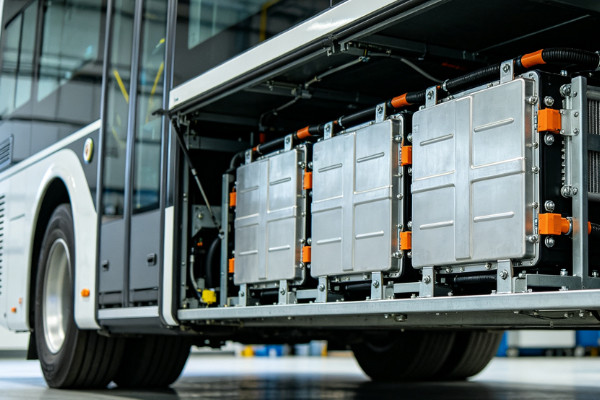
Optimized PACK Structural Design
Structural design directly affects battery system performance and vehicle space utilization efficiency.
- Optimize module layout to improve space utilization and energy density.
- Reduce internal connection losses to improve overall energy efficiency.
- Strengthen anti-vibration structural design to meet complex road conditions.
A well-designed PACK helps improve power output stability and system durability.
Thermal Management System
During operation, power batteries continuously generate heat. Efficient heat dissipation structures using air cooling or liquid cooling are required to control temperature rise, dynamically adjust operating temperature to keep the battery within the optimal working range, and reduce the impact of high-temperature environments on performance, thereby extending service life. A complete thermal management system can significantly improve safety and long-term stability.
Recommended Solutions for Different Operating Scenarios
Different application scenarios have different priorities for power batteries, requiring targeted configurations.
| Application Scenario | Main Requirements | Recommended Battery Solution |
| Urban Bus | High-frequency operation, stable power supply | Intelligent BMS + long-life power battery |
| Intercity Bus | Long range | High energy density battery solution |
| Tourist Coach | Long-duration operation | High-reliability PACK design |
| School Bus | Safety and stability | Multi-layer battery safety protection solution |
| Customized Bus | Comprehensive performance | Intelligent power battery system |
Through differentiated configuration solutions, different operational needs can be better matched, improving overall economic efficiency and operational performance.
How Enterprises Should Choose Power Battery Solutions
In project implementation, selecting the right power battery solution has a significant impact on vehicle performance and operating costs.
Focus on Overall System Matching
Power batteries need to achieve a high level of coordination with the vehicle system to deliver optimal performance. Battery specifications should be designed according to vehicle requirements, ensuring capacity and voltage match the vehicle’s power demand. Deep integration with the drive and control systems ensures coordinated power output and energy management. Standardized communication interfaces should also be provided to support data interaction and unified system management. The higher the system coordination, the more stable the vehicle performance and the better the energy efficiency.
Emphasize Product Quality and Testing Capability
A comprehensive testing system is the foundation for ensuring product reliability and an important means of reducing long-term risks.
- Conduct cycle life and performance testing to verify long-term stability and degradation behavior.
- Perform high and low temperature testing to ensure adaptability to different climates.
- Carry out vibration and safety testing to simulate real operating conditions.
- Establish strict quality control processes to ensure product consistency.
Mature testing capabilities can provide long-term stable support for electric buses and reduce operational risks.
Support Customized Development Services
Different projects have differentiated requirements for power batteries, and standardized products often cannot fully meet real application scenarios.
- Support capacity and voltage customization to flexibly adapt to vehicle requirements.
- Support PACK structural optimization to improve space utilization and compatibility.
- Support BMS software and communication protocol development to achieve system integration.
Customization capabilities can improve project adaptability, accelerate deployment, and enhance the competitiveness of the overall solution.
As the electric bus industry continues to develop toward intelligence and efficiency, power batteries play an increasingly critical role in vehicle systems. Building a comprehensive technical system around battery safety, intelligent management, structural optimization, and thermal management will continuously improve vehicle reliability and economic performance. At the same time, by continuously accumulating operational data and optimizing system design, electric buses will demonstrate greater value in the future transformation of green public transportation.