Scenic lakes, reservoirs, and urban waterways place high demands on the operating experience of sightseeing boats. Vessels need to maintain smooth navigation while reducing noise and charging pressure. As an important power unit of electric sightseeing boats, the battery’s capacity configuration, installation method, charging efficiency, and environmental adaptability all affect actual operation. Planning the battery solution according to the vessel type and operating route is more conducive to controlling equipment investment and long-term operating costs.
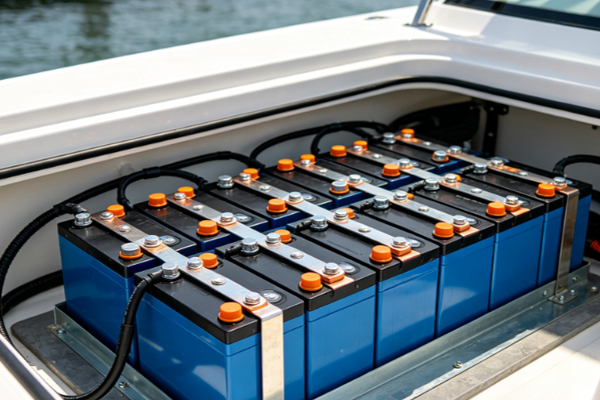
What Requirements Should Electric Sightseeing Boat Batteries Meet?
Sightseeing boats generally operate on relatively fixed routes, but different projects vary in navigation distance, passenger capacity, and daily trips. Battery configuration needs to be based on actual operating conditions.
Meet Continuous Navigation Requirements
Sightseeing boats often need to complete multiple trips continuously, so capacity planning should be coordinated with the actual operating schedule.
- Determine the capacity range according to vessel tonnage, cruising speed, and single-trip distance.
- Calculate continuous discharge requirements based on propulsion motor power.
- Arrange charging times and energy replenishment cycles according to the number of daily trips.
Proper capacity planning can reduce the impact of frequent charging on operating schedules.
Adapt to Vessel Installation Space
Battery installation is usually restricted by cabin structure, equipment layout, and weight distribution.
- Design an appropriate PACK shape according to the cabin dimensions.
- Arrange battery weight and installation position properly.
- Reserve space for wiring harnesses, connectors, the BMS, and maintenance operations.
Efficient use of cabin space helps improve equipment integration and facilitates subsequent maintenance.
Adapt to Humid and Vibrating Environments
Sightseeing boats operate in water environments for extended periods, so battery structures need to account for moisture, salt spray, and hull vibration. The enclosure and connection components should be protected according to actual operating conditions, while fixation and vibration reduction measures should be strengthened in coordination with the vessel structure. Optimizing the structure according to environmental conditions can reduce the impact of external factors on battery system operation.
How Should an Electric Sightseeing Boat Battery System Be Designed?
A complete power system requires coordinated design of cells, PACK, BMS, and thermal management. Improving a single parameter alone does not determine whether the overall solution is suitable.
Properly Configure Cells and PACK Structure
Cells determine basic energy and output characteristics, while the PACK performs functions such as combination, fixation, and installation.
- Select appropriate cell capacity according to navigation distance and load.
- Optimize cell arrangement and internal connections to reduce unnecessary energy losses.
- Strengthen structural fixation to reduce the impact of vessel vibration on the battery pack.
A properly designed combination of cells and PACK can balance capacity, weight, and installation conditions.
Configure an Intelligent BMS Management System
The BMS collects battery operating data and implements corresponding management strategies, making it an important control unit of the power system.
- Monitor voltage, current, and temperature in real time.
- Perform status balancing management for multiple cells.
- Configure protection against overcharge, over-discharge, overcurrent, and abnormal temperatures.
- Record operating data according to project requirements for subsequent analysis.
A comprehensive BMS configuration can improve battery status management and fault identification capabilities.
Design a Thermal Management Solution Based on Operating Conditions
Batteries generate heat during continuous navigation, especially during high-power operation or in high-temperature seasons, making proper heat management important. During design, heat conduction and dissipation paths can be planned according to battery power, cabin space, and environmental conditions, with an appropriate thermal management method selected for the project. Thermal management designed around actual operating conditions helps maintain a suitable operating temperature.
How Should Battery Solutions Be Matched to Different Sightseeing Boat Applications?
Different vessel types, routes, and operating frequencies have different priorities for power systems. Actual projects can refer to the following configuration directions.
| Application Scenario | Main Requirements | Battery Solution Direction |
| Short-distance scenic sightseeing boat | High-frequency short-distance navigation | Long-cycle-life battery system |
| Medium-distance lake sightseeing boat | Continuous navigation capability | High-energy-density battery PACK |
| Reservoir sightseeing boat | Long-duration operation | Large-capacity power battery system |
| Urban waterway sightseeing boat | Low noise, smooth operation | Intelligent BMS battery system |
| Customized sightseeing boat | Significant differences in hull structure | Customized battery solution |
Configuring the system according to route length, vessel load, and daily operating schedule can reduce discrepancies between selected parameters and actual operating conditions.
How to Choose a Suitable Electric Sightseeing Boat Battery Solution?
When purchasing power batteries, companies should evaluate not only product parameters but also system integration, quality verification, and project services.
Check Battery Compatibility with the Vessel Power System
The battery needs to coordinate with the propulsion motor, controller, and charging equipment.
- Verify the operating voltage and propulsion motor power.
- Confirm the PACK dimensions and installation method according to the cabin structure.
- Confirm communication interfaces and BMS data interaction requirements.
Completing system parameter verification in advance can reduce compatibility issues during installation and commissioning.
Emphasize Product Safety and Testing Validation
Marine power batteries operate in a specialized environment and require appropriate performance and reliability validation.
- Check overcharge, over-discharge, overcurrent, and temperature protection functions.
- Pay attention to high- and low-temperature, vibration, and protection performance testing.
- Verify cell consistency and the product’s factory inspection procedures.
Complete testing documentation helps procurement personnel evaluate product suitability more accurately.
Evaluate Customized Development and Project Services
Different sightseeing boats may vary in voltage platforms, capacity, installation dimensions, and communication requirements. The supplier’s customization capability can directly affect project implementation efficiency.
- Support capacity and voltage platform adjustments.
- Optimize PACK structures according to cabin space.
- Develop BMS functions and communication protocols according to project requirements.
- Provide installation, commissioning, and technical support.
Comprehensive project services can reduce communication and implementation costs during the deployment of customized battery systems.
For electric sightseeing boat projects, battery procurement is not simply about comparing individual parameters, but about evaluating the level of coordination between the product and the vessel power platform. In practical selection, evaluation criteria can be established from dimensions such as operational requirements and system configuration. Electric boat battery solutions with engineering design and customized development capabilities are better suited to the practical requirements of different sightseeing boat projects.