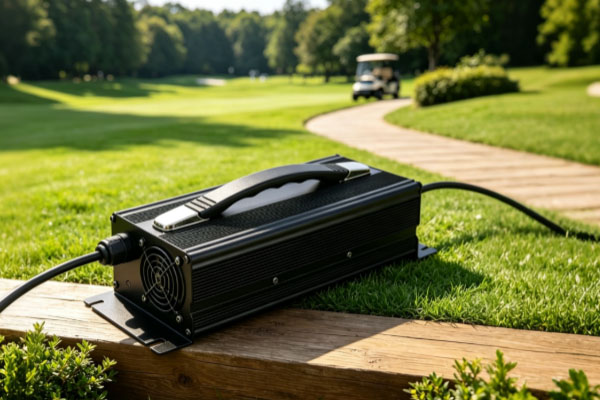
Golf carts are widely used on golf courses, at resorts, hotels, scenic areas, industrial parks, airports, and large property areas. As lithium batteries gradually replace traditional lead-acid batteries, charging equipment also needs to be adjusted according to battery voltage, capacity, BMS communication requirements, and vehicle usage frequency. For golf cart applications, the 84V 10A C1200 series fast charger can be used as a customized charging equipment solution. The product adopts a metal housing structure with a heat dissipation design and fan, making it suitable for vehicles that require relatively frequent charging. According to the actual battery pack specifications, the output parameters, charging connector, cable length, communication method, and protection requirements can be further confirmed. For customers using different battery brands or vehicle platforms, customization can also be provided through OEM/ODM services.
Configuration Design of the 84V 10A Golf Cart Charger
Determine the Charging Specifications According to the Battery Pack Parameters
Golf cart lithium batteries usually have a high cycle usage frequency, so the charger needs to match the rated voltage and maximum charging voltage of the battery pack. The C1200 model shown in the image provides 84V and 10A charging parameters, making it suitable for charging requirements on corresponding vehicle voltage platforms. During customization, the actual number of cells connected in series, rated voltage, full-charge voltage, capacity, and maximum charging current allowed by the BMS need to be confirmed. In particular, lithium batteries and traditional lead-acid batteries have different charging curves, so the charger needs to be configured according to the actual battery chemistry.
| Item | C1200 Reference Configuration | To Be Confirmed for Customization |
| Model | C1200 | Can be adjusted according to the project |
| Output Voltage | 84V | Confirm according to the battery pack full-charge voltage |
| Output Current | 10A | Confirm according to battery capacity and BMS requirements |
| Application | Golf carts, electric vehicles, etc. | Adjust according to vehicle type |
| Input Interface | Customizable | Confirm according to the region of use |
| Charging Connector | Customizable | Confirm according to the vehicle charging socket |
| Housing | Metal structure | Can be adjusted according to the installation method |
| Cooling Method | Fan-assisted cooling | Determine according to power and operating environment |
10A Charging Output Balances Efficiency and Usage Requirements
Charging current directly affects vehicle charging time. Taking a 10A output as an example, if the battery pack has a large capacity, a full charge will require more time. Therefore, actual use needs to be planned according to daily operating hours and the time when vehicles return to the charging area. Golf courses, hotels, and scenic areas usually have situations where vehicles are used and charged in groups. After vehicles finish operating, they return to designated areas for charging. The charger needs to maintain stable operation and adapt to relatively frequent charge and discharge cycles. If vehicles operate for long periods every day, the charging current can also be determined again according to battery capacity, remaining power, and available charging time.
Customize the Charging Connector and Installation Method
There are many golf cart brands and models, and battery compartments, charging sockets, and charger installation positions also vary. The charger needs to meet the electrical requirements while ensuring that the cable can be properly connected to the vehicle. The C1200 adopts an independent charger structure, allowing fixed installation or external use according to the available vehicle space. During customization, the AC input cable, DC output cable, connector type, and cable length can be confirmed to reduce the need to replace cables during later installation.
Working and Protection Design of Golf Cart Lithium Battery Fast Chargers
Stable Charging Performance
Fast charging does not mean continuously increasing the charging current. During the charging process, lithium batteries need to go through constant-current, constant-voltage, and other stages, and the charger output needs to be controlled according to the battery pack requirements. If the charging parameters do not match the battery, problems such as abnormal charging time, frequent BMS protection, or failure to complete charging may occur. Therefore, when customizing an 84V 10A charger, the battery pack technical specifications should be confirmed first before determining the specific output parameters. For golf cart lithium batteries already equipped with a BMS, the maximum BMS charging current and whether communication functions are required should also be confirmed.
Built-In Heat Dissipation Capability
The charger generates heat during operation, especially in high-temperature environments, continuous charging, or centralized vehicle charging scenarios. Heat dissipation directly affects the operating condition of the equipment. The C1200 adopts a structure with a cooling fan and uses a metal housing for additional heat dissipation. During installation, sufficient ventilation space is recommended to avoid installing the charger tightly inside an enclosed space or next to high-temperature components. Golf course and scenic area vehicles may need to be charged outdoors or in semi-outdoor areas, so the dustproof and waterproof rating and installation location should also be confirmed according to the actual environment. Different environmental conditions can use different housing and structural solutions.
Protection Functions Need to Work with the Battery BMS
Lithium battery chargers generally need basic protection functions such as overvoltage, overcurrent, short circuit, and overtemperature protection. For golf cart applications, abnormal charging connector connections, vehicle battery abnormalities, and stop control after charging is completed should also be considered. The charger and BMS are different components, and their parameters need to remain consistent. The BMS is responsible for monitoring and protecting the internal battery pack, while the charger provides charging power that meets the required specifications. When the two work together, the risks associated with abnormal charging can be reduced.
Customized Solutions for Different Golf Cart Applications
Centralized Charging for Golf Course Vehicles
Golf courses usually operate a large number of vehicles, and a group of vehicles may return to the parking area after business hours for centralized charging. Such applications place greater importance on stable charger operation, installation efficiency, and daily maintenance. If vehicles use lithium battery packs with the same specifications, chargers with the same model can be configured in batches, with unified charging connectors and cable specifications. For different vehicle models, the connectors and cables can also be adjusted while maintaining the core electrical parameters, making charging equipment easier to manage.
Vehicles at Hotels, Resorts, and Scenic Areas
Golf carts used in hotels, resorts, and scenic areas may be used not only for short-distance transportation but also for long periods of frequent operation. Daily operating time and charging time can vary significantly, so the charger needs to be configured according to the actual battery capacity. For example, vehicles with long daily operating hours can prioritize equipment suitable for frequent charging. If vehicles are mainly used during fixed periods, the appropriate output current can be selected according to the available nighttime charging time. This can reduce unnecessary high-power configurations while also making subsequent vehicle management easier.
Vehicles in Industrial Parks and Property Areas
Electric vehicles used in industrial parks, factories, large properties, and airports often need to move frequently over short distances. Vehicles may start, travel, and charge several times a day, so the charger needs to provide stable repeated-use performance. For such applications, standardized charging equipment specifications can be designed according to the number of vehicles. For projects requiring long-term operation, the quantity of backup chargers, charging connectors, and cable specifications can also be confirmed in advance to reduce later maintenance costs.
Charger OEM/ODM Customization Process
Provide Battery and Vehicle Parameters
Before customizing the charger, it is recommended to provide the battery pack nameplate, BMS specifications, and vehicle charging connector information. If a battery sample or original charger is already available, the relevant parameters can also be provided to help confirm whether the new charger can directly replace the existing one.
The key information to confirm includes:
- Battery rated voltage and full-charge voltage
- Battery capacity and allowable charging current
- BMS charging parameters
- Vehicle charging connector model
- Input voltage and country of use
- Charger installation space
- Whether communication functions are required
The more complete the information, the easier it is for the customized charger to enter the actual application stage directly.
Determine the Charger Structure and Electrical Parameters
After the basic parameters are confirmed, the output voltage, current, connector, cable, cooling structure, and housing type can be further determined. The reference specification of the C1200 is 84V 10A. The minimum order quantity is one unit, and the image information indicates a delivery time of approximately 5–8 working days. The specific delivery time still needs to be confirmed according to the customization requirements and order quantity. For batch projects, charger specifications and packaging requirements can be standardized in advance, making vehicle delivery and subsequent after-sales management easier.
Complete Sample Verification Before Batch Purchasing
If a customer is developing a new golf cart lithium battery project, sample testing is recommended first. During the sample stage, the charging start process, charging time, BMS protection, charging completion status, connector temperature rise, and actual vehicle operation can be checked. After sample verification is completed, batch production can begin, reducing the possibility of inconsistent specifications in large quantities of equipment. For different national markets, input voltage, plug standards, transportation documents, and product compliance documents can also be confirmed in advance.
Frequently Asked Questions
Is a 10A Charger Fast?
Charging speed depends on battery capacity. For example, a larger-capacity battery will still require more time to charge even when using a 10A charger. Actual charging time is also affected by the remaining battery power, BMS limitations, and charging stages.
Can the Golf Cart Charging Connector Be Customized?
Yes. The connector can be confirmed according to the actual vehicle interface, including connector type, cable length, and connection method. Before batch purchasing, it is recommended to provide photos and dimensional information of the original charger or vehicle interface.
Can It Be Used for Golf Carts from Different Brands?
It can be evaluated according to the vehicle battery specifications and charging connector. Different vehicle brands may use different battery voltages, BMS parameters, and connectors, so separate confirmation is required.
Can the Lithium Battery and Charger Be Customized at the Same Time?
Yes. The battery pack, BMS, and charger can be designed as a complete solution for the same project, keeping the battery parameters and charging parameters consistent and reducing compatibility problems caused by purchasing different equipment separately.
After a golf cart switches to a lithium battery, the charger also needs to be adjusted accordingly. A suitable charger is determined not only by voltage and current, but also by battery capacity, BMS parameters, vehicle connector, and daily operating time. The 84V 10A C1200 can be used as a reference configuration for golf cart charging projects, but the specific parameters still need to be confirmed according to the battery pack specifications. This helps provide more stable operation and reduces the inconvenience of replacing equipment later. For batch purchases for golf courses, hotels, scenic areas, or industrial parks, battery nameplates, original chargers, vehicle models, and connector information can be prepared in advance. We can confirm the parameters based on this information before proceeding with sample testing and batch production. For projects requiring integrated battery, BMS, and charger solutions, complete requirements can also be provided directly for customized development by a professional team.
WhatsApp: +86 15074995718
Email: info@deligreen.net