After a golf cart has been used for a period of time, if the original lead-acid battery shows reduced driving range, longer charging times, obvious capacity degradation, or other issues, it may be worth considering replacing it with a lithium battery. Many golf carts now use LiFePO4 batteries. Compared with traditional lead-acid batteries, lithium batteries generally offer lighter weight, less maintenance, longer cycle life, and higher charging efficiency. Some models can also use a BMS to monitor battery status in real time, reducing the risks associated with overcharging, overheating, and over-discharging. However, replacing a golf cart battery with a lithium battery requires confirmation of the vehicle’s original voltage, controller, charger, wiring method, battery dimensions, and installation space. If the voltage is selected incorrectly or the lithium battery is incompatible with the existing charging equipment, it may affect normal vehicle startup and charging.
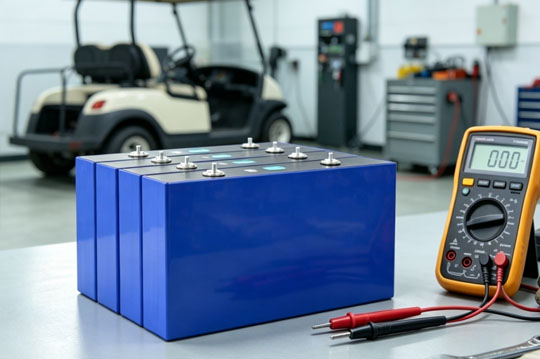
Different brands, production years, and models of golf carts may have different electrical configurations. Therefore, before replacement, check the vehicle nameplate, original battery specifications, and product specifications of the new battery. For golf courses, resorts, hotels, scenic areas, industrial parks, and private users who need to use golf carts for extended periods, battery capacity, output current, mounting and fixing, operating environment, and after-sales service should also be considered. Only when the battery specifications match the vehicle’s requirements can the replacement golf cart maintain stable operation.
Confirm the Vehicle Voltage and Battery Specifications
Do Not Look Only at Battery Capacity Before Replacement
Golf carts commonly use different voltage platforms such as 36V and 48V, while some models use higher-voltage configurations. Lithium batteries on the market are also available in different voltage specifications, so the original vehicle voltage and the rated voltage of the new battery need to be confirmed before purchasing.
Confirm the vehicle’s rated voltage: Check the vehicle nameplate, original battery pack label, or vehicle manual.
Confirm the battery dimensions: Check the length, width, and height of the battery compartment to prevent installation and fixing problems.
Confirm the required capacity: Select the Ah capacity according to the daily driving distance, load, road slope, and frequency of use.
Confirm the output capability: In addition to capacity, check the continuous discharge current and peak discharge capability.
For example, when the original vehicle uses a 48V lead-acid battery, you cannot simply choose any 48V lithium battery based only on the words “48V.” You also need to confirm whether the vehicle controller, motor, and charger support the corresponding lithium battery solution. Some products use specially designed complete battery replacement solutions, which can reduce vehicle modification work. Some manufacturers also provide installation components designed for specific vehicle models.
Check the Charger, BMS, and Vehicle Controller
Choose Compatible Charging Equipment
After replacing the lithium battery, the original lead-acid battery charger may not necessarily continue to be used. The charging parameters of lithium batteries differ from those of lead-acid batteries. During actual installation, the charger model, output voltage, and charging current should be confirmed according to the requirements provided by the battery manufacturer. Golf cart lithium batteries generally use a BMS to provide protection against overcharging, over-discharging, overcurrent, temperature abnormalities, and other conditions. Some smart lithium batteries can also communicate with the vehicle controller or charging equipment, allowing users to view battery status.
Common Questions
Q: Can the original charger continue to be used?
A: It should not be assumed that it can be used directly. Confirm it according to the charging requirements of the new lithium battery. If the charger parameters do not meet the requirements, it should be replaced with a lithium battery charger that is compatible with the battery.
Q: Is a BMS optional?
A: A BMS is an important protection component of a lithium battery. It can monitor the battery’s operating status and provide protection under abnormal conditions. Some golf cart lithium battery products already have the BMS integrated inside the battery pack.
Q: Is a larger capacity always better?
A: Not necessarily. Increasing capacity can generally increase the available driving range, but battery weight, dimensions, vehicle controller, motor load, and installation space must also be considered. The actual vehicle requirements and battery specifications need to be reasonably matched.
Pay Attention to Wiring, Mounting, and Operating Environment During Installation
Inspect the Battery After Installation
Lithium batteries are generally lighter than lead-acid batteries with similar capacity, so the overall vehicle weight may change after replacement. During installation, it is not enough to consider only whether the battery “can fit.” You also need to confirm that the battery can be securely mounted to prevent movement caused by bumps during vehicle operation. Taking a 48V vehicle that is used on a golf course for extended periods as an example, if the original lead-acid battery pack is removed and replaced with a 48V lithium battery, the following inspection sequence can be used:
- Remove the old battery and inspect the battery compartment, clean dust, corrosion, and residue, and check whether the connection wires and terminals have any obvious damage.
- Install and secure the lithium battery, ensuring that the battery cannot move forward, backward, left, or right while the vehicle is operating.
- Check the positive and negative connections, confirm that the polarity is correct, and ensure that the terminals are securely connected to prevent poor contact.
- Connect the controller and other supporting components, completing the connections according to the installation requirements provided by the battery manufacturer.
- Test with a compatible charger, confirming that the vehicle can charge, start, and operate normally.
Appropriate personal protective equipment and insulated tools should also be used during installation. If the golf cart is frequently used in rainy conditions, damp areas, or outdoor environments, attention should also be paid to the waterproof and dustproof design of the battery enclosure. Some new golf cart lithium batteries use sealed battery enclosures and meet corresponding IP protection ratings, but the specific protection capability should be based on the product specifications.
Perform Proper Charging and Daily Checks After Replacement
Although lithium batteries generally do not require regular water refilling like traditional lead-acid batteries, they still need to be charged, stored, and inspected according to the manufacturer’s instructions. Particular attention should be paid to the first few uses after replacement. Observe the battery condition during vehicle startup, acceleration, hill climbing, charging, and after parking. If abnormal heating, unusual odors, alarms, charging interruption, or sudden vehicle power loss occurs, stop using the vehicle immediately and inspect the battery.
When replacing a golf cart battery with a lithium battery, the original vehicle voltage, motor power, controller, battery compartment dimensions, and daily usage intensity should all be considered. Confirming the battery specifications before installation can reduce problems such as unsuitable dimensions, insufficient output, or connection difficulties. During replacement, checking the positive and negative connections, battery mounting method, and connection terminals can reduce the risk of loosening or poor contact during vehicle operation. At the same time, the charger should be selected according to the lithium battery’s charging parameters, and the BMS should provide appropriate protection against overcharging, over-discharging, overcurrent, and abnormal temperatures.
If the golf cart is used for extended periods at golf courses, hotels, scenic areas, resorts, or industrial parks, battery capacity can also be determined according to daily driving distance, load, slope conditions, and charging frequency. For vehicles requiring customized batteries, it is recommended to provide the specific vehicle model and original battery specifications before purchasing, allowing a professional lithium battery manufacturer to confirm the voltage, capacity, dimensions, and connection method. After selecting the appropriate battery and completing proper installation, charging and driving tests can be performed to help the replacement lithium battery provide more stable performance for the golf cart’s daily operating requirements.