
As lithium batteries become increasingly popular in residential energy storage, commercial energy storage, industrial equipment, and electric transportation, battery safety and management efficiency are receiving greater attention from businesses. The Battery Management System (BMS) is an essential component of a lithium battery pack. It monitors battery operating conditions, manages charging and discharging processes, and activates appropriate protection measures when abnormal conditions occur.
Different lithium batteries have different voltage levels, capacities, chemical compositions, and application requirements. Therefore, selecting a BMS should not be based solely on price or the number of protection functions. For buyers and energy storage system integrators, a comprehensive evaluation of battery specifications, protection capabilities, communication protocols, and operating environments is necessary.
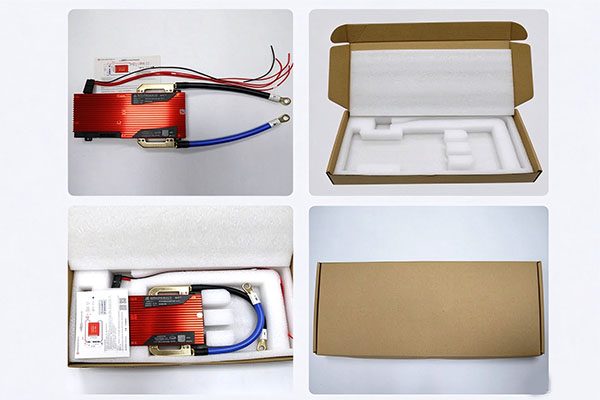
Choose a BMS That Matches the Battery Type
The first step in BMS selection is identifying the battery chemistry and basic electrical parameters. Different lithium battery types have different operating voltage ranges and charging and discharging requirements.
Confirm the Battery Chemistry
Common lithium battery types include lithium iron phosphate (LiFePO4) batteries and ternary lithium batteries. Different chemistries have different nominal cell voltages, charging cutoff voltages, and discharging cutoff voltages.
For example, LiFePO4 batteries typically have a nominal cell voltage of 3.2V. Their BMS must be configured with appropriate overcharge and overdischarge protection parameters according to their voltage characteristics.
Protection settings designed for other battery chemistries should not be directly applied to LiFePO4 batteries.
Match Battery Pack Voltage and Capacity
The number of cells connected in series determines the overall battery pack voltage, while battery capacity affects continuous charging and discharging requirements.
When selecting a BMS, buyers should confirm its supported series cell count, voltage range, and capacity compatibility.
For high-voltage energy storage systems, insulation design, voltage sampling accuracy, and high-voltage safety requirements should also be considered to ensure compatibility with the entire battery pack.
Check Whether the BMS Provides Comprehensive Protection Functions
Protection capabilities are among the most important criteria when evaluating BMS quality. A reliable battery management system should identify common abnormal conditions and activate effective protective measures promptly.
Overcharge and Overdischarge Protection
Overcharging may cause increased internal pressure and temperature, while overdischarging can lead to capacity degradation or even internal cell damage.
A BMS should continuously monitor individual cell voltages and limit charging or stop discharging when preset protection thresholds are reached.
Before purchasing, buyers should confirm whether the system supports individual cell voltage monitoring and whether protection thresholds can be configured according to battery specifications.
Overcurrent and Short-Circuit Protection
Excessive current can increase the temperature of battery cells, connectors, and electrical wiring. A BMS should provide charging overcurrent, discharging overcurrent, and short-circuit protection.
Buyers should also pay attention to protection response times, continuous current ratings, and peak current ratings.
For industrial equipment and energy storage systems, the appropriate current specifications should be selected according to actual load requirements. Additional protection devices, such as fuses and circuit breakers, should also be incorporated to establish multiple layers of protection.
High-Temperature and Low-Temperature Protection
Temperature directly affects lithium battery charging and discharging performance. A comprehensive BMS should use temperature sensors to monitor battery operating conditions and limit or stop relevant operations when temperatures exceed permitted ranges.
For batteries used outdoors or in environments with significant temperature fluctuations, buyers should also consider the number and installation positions of temperature sensors, as well as the configured temperature protection thresholds.
Evaluate Cell Balancing and Battery Status Monitoring Capabilities
Active Balancing and Passive Balancing
Individual cells may develop voltage and capacity differences during long-term operation, affecting the usable capacity and operating stability of the entire battery pack.
Passive balancing generally works by dissipating excess energy from higher-voltage cells to reduce voltage differences. It has a relatively simple structure.
Active balancing transfers energy between cells to improve charge consistency. It is suitable for battery systems with more demanding balancing requirements.
Businesses should select an appropriate balancing solution according to battery pack size, budget, and application requirements.
SOC and SOH Monitoring
SOC (State of Charge) indicates the remaining battery charge, while SOH (State of Health) evaluates changes in battery performance compared with its initial condition.
A BMS with these monitoring capabilities helps users understand battery operating conditions and provides useful information for charging and discharging management, maintenance, and replacement planning.
Confirm Communication Protocols and System Compatibility
Modern energy storage systems usually require communication between the BMS, inverters, energy storage controllers, and Energy Management Systems (EMS). Therefore, communication compatibility is another important factor in BMS selection.
Common Communication Interfaces
CAN and RS485 are common communication interfaces used in battery management systems.
Before purchasing, buyers should confirm the supported communication protocols, data formats, and communication speeds to ensure proper connections with target devices.
Alarm and Data Recording Functions
A BMS should be able to report information such as voltage, current, temperature, and fault status.
Some systems also support historical data recording and remote monitoring, allowing technicians to troubleshoot problems and analyze battery operating conditions more efficiently.
Select the Right BMS According to the Application
Different applications have different BMS requirements.
- Residential energy storage: Focus on overcharge, overdischarge, and temperature protection, as well as communication compatibility with energy storage inverters.
- Commercial energy storage: Consider continuous current ratings, system scalability, data monitoring, and fault management.
- Industrial equipment: Select suitable current specifications according to load variations and prioritize short-circuit protection and operational stability.
- Outdoor energy storage: Consider operating temperature, protective design, and long-term reliability.
Choose a Professional Lithium Battery Supplier to Ensure System Safety
BMS protection performance depends not only on the control board itself but also on battery cell quality, parameter configuration, wiring design, and overall battery system integration.
Therefore, buyers should prioritize suppliers with capabilities in battery development, BMS configuration, production testing, and customized services.
Deligreen specializes in the development and supply of LiFePO4 cells, battery packs, BMS products, and energy storage systems. Its products are used in residential, commercial, and industrial energy storage applications.
The company also provides OEM/ODM services, allowing battery voltage, capacity, BMS configurations, and product packaging to be customized according to project requirements.
Choosing a lithium battery BMS with comprehensive protection functions requires evaluating battery chemistry, electrical parameters, protection mechanisms, cell balancing, communication compatibility, and operating environments.
By defining these technical requirements before purchasing and communicating with a supplier with professional technical capabilities, businesses can improve battery system safety and operational reliability while meeting the long-term requirements of different energy storage projects.




