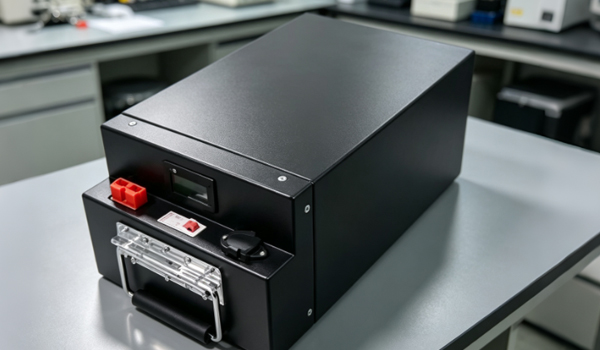
Hospitals cannot afford to lose power while critical equipment is operating. A UPS may look like a simple backup power device, but in practice it supports a wide range of systems, including surgical equipment, patient monitoring devices, servers, laboratory instruments, and communication systems. When the battery starts to degrade, the UPS may still switch to backup mode, but it may not provide power for as long as expected. For hospital battery energy storage, capacity is only part of the solution. Continuous discharge performance, peak loads, monitoring, communication, and maintenance all matter. A reliable hospital UPS battery solution should provide stable backup power while making the system easier to monitor, maintain, and upgrade.
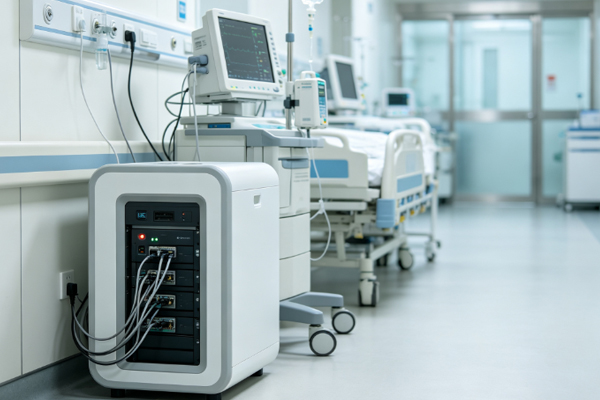
Why Does Hospital UPS Battery Runtime Become Shorter Over Time?
A newly installed UPS battery may provide a relatively long backup time during a power outage. After several years of operation, however, hospital staff may notice that the same load can only be supported for a much shorter period. The problem may not come from the UPS itself. Battery aging, operating temperature, charging conditions, and usage patterns can all affect actual battery performance.
Why Can a UPS Show a Normal Battery Level but Still Provide Short Runtime?
The battery percentage shown on a UPS does not always represent the amount of usable energy the battery can actually deliver. As a battery ages, its voltage may look normal when there is little or no load, but the voltage can drop much faster once equipment is connected. When purchasing hospital UPS batteries, it is important to look beyond the rated Ah capacity and check actual discharge performance under different loads.
What Are the Common Signs of Hospital UPS Battery Problems?
During routine maintenance, several signs deserve attention:
- UPS runtime becomes noticeably shorter during outages
- Battery charging takes unusually long
- The UPS frequently generates battery alarms
- Voltage differences appear between individual battery cells
- Voltage drops quickly when the load increases
When these problems occur repeatedly, simply charging the battery again is not a reliable solution. For hospitals where uninterrupted power is critical, battery performance should be tested early so that maintenance or replacement can be scheduled before an actual outage creates a problem.
Can Temperature Affect Hospital UPS Battery Life?
Yes. Long-term exposure to high temperatures or poor ventilation can accelerate battery aging. Battery rooms, equipment rooms, and data center areas in hospitals should have suitable environmental conditions. A battery cabinet should not simply be placed in an unused corner without considering heat dissipation and ventilation.
| Operating Condition | Possible Problem | Maintenance Focus |
| Long-term high temperature | Faster battery aging | Maintain proper cooling and ventilation |
| Long-term low-load operation | Low energy utilization | Check actual battery condition regularly |
| Frequent power outages | Increased charge-discharge cycles | Monitor cycle performance |
| Long-term fully charged storage | Gradual performance degradation | Perform periodic battery checks |
Hospital UPS battery reliability is not determined only when a power outage occurs. It develops through every charging cycle, discharge event, and environmental change during daily operation. Regular battery monitoring is far safer than discovering poor runtime when the hospital actually loses power.
Can Different Hospital Departments Share the Same UPS Battery System?
Hospital equipment has very different power requirements. A server, patient monitoring system, laboratory instrument, and office computer may all use UPS backup power, but their operating conditions and power continuity requirements are not the same. A shared battery system may be possible, but it depends on the UPS architecture, load priority, and the equipment that must remain operational during an outage.
Which Hospital Equipment Should Have Higher UPS Priority?
When designing backup power for a hospital, critical equipment should be identified and prioritized:
- ICU monitoring and life-support-related equipment
- Critical equipment in operating rooms
- Essential equipment in emergency departments
- Hospital servers, networking, and communication systems
These loads require dependable backup power and stable battery discharge performance. General lighting and office equipment can be distributed according to the hospital’s existing electrical design rather than automatically placing every load on the highest-priority UPS system.
How Do UPS Battery Requirements Differ by Hospital Area?
| Hospital Area | Typical Load Characteristics | Battery System Priorities |
| Operating Room | Multiple critical devices operating continuously | Stable discharge and UPS compatibility |
| ICU | Critical equipment must remain powered | Reliability and monitoring |
| Emergency Department | Equipment may start and stop frequently | Peak load capability |
| Laboratory | Instruments can be sensitive to unstable power | Voltage stability and communication |
| Server Room | Continuous operation | Runtime, thermal management, and scalability |
| Office Area | Relatively predictable loads | Cost and capacity matching |
Why Should Hospitals Avoid Putting Every Load on One Battery System?
The more complex the load profile, the more operating conditions the battery system may experience. Hospitals can divide loads according to priority so that critical equipment receives more reliable UPS support while leaving room for future expansion. This is often easier to manage than installing an oversized battery system from the beginning simply to cover every possible load.
If the hospital later adds servers, monitoring equipment, medical devices, or other high-power loads, the existing UPS system may need to be reassessed. A modular battery solution can make future expansion easier without requiring the entire backup power system to be redesigned.
How Can Hospitals Replace UPS Batteries Without Disrupting Normal Operations?
Battery replacement is one of the most easily overlooked parts of hospital UPS maintenance. In a typical office, a short power interruption may only cause a computer to restart. In a hospital, the consequences can be much more serious. When a battery reaches the end of its service life, replacement should be planned in advance, with the new battery, UPS system, cables, connectors, and communication functions checked before installation.
What Should Be Checked Before Replacing UPS Batteries?
Before replacement, hospital maintenance teams should review the battery system’s operating records and have the supplier verify the new battery specifications.
- Confirm the UPS brand, model, and required battery voltage
- Check the battery quantity, series-parallel configuration, and connection method
- Inspect battery cabinets, cables, and terminals
- Confirm that the new battery dimensions fit the existing cabinet
- Test communication interfaces and monitoring functions in advance
Can New and Old UPS Batteries Be Used Together?
Mixing batteries with different models, capacities, or aging levels is generally not recommended. Differences between batteries can affect the performance of the entire battery pack during long-term operation. When a hospital needs additional capacity, simply adding several new batteries is not always enough. The existing system should be checked to confirm whether expansion is supported and whether the charging system is compatible with the larger battery bank.
What Should Be Done After Battery Replacement?
After installation, the battery connections, charging status, and UPS operating conditions should be checked. When conditions permit, a controlled load test can be performed during a scheduled maintenance window to confirm UPS transfer, battery discharge, and alarm functions before returning the system to normal operation.
The difficult part of replacing hospital UPS batteries is not removing the old batteries and installing the new ones. The real challenge is completing the work without affecting normal medical operations. Preparing the battery specifications, installation method, and power transfer plan in advance can make the entire replacement process much smoother.
What Should Hospitals Ask Suppliers Before Purchasing LiFePO4 UPS Batteries?
When purchasing UPS batteries, the voltage, Ah rating, and kWh capacity shown on a quotation are only the starting point. Hospitals should also confirm whether the battery is compatible with the existing UPS, whether the BMS supports the required communication method, whether the battery cabinet has enough installation space, and whether abnormal conditions can be identified quickly. For long-term hospital projects, testing documentation, protection functions, technical support, and after-sales service should also be part of the purchasing requirements.
For hospitals considering LiFePO4 batteries for UPS backup power, suppliers should provide complete battery specifications, BMS parameters, communication protocols, charge and discharge data, protection functions, and installation dimensions. Hospitals planning phased expansion can also confirm whether additional battery modules can be added later. DELIGREEN provides LiFePO4 batteries, battery packs, DIY battery boxes, BMS accessories, and scalable energy storage solutions that can be configured around UPS specifications and actual load requirements.
Hospital battery energy storage is not simply about installing a battery and leaving it there. The real goal is to make sure the UPS can reliably take over critical loads when needed while giving maintenance teams a clear view of battery condition. When selecting hospital UPS batteries, checking compatibility, monitoring, maintenance, replacement, and future expansion in advance can make the system easier to manage and better suited to long-term hospital backup power needs.