Once a battery is installed in medical equipment, the real test is not simply whether it can power the device at the beginning, but whether it can maintain stable performance over long-term use. Medical monitors, infusion pumps, portable ultrasound systems, nursing robots, and other equipment all have specific requirements for battery runtime, output stability, safety protection, and service life. For hospitals and medical equipment manufacturers, choosing a LiFePO4 battery is not just about capacity. BMS configuration, discharge capability, size, weight, and compatibility with the equipment also need to be considered. Getting these parameters right early can make future operation and maintenance much easier.
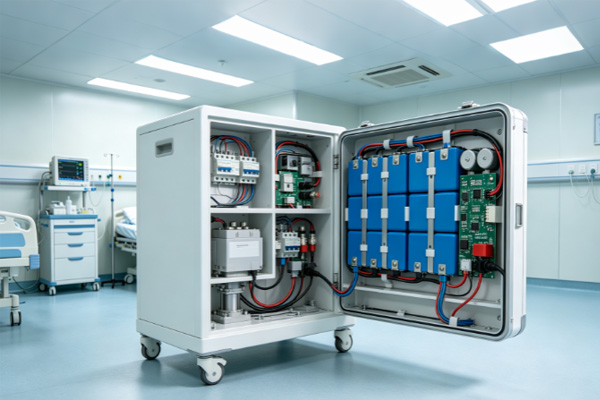
Why Do Medical Devices Need Dedicated Lithium Batteries?
Medical equipment does not use power in the same way as ordinary consumer electronics. Some devices need to operate continuously for long periods, some need to be moved frequently, and others have very strict requirements for battery size and weight. Choosing the wrong battery can make even a high-capacity battery difficult to use. Hospital battery storage focuses more on continuous power supply and stable operation, while medical device lithium batteries need to match the specific working conditions of the equipment.
Which Medical Devices Use Lithium Batteries?
Battery requirements vary significantly between medical devices. When designing a power system, manufacturers usually consider the device’s power consumption, operating time, and mobility before determining the battery pack specifications.
| Medical Device | Common Battery Requirement | Key Parameters |
| Portable Patient Monitor | Compact size, long runtime | Capacity, weight, BMS |
| Infusion Pump | Stable continuous power | Discharge stability, cycle life |
| Portable Ultrasound Device | High energy density | Capacity, size, weight |
| Nursing Robot | Relatively high continuous power | Discharge current, communication |
| Emergency Medical Equipment | Long backup runtime | Safety, low-voltage protection |
| Mobile Diagnostic Equipment | Frequent charging and discharging | Cycle life, charging management |
Actual power consumption should be determined from the equipment nameplate and operating modes. The same device may consume different amounts of power during standby, normal operation, and high-load conditions. If battery sizing is based only on rated power, the actual runtime may fall short.
What Basic Requirements Should Medical Device Lithium Batteries Meet?
A medical equipment battery is more than simply a combination of cells and a housing. The battery pack needs to work properly with the equipment’s control system, charger, and electrical interfaces.
- Stable discharge: Medical equipment needs a stable output voltage during operation, and significant voltage fluctuations should not interfere with device performance.
- Sufficient runtime: Portable equipment should be configured according to its actual operating time rather than relying only on the nominal battery capacity.
- Safety protection: The battery pack should use a BMS to monitor voltage, current, and temperature while providing overcharge, over-discharge, and overcurrent protection.
- Size compatibility: Portable medical devices often have limited internal space, so battery dimensions, interface locations, and mounting methods need to be planned in advance.
- Communication compatibility: Smart medical equipment may need real-time battery data such as remaining capacity, temperature, and cycle count, so the communication protocol should match the equipment control system.
Confirming these parameters before purchasing is much easier than discovering an incompatible interface after production. For medical equipment manufacturers, the battery should be treated as part of the complete power system from the beginning.
Are LiFePO4 Batteries Suitable for Medical Devices?
LiFePO4 batteries are increasingly used in energy storage, backup power, and mobile equipment. Their characteristics can work well for battery systems designed for long-term use. However, medical equipment has different requirements, so a larger battery is not automatically a better choice. Equipment power, installation space, and charging and discharging frequency all need to be considered.
What Are the Benefits of LiFePO4 Batteries for Medical Equipment?
For medical devices that require frequent charging and long operating periods, battery life and stable performance can be more important than simply maximizing capacity.
- Good cycle performance: Medical devices may go through frequent charging and discharging cycles, so the battery needs to withstand repeated use over an extended period.
- Good thermal stability: Under proper design and operating conditions, LiFePO4 chemistry offers good thermal stability and can be suitable for power applications where safety is important.
- Suitable for long-term energy storage: Hospital backup power systems, mobile medical equipment, and some medical robots may require batteries with long service life.
- Stable output performance: A properly designed battery pack can provide a relatively stable power supply and reduce the need for frequent battery replacement.
Battery chemistry is only one part of the purchasing decision. Cell quality, BMS design, structural protection, charger compatibility, and production testing can also directly affect the final performance.
How Do You Choose Battery Capacity for Medical Equipment?
Battery capacity should ideally be calculated from the equipment’s actual operating time rather than selected from a fixed specification. If a mobile device has an average power consumption of 200W and needs to operate continuously for 6 hours, its theoretical energy consumption is about 1.2kWh. Actual battery sizing also needs to account for conversion losses, depth of discharge, and capacity degradation over time.
Common battery selection considerations for hospital equipment include:
| Application | Key Requirement | Battery Design Focus |
| Portable Equipment | Lightweight and easy to carry | Control size and weight |
| Mobile Ward Equipment | Continuous operation | Increase usable capacity |
| Nursing Robots | Frequent operation | Focus on continuous discharge capability |
| Emergency Medical Equipment | Long backup time | Add appropriate capacity margin |
| Hospital Backup Systems | Large-scale energy storage | Support modular expansion |
After determining capacity, the battery’s continuous discharge current must also be checked against the equipment requirements. If the equipment contains motors, pumps, or similar loads, startup current should not be overlooked. Otherwise, the battery may have sufficient capacity but still struggle to start the equipment.
How Should You Choose a BMS for Medical Device Batteries? Safety Protection Is Not Just About Capacity
When receiving battery quotations, many buyers naturally compare capacity, price, and dimensions. In actual medical equipment operation, however, the BMS can be one of the key components affecting battery stability. Hospital battery storage systems and mobile medical equipment have different monitoring requirements, so the BMS configuration should not simply use the same standard for every application.
What BMS Functions Are Needed for Medical Device Lithium Batteries?
The BMS monitors and manages the battery pack, while its specific functions should be configured according to the electrical design of the medical equipment.
- Overcharge and over-discharge protection: When the battery reaches a defined voltage protection threshold, the BMS should respond promptly to prevent the cells from remaining in abnormal operating conditions.
- Overcurrent and short-circuit protection: When the equipment starts or the load suddenly increases, the BMS should monitor current changes and reduce the impact of abnormal current on the battery pack.
- Temperature monitoring: Battery temperature should be monitored during charging and discharging so that abnormal conditions can be detected promptly.
- Cell balancing: Over long-term use, voltage differences can develop between cells, and balancing helps maintain battery pack consistency.
- Data communication: Medical equipment requiring smart battery management can use CAN, RS485, or similar communication interfaces to read battery status and monitor remaining capacity and operating information.
If the medical device has a display or intelligent control system, it may also need to receive SOC and SOH information. The earlier the battery-to-equipment data interface is confirmed, the smoother development and testing will be.
Why Should Medical Batteries Go Through Sample Testing?
Medical equipment manufacturers should avoid placing large orders based only on a supplier’s specification sheet. Installing battery samples into the actual equipment can reveal problems that are difficult to identify from technical parameters alone.
- Runtime testing: Operate the equipment under its actual working conditions and record the time from full charge to low-voltage protection.
- Load testing: Check whether the equipment operates reliably under normal load, peak load, and startup conditions.
- Charging testing: Test the existing charger with the battery pack to verify charging time and protection functions.
- Temperature-rise testing: Monitor battery temperature during continuous operation to evaluate whether the thermal design is appropriate.
- Communication testing: If the equipment needs battery data, verify the communication protocol, data accuracy, and alarm information.
Once the sample passes testing, the project can move into mass production with greater confidence. Although this step requires additional time, it can reduce the risk of discovering installation, communication, or runtime problems after a large battery shipment has already arrived.
How Can Medical Device Lithium Batteries Be Customized? What Parameters Should Buyers Confirm?
Medical equipment batteries are rarely a simple plug-and-play product. Even batteries with the same capacity can have completely different requirements for installation space, interfaces, operating current, and communication functions. When medical equipment manufacturers develop products for mass production, battery structure and BMS parameters need to be developed alongside the equipment. Confirming these details early can make the entire project much easier to manage.
What Information Is Needed to Customize a Medical Battery?
If you are looking for a LiFePO4 battery supplier for customized medical equipment batteries, it is useful to prepare the equipment’s basic technical specifications and installation requirements in advance.
- Rated and peak power: The supplier needs to know the current requirements during normal operation and startup.
- Target runtime: Provide the desired operating time after a full charge so the supplier can calculate the required usable capacity.
- Installation space: Provide the maximum length, width, and height available for the battery.
- Interface requirements: Specify charging and discharge connectors, cable length, plug type, polarity, and mounting method.
- Communication requirements: If the equipment needs battery data, confirm whether CAN, RS485, or another communication protocol is required.
- Charging method: Confirm the charger type as well as charging voltage, current, and expected charging time.
- Operating environment: Battery design should account for temperature, humidity, and usage frequency in different hospital environments.
The more complete the technical information, the easier it is for the supplier to develop a suitable battery solution. Medical equipment manufacturers with long-term purchasing plans can also define sample, pilot-production, and mass-production requirements early to maintain consistent specifications between different batches.
What Else Should You Check When Purchasing Medical Device Lithium Batteries?
Price is important, but comparing medical device batteries only by unit cost can overlook factors that have a major impact on long-term operating costs.
- Cell consistency: Consistency between cells affects capacity, internal resistance, and long-term battery performance.
- BMS stability: Proper protection parameters are important for ensuring that the battery can respond appropriately under abnormal conditions.
- Batch consistency: For bulk orders, buyers should check whether capacity, dimensions, and communication parameters remain consistent between production batches.
- Testing documents: Buyers can request factory test records, capacity test results, and relevant product documentation for project management and quality control.
- Customization capability: Confirm whether the supplier can customize battery dimensions, interfaces, BMS settings, and communication functions instead of supplying only fixed specifications.
A medical device lithium battery needs to match the cells, BMS, battery structure, and equipment interface before it can be used reliably in volume. For hospital equipment manufacturers and medical device companies, confirming these specifications early can reduce repeated development work while making future maintenance and replacement easier.
As medical equipment becomes increasingly mobile and dependent on reliable power, demand for hospital battery storage and medical device lithium batteries is becoming more specialized. LiFePO4 batteries can be used in patient monitors, infusion pumps, nursing robots, portable diagnostic equipment, and selected hospital backup power applications. What makes a battery solution work well is not capacity alone, but the combination of discharge capability, BMS protection, safety design, dimensions, interfaces, and equipment compatibility. DELIGREEN provides LiFePO4 batteries, battery packs, BMS accessories, and scalable energy storage solutions for global medical equipment customers, with customizable capacity, structure, communication, and connection configurations to meet different equipment requirements.