Bus routes operate repeatedly every day, with vehicles experiencing frequent stops and starts, changing passenger loads, uphill and downhill sections, and temperature variations across different seasons. Actual energy consumption is difficult to measure using a single fixed value. For operators, energy saving is not simply about increasing battery capacity, but about reducing unnecessary energy consumption in power supply, driving, braking, air conditioning, and charging. A reasonable energy management solution needs to be based on actual vehicle operating conditions, allowing every unit of electricity to be converted into useful driving capability as efficiently as possible.
Optimize the Battery System to Reduce Energy Loss During Power Supply
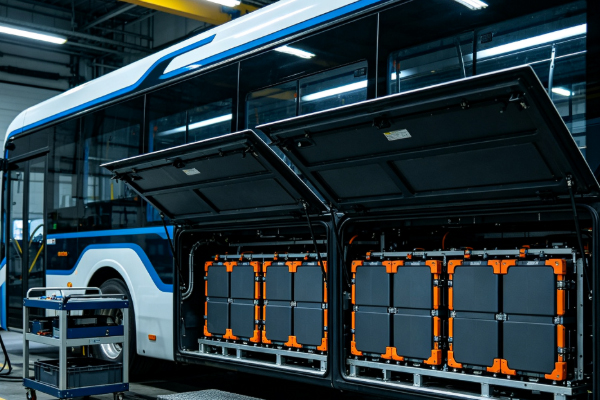
The traction battery provides the main power supply for the vehicle. Cell performance, internal resistance, and high-voltage connections can all affect the actual efficiency of transferring energy from the battery to the drive system. Capacity configuration also needs to be determined based on route data to avoid excessive capacity increasing vehicle weight.
Cells and Battery Packs Need to Balance Energy and Power
Battery selection can be determined according to the vehicle’s actual operating conditions:
- Routes with frequent stops need to focus on continuous charging and discharging capability and cycle life.
- Long-distance routes need to balance usable capacity with battery system weight.
- Fully loaded routes require stable continuous power output.
- Regions with high or low temperatures need to evaluate capacity and power retention under different environmental conditions.
Appropriate cell configuration can meet power requirements while controlling system weight and leaving a reasonable energy margin for vehicle operation.
The High-Voltage Power Supply Link Needs to Reduce Additional Losses
The electrical energy output from the battery needs to pass through high-voltage connections, power distribution, and the electric drive system before reaching the motor. The design of connection components and wiring can affect transmission efficiency. Optimization can focus on the following aspects:
- Cable specifications can affect transmission efficiency and can be included in the optimization scope.
- Connector selection and design can affect transmission efficiency and can be included in the optimization scope.
- Busbar design can affect transmission efficiency and can be included in the optimization scope.
- High-voltage power distribution layout can affect transmission efficiency and can be included in the optimization scope.
- These optimizations can help reduce energy losses caused by electrical resistance.
Evaluating the battery pack together with the vehicle’s overall high-voltage system makes it easier to identify energy-loss points in the power supply chain instead of adjusting only a single component.
Improve Energy Utilization Through Regenerative Braking
City buses have frequent deceleration and stopping conditions. When a vehicle reduces its speed from a moving state, the motor can enter regenerative braking mode under appropriate conditions, converting part of the vehicle’s kinetic energy into electrical energy and returning it to the battery. Electric bus testing materials from the U.S. Department of Energy also identify regenerative braking as an important factor affecting vehicle energy consumption.
Different Routes Require Appropriate Energy Recovery Strategies
Route characteristics directly affect actual energy recovery performance:
| Route Characteristics | Energy Recovery Focus | Battery Considerations | Operational Focus |
| Frequent stops in urban areas | Deceleration energy recovery | Charging and discharging response | Frequent stops and starts |
| Flat express routes | Stable cruising power supply | Energy consumption control | Reducing continuous driving power consumption |
| Routes with multiple slopes | Energy management during uphill and downhill driving | Power and temperature | Long-duration load changes |
| Fully loaded bus routes | Coordination between propulsion and energy recovery | Continuous power capability | Changes in passenger load |
Different routes have variations in speed, slope, and stopping frequency. Energy recovery strategies need to be matched with vehicle control parameters and the battery’s charging acceptance capability.
Regenerative Braking Needs to Work With Battery Status
The regenerative braking power that can be recovered is affected by factors such as SOC, temperature, and the battery’s allowable charging power. The BMS can provide battery status information, while the vehicle control system coordinates mechanical braking and electric braking according to the vehicle’s current operating conditions. Appropriate braking control can improve the utilization of recoverable electrical energy while preventing the battery from operating under conditions unsuitable for high-power charging.
Reduce Actual Energy Consumption Through Thermal Management and Auxiliary Power Optimization
The drive motor is not the only power-consuming component in a bus. Air conditioning, heating, compressors, and onboard auxiliary systems also consume battery energy. In particularly cold or hot weather, temperature-control equipment can become a major load affecting the vehicle’s single-trip range.
Battery Thermal Management Needs to Balance Efficiency and Service Life
Battery thermal management can be optimized in the following areas:
- Adjust cooling or heating requirements according to battery temperature.
- Control the electrical energy consumed by the thermal management system itself.
- Reduce temperature differences between individual cells.
- Adjust preheating and pre-cooling strategies according to seasonal and operating conditions.
An appropriate temperature-control strategy can keep the battery within a suitable operating range while avoiding excessive additional power consumption from thermal management equipment.
The Air Conditioning System Needs to Be Included in Overall Vehicle Energy-Saving Planning
Bus air-conditioning loads are affected by outdoor temperature, passenger numbers, operating periods, and other factors. During operation, air-conditioning settings can be adjusted according to route characteristics, while pre-cooling or preheating can be appropriately scheduled before vehicles leave the depot. Including air conditioning and other auxiliary equipment in energy consumption statistics helps operators identify areas with relatively high power consumption and optimize energy distribution from the perspective of the entire vehicle.
Coordinate Charging Management With Operational Scheduling
After vehicles return to the depot following their scheduled operations, charging arrangements can also affect fleet utilization efficiency. Charging power, vehicle SOC, departure times, and depot power distribution capacity need to be considered within the same scheduling strategy.
Charging Strategies Need to Match Bus Operating Schedules
Bus fleets can arrange energy replenishment according to their daily schedules:
- Overnight centralized charging is suitable for vehicles with longer parking periods.
- High-frequency operating vehicles can use intervals between scheduled trips for energy replenishment.
- When multiple vehicles are charging simultaneously, depot power distribution capacity needs to be calculated.
- Charging completion times need to be coordinated with the departure time of the next scheduled trip.
A reasonable charging schedule can reduce unnecessary vehicle waiting time while helping the fleet arrange backup vehicles and charging equipment.
Continuously Optimize the Power Supply Solution Through Operational Data
During long-term operation, data such as individual vehicle energy consumption, SOC changes, charging energy, route distance, passenger load, and ambient temperature can be recorded. Periodic analysis of these data can help identify high-energy-consumption vehicles and abnormal operating conditions, providing a basis for optimizing charging plans, maintenance intervals, and battery configuration.
Energy-saving management for electric buses needs to be based on actual operational data and the vehicle’s service cycle. Buyers can conduct a comprehensive evaluation based on battery weight, cycle life, charging compatibility, thermal management capability, and system maintenance. For different routes, loads, and operating schedules, properly configured electric bus batteries can help fleets establish a more stable energy management plan while supporting battery condition monitoring, vehicle maintenance, and operating cost control for larger-scale fleet deployment.