During summer outdoor inspections, desert surveying and mapping, forest patrols, and power line operations, drones often need to fly for extended periods in high-temperature environments. High temperatures accelerate battery aging and increase heat accumulation during continuous high-current output, which can affect flight endurance, power performance, and mission stability. Therefore, high-temperature power supply solutions require integrated design covering battery cells, thermal dissipation structures, the BMS, and actual flight operating conditions.
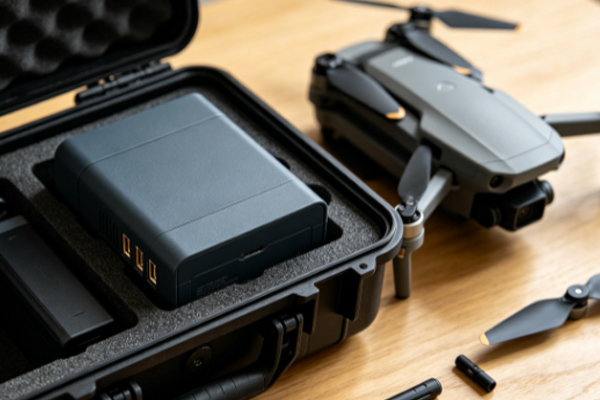
Higher Requirements for Drone Batteries in High-Temperature Environments
When drones perform missions in hot weather, the battery is affected not only by the ambient temperature but also by the heat generated by the motors and payloads. Therefore, battery cell selection must balance power output and heat resistance.
High-Temperature Performance Must Be Considered in Battery Cell Selection
For high-temperature applications, rated capacity alone is not sufficient. The following indicators also require particular attention:
- Cycle performance: Frequent flights and repeated charge-discharge cycles require good capacity retention.
- Rate performance: Stable instantaneous current output is required during takeoff, climbing, and flight against the wind.
- Temperature adaptability: Changes in capacity, internal resistance, and output capability under high-temperature conditions must be considered.
- Consistency: Maintaining good performance consistency among cells connected in series helps reduce localized heat generation.
Suitable battery cells provide a more reliable design foundation for thermal management and BMS control.
Battery Capacity Cannot Be Designed Independently of the Drone Payload
In high-temperature environments, increasing battery capacity can extend flight time, but the resulting increase in battery weight also raises flight power consumption. Solution design can take the following factors into account:
- Maximum drone payload;
- Mission duration per flight;
- Power consumption of payloads such as cameras and infrared equipment;
- Reserved power for return-to-home operations.
Configuring capacity based on the overall energy requirements of the drone is more practical than simply increasing battery capacity.
High-Temperature Drone Batteries Require Enhanced Thermal Dissipation and Structural Design
High temperatures reduce battery heat dissipation efficiency. Therefore, thermal management solutions need to be designed in combination with the battery pack structure, flight airflow, and the available installation space on the drone.
Thermal Dissipation Design Needs to Reduce Heat Accumulation
For high-temperature flight missions, optimization can be carried out in areas such as heat dissipation paths, natural air cooling, active temperature control, and temperature monitoring. Battery cells, thermal conductive materials, and structural components should be arranged appropriately to reduce localized heat concentration. Airflow generated during flight can be used to help lower the battery surface temperature, while more active cooling measures can be configured for battery systems with high thermal loads. Temperature monitoring points should also be installed in key locations to provide real-time data for the BMS. Proper thermal dissipation design helps reduce battery temperature rise and maintain stable operating conditions.
Battery Structures Must Also Adapt to High-Temperature Outdoor Operations
In addition to high temperatures, outdoor flights may also involve vibration, dust, and frequent takeoffs and landings. Structural design should focus on the following aspects:
| Design Item | Main Considerations | Customer Concerns |
| Housing structure | Heat resistance and impact resistance | Improving outdoor operating reliability |
| Cell fixation | Reducing displacement and vibration during operation | Maintaining stable internal connections |
| Connectors | Preventing loosening and ensuring reliable connections | Reducing the risk of power interruptions |
| Thermal conductive structure | Optimizing heat transfer paths | Reducing localized high temperatures |
Planning structural design and thermal management simultaneously can reduce adaptation issues caused by later modifications.
The BMS Needs Protection Strategies Designed for High-Temperature Flights
In high-temperature environments, the BMS needs to monitor and regulate battery operation in real time based on temperature, current, and voltage conditions.
Temperature Monitoring Is the Core of High-Temperature Power Management
In practical applications, the following parameters can be monitored closely:
- Individual cell temperature: Identifying temperature differences between cells.
- Battery pack temperature: Understanding the overall thermal condition.
- Charge and discharge current: Assessing thermal stress during high-load operation.
- Individual cell voltage: Observing changes in cell consistency during high-temperature operation.
- SOC and SOH: Providing references for mission duration estimation and maintenance planning.
Continuous collection of operating data helps identify abnormal temperature rises and performance changes in a timely manner.
Charge and Discharge Strategies Need to Be Adjusted Dynamically in High-Temperature Environments
After a drone completes a high-load flight, the battery temperature may remain elevated. Starting high-power charging immediately can increase thermal management pressure. The BMS can limit charging or discharging power according to the battery temperature and operating condition, while coordinating with cooling measures. Dynamic power management can reduce battery stress under high-temperature conditions and help balance safety, mission efficiency, and service life.
Drone High-Temperature Power Supply Solutions Require Validation Under Actual Operating Conditions
For drone manufacturers, power inspection companies, surveying and mapping companies, and bulk procurement customers, laboratory parameters are only one part of solution evaluation. Actual high-temperature flight performance is equally important.
Key Parameters That Need to Be Clarified Before Customization
Customers can provide the following information in advance:
- Drone model and voltage platform: Determining the basic power supply requirements of the propulsion system.
- Target flight endurance: Defining the required flight duration for each mission.
- Maximum payload: Confirming the weight of cameras, sensors, and other equipment.
- Peak power: Evaluating the requirements for takeoff, climbing, and flight against the wind.
- Operating temperature: Clarifying the actual high-temperature environment and mission season.
- Battery compartment dimensions: Confirming the battery installation space and connection method.
Complete parameters help match the battery cells, BMS, structural design, and temperature control system.
High-Temperature Testing Should Simulate Real Mission Conditions
After battery samples are completed, high-temperature environmental tests can be conducted in combination with the actual drone. The following aspects should be observed:
- Full-load takeoff: Checking instantaneous current and temperature changes.
- Continuous cruising: Observing temperature rise and remaining capacity after extended operation.
- High-load missions: Verifying power supply stability while payload equipment is operating.
- Cycle testing: Comparing capacity changes after multiple charge-discharge cycles under high-temperature conditions.
Validation under conditions close to actual missions can help identify issues such as reduced endurance, excessive temperature rise, and power limitations at an early stage, providing a data foundation for subsequent mass production.
For drone manufacturers and industry customers, battery solutions should also take installation compatibility, batch consistency, and ease of later maintenance into account. By clarifying the voltage platform, payload requirements, mission duration, and operating temperature, and completing full-load takeoff, continuous cruising, and charge-discharge cycle validation during the sample stage, more reliable data support can be provided for subsequent mass applications, helping improve the overall operating efficiency of drone systems.