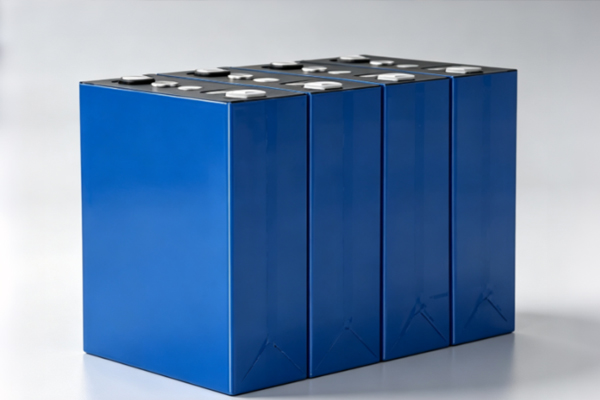
Electric boats operate on the water for extended periods, so their power batteries must withstand high humidity, vibration, temperature fluctuations, continuous discharge, and frequent starting and stopping. For boat owners, shipbuilders, and battery procurement companies, key considerations include range, output stability, safety protection, installation space, and maintenance costs. Therefore, an electric boat power battery solution needs to be designed around cell selection, battery pack structure, BMS management, thermal management, and whole-vessel integration.
How to Match Electric Boat Power Batteries to Actual Navigation Requirements
Boat types and operating scenarios vary significantly. Sightseeing boats, passenger boats, workboats, and small recreational boats have different power battery requirements, so solution design should be based on actual operating conditions.
Select the Cell Solution According to Vessel Operating Conditions
Cell performance directly affects the range, output, and service life of the power battery. The following aspects should be considered during selection:
- Energy density: Provides more usable energy within limited installation space and load capacity.
- Discharge capability: Meets the power requirements of high-load conditions such as starting, acceleration, and navigating against the current.
- Cycle performance: Commercial vessels operating frequently need to maintain good capacity retention after long-term charging and discharging.
- Consistency: Battery packs with multiple series and parallel connections require good consistency in voltage, capacity, and internal resistance.
Properly matching cell parameters helps the battery system form a more stable power combination with the vessel’s propulsion motor.
Determine Capacity and Range According to Vessel Type
Different vessel types vary in load capacity, speed, operating time, and route length. Battery capacity should not simply be made as large as possible. It should be configured comprehensively based on motor power, average daily operating time, charging conditions, and available installation space to prevent excessive battery weight or insufficient capacity from affecting operations.
Electric Boat Power Battery Structure Design Must Balance Space and Environmental Conditions
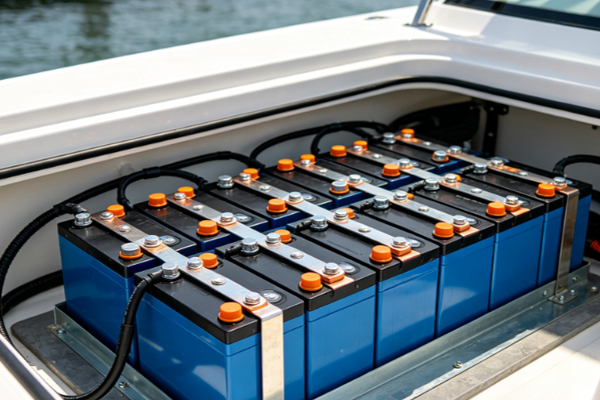
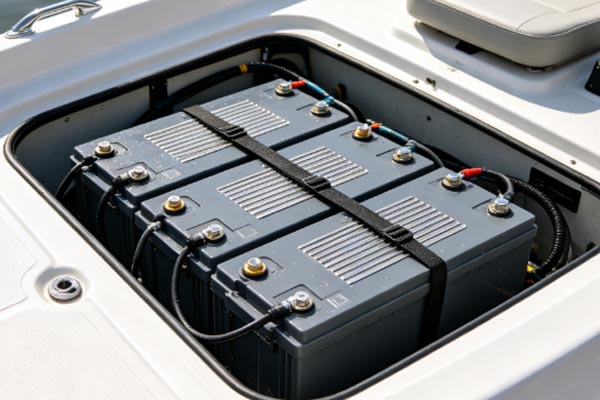
The internal space of a vessel is usually restricted by its hull structure. The battery pack must also withstand long-term exposure to moisture, vibration, and complex environmental conditions. Structural design directly affects installation convenience and operational stability.
Optimize Battery Pack Dimensions and Installation Methods
The battery pack should be designed to match the cabin space, mounting position, and maintenance access. Key considerations include:
- Dimensional compatibility: Customize the length, width, and height of the battery pack according to the available cabin space.
- Weight distribution: Arrange the battery pack position properly to reduce its impact on the vessel’s center of gravity and load distribution.
- Interface design: Determine connectors, wiring harnesses, and cable outlet directions according to the motor, electrical control system, and charging equipment.
A well-matched design can simplify installation, inspection, and future maintenance.
Strengthen Protection and Insulation Design
Vibration, moisture, and temperature changes during vessel operation may affect the battery pack over the long term. Therefore, the enclosure, sealing, insulation, and connection structures all require targeted design. For batteries installed at the bottom of the cabin or in damp areas, special attention should also be paid to waterproofing, moisture resistance, and maintenance convenience.
BMS and Thermal Management Determine Power Battery Stability
Electric boat power batteries need to supply power to the propulsion system for extended periods. The BMS and thermal management system should therefore be configured in coordination with actual navigation conditions.
The BMS Should Cover Core Safety Management Functions
The BMS can continuously collect battery operating data and monitor and protect the system according to preset strategies. Common functions include:
- Cell voltage monitoring: Identifies voltage differences between cells.
- Temperature monitoring: Tracks temperature changes in different areas of the battery pack.
- Overcharge and over-discharge protection: Reduces the risk of the battery entering abnormal voltage ranges.
- Overcurrent protection: Establishes corresponding protection strategies for high-load operation of the propulsion system.
- Balancing management: Reduces the expansion of differences in cell conditions during long-term cycling.
A comprehensive BMS configuration enables crew members and maintenance personnel to understand the battery’s operating status more promptly.
Configure Thermal Management According to Power and Environmental Conditions
The power battery generates a certain amount of heat during long-term navigation or high-load operation. The thermal management solution should be selected based on battery capacity, power level, installation environment, and heat dissipation conditions.
| Thermal Management Method | Main Features | Applicable Scenarios |
| Air cooling | Relatively simple structure and convenient maintenance | Battery systems with relatively controllable power and heat generation |
| Liquid cooling | Higher heat transfer efficiency and better temperature uniformity | Large-capacity, high-power power batteries |
| Intelligent temperature control | Adjusts operating strategies based on temperature data | Vessels with high requirements for temperature control and operational stability |
A properly designed thermal management system helps reduce localized heat accumulation and maintain stable power battery operation.
Establish a Complete Electric Boat Battery Solution from Customization to Delivery
For shipbuilders and customers purchasing in batches, a power battery solution should cover parameter confirmation, structural design, sample testing, and mass production.
What Key Parameters Need to Be Confirmed Before Customization?
When submitting electric boat power battery requirements, customers can provide the following information:
- Vessel type and primary application.
- Motor rated power and peak power.
- Operating voltage and target capacity.
- Operating time per trip or range requirements.
- Battery installation space and weight limitations.
- Charging method and charging time.
- BMS communication interface and functional requirements.
The clearer the parameters, the easier it is to match the battery cells, capacity, structure, and BMS configuration with the entire vessel system.
Sample Testing Should Reflect Actual Navigation Conditions
After completing the design, installation and operation tests should be conducted on the actual vessel type. Key aspects to observe include:
- High-load operation: Check power output and temperature rise.
- Continuous navigation: Evaluate capacity performance and range.
- Frequent starting and stopping: Assess the stability of the battery pack under dynamic loads.
- Installation and fixation: Check the fixation of the battery pack, wiring harnesses, and connection components.
Through testing under actual operating conditions, issues related to parameter matching, structural layout, and thermal management can be identified promptly, providing a basis for subsequent mass production.
An electric boat power battery solution should be systematically designed around vessel type, navigation conditions, and the operating environment, covering cell selection, capacity configuration, structural protection, BMS management, and thermal management. A properly configured battery system can balance range, power, safety, and maintenance requirements, reduce the pressure of later modifications and integration, and provide reliable support for the long-term stable operation of electric boats.