For a robot, running out of power is not the only problem. A battery that still shows charge but suddenly drops voltage, triggers an alarm, or shuts the robot down in the middle of a job can be even more frustrating. For AGVs, AMRs, cleaning robots, inspection robots, and similar equipment, choosing a robot battery is not simply about buying the largest capacity available. Voltage, discharge current, runtime, installation space, communication, and BMS configuration all need to match the machine. LiFePO4 batteries have become a popular choice for many robotic applications thanks to their stable cycling performance and strong safety characteristics. The right battery solution, however, should always start with the robot’s actual operating conditions.
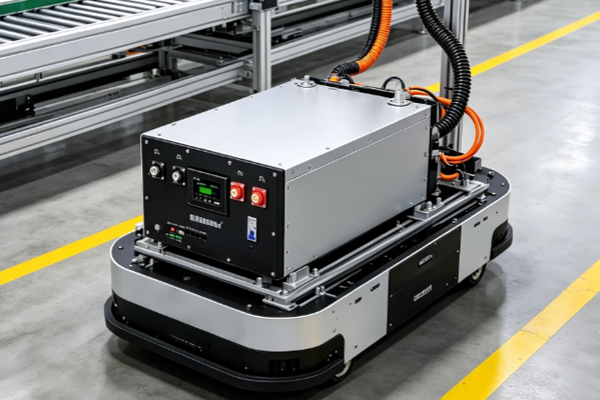
How Much Battery Capacity Does a Robot Need? Start With Real Runtime
Many buyers look at the Ah rating first and assume that a larger number automatically means a better battery. In reality, the robot’s daily operating hours, average load, acceleration, climbing, stopping, and other working conditions all affect runtime. A battery that is too small means frequent recharging, while an oversized battery adds unnecessary weight and cost.
How Do You Calculate Robot Battery Capacity?
A simple starting point is to multiply the robot’s average power consumption by the required operating time. If a robot consumes an average of 500W and needs to run for 6 hours, the theoretical energy requirement is 3kWh. The actual battery should normally include additional capacity rather than being selected right at the theoretical minimum.
Why Do Different Robots Need Different Batteries?
A warehouse AGV and a floor-cleaning robot may both be called robots, but their battery requirements can be very different. A machine that repeatedly starts, stops, turns, or carries heavy loads can place much greater demands on the battery than a robot operating at a steady power level.
- Cleaning robots: Continuous operating time and daily cycling are important, especially when the machine needs to clean for several hours without interruption.
- AGVs: Starting, acceleration, load changes, and climbing can create high current demand, so peak discharge capability matters.
- AMRs: In addition to driving power, the battery must support sensors, LiDAR, controllers, communication systems, and other electronics.
- Inspection robots: Some spend long periods in standby and then move or collect data for short periods, making standby consumption and stable low-load performance important.
When sizing a robot battery, it is useful to separate theoretical runtime from real-world runtime. A robot may run for eight hours during a controlled test, but frequent stops, changing loads, outdoor temperatures, and uneven surfaces can shorten actual operating time.
| Robot Type | Typical Power Demand | Battery Priorities |
| Cleaning Robot | Long continuous operation | Capacity, cycle life, charging speed |
| AGV | Frequent starts and load changes | Discharge current, peak current |
| AMR | Movement + continuous electronics | Capacity, BMS, communication |
| Inspection Robot | Standby + intermittent movement | Standby stability, runtime |
Should You Choose a 24V, 36V, or 48V Robot Battery?
Battery voltage cannot simply be selected based on capacity. The motor, controller, drive system, charger, and other electrical components all have their own voltage requirements. The battery voltage needs to match the robot’s electrical architecture. Higher system voltage can reduce current at the same power level, but whether a robot should use 24V, 36V, 48V, or another voltage depends on the original system design.
Why Does a LiFePO4 Robot Battery Need a Reliable BMS?
A robot battery may go through charging, discharging, standby, acceleration, and repeated restarts every day. The stability of the system depends not only on the cells but also on how well the battery management system monitors voltage, current, and temperature. Since many automated machines cannot be manually monitored throughout the day, a reliable BMS acts like a real-time protection and monitoring system for the battery pack.
What Should a Robot Battery BMS Monitor?
BMS configurations vary between applications, but buyers should at least confirm that the system provides the monitoring and protection functions required by the robot.
- Cell voltage monitoring: Helps identify abnormal voltage conditions between individual cells.
- Charge and discharge current monitoring: Tracks current changes when the robot accelerates or encounters a heavier load.
- Temperature monitoring: Monitors battery temperature during charging and operation.
- Overcharge, over-discharge, and short-circuit protection: Helps stop abnormal battery conditions from damaging the pack or equipment.
- Data communication: If the robot controller needs SOC, voltage, current, or temperature data, the BMS must support a compatible communication interface.
Some robotic systems also require CAN or RS485 communication. This detail is easy to overlook during purchasing, but it can determine whether the battery can communicate properly with the robot controller. Battery data, fault alarms, remaining capacity, and automatic charging functions may all depend on this communication.
Can the Battery Handle Frequent Robot Starts?
This is one of the robot battery specifications that buyers often overlook. Two battery packs with the same Ah rating can have very different discharge capabilities. When a robot starts its motor, climbs a ramp, turns with a heavy load, or accelerates quickly, the battery may need to deliver a much higher current for a short period. If the battery cannot handle the demand, voltage may drop and the robot may trigger an alarm or shut down.
When requesting a quotation, do not ask only, “How many Ah is the battery?” Also confirm the continuous discharge current, peak discharge current, and the duration for which the peak current can be supported. For AGVs and AMRs, these figures can be more useful than capacity alone.
Are LiFePO4 Batteries Suitable for Daily Robot Cycling?
If the robot operates every day, battery cycle life becomes an important purchasing factor. LiFePO4 batteries are well suited to repeated charge and discharge applications, but actual service life is still affected by depth of discharge, temperature, current, charging conditions, and BMS settings. Regularly running the battery down to an extremely low state of charge is not a good long-term operating strategy.
How Should Robot Battery Dimensions Be Designed? Plan Charging and Battery Replacement Early
Even when the electrical specifications are correct, the battery is useless if it cannot physically fit inside the robot. Robotic equipment often has very limited internal space. The battery needs to provide enough energy without interfering with cooling, wiring, drive components, or maintenance access. Many custom robot projects only discover the problem at the prototype stage when the battery turns out to be too thick or the connector is in the wrong position.
What Dimensions Should Be Provided for a Custom Robot Battery?
Before designing a custom battery pack, provide the battery compartment length, width, and height together with mounting holes, connector location, and cable direction. Giving a supplier only an approximate size such as “around 300 × 200 × 150mm” can easily lead to installation problems later.
- Battery dimensions: Confirm the maximum allowable length, width, and height.
- Mounting method: Specify screw holes, brackets, rails, clips, or other fixing structures.
- Connector position: Different connector orientations can affect internal wiring and installation.
- Cooling space: Do not fill the entire battery compartment simply to achieve a larger capacity.
How Should Robot Battery Charging Be Designed?
For robots with high utilization rates, the charging method can directly affect productivity. Some machines use manual battery replacement, while AGVs and AMRs may use automatic charging stations. These systems have different requirements for connectors, charging voltage, BMS communication, and mechanical positioning.
For automatic charging systems, make sure the charger and BMS are compatible. Matching voltage alone is not enough. Charging current, charging protocol, connector type, and protection logic should all be checked before production.
Does a Robot Need a Spare Battery?
For robots operating in two or three shifts, having spare battery packs can be more practical than simply making one battery extremely large. Once one battery is depleted, a fully charged spare can be installed while the used battery goes back to the charging station. This reduces downtime and can also make future fleet expansion easier.
What Should You Confirm When Buying a LiFePO4 Robot Battery?
The biggest problems often appear during the purchasing stage: the specifications look correct on paper, but the battery does not work properly once installed in the robot. A complete robot battery solution can involve cells, pack construction, BMS, connectors, communication, and mechanical design. Providing complete information before quotation can save a lot of time when the project moves into sampling and mass production.
How Should Battery Voltage and Capacity Be Confirmed?
Voltage and capacity are the two most basic battery specifications, but simply writing down two numbers is not enough. The battery supplier needs to understand how the robot actually operates in order to determine the appropriate cell configuration and overall battery pack design.
- Confirm the robot’s rated operating voltage and acceptable voltage range.
- Confirm the required runtime and daily operating hours.
- Confirm average power consumption and maximum power demand.
- Confirm the maximum battery weight allowed by the robot.
- Confirm whether additional capacity may be required in the future.
Once these parameters are clear, the battery design becomes much easier to define. For robots with an established electrical system, changing the voltage platform simply to achieve a larger capacity is usually not a practical approach.
How Should Peak Current and BMS Specifications Be Checked?
For mobile robots, rated current is only part of the story. The short bursts of current required during motor startup, acceleration, climbing, or heavy-load movement are often where battery problems appear. The BMS should also be evaluated beyond basic protection functions. If the robot controller needs battery data, communication compatibility should be confirmed before ordering.
- Confirm continuous discharge current and peak discharge current.
- Confirm how long the battery can support the peak current.
- Confirm BMS protection against overcurrent, overtemperature, overcharge, and over-discharge.
- Confirm whether CAN, RS485, or another required communication interface is supported.
- Confirm whether SOC, voltage, current, temperature, and fault information can be transmitted to the robot controller.
For robots with automatic charging, remote monitoring, or low-battery warnings, BMS communication is not an optional extra. It can be an important part of the complete robot battery system.
What Information Is Needed for Battery Dimensions and Connectors?
Robot batteries often require custom mechanical designs, especially in compact AMRs, cleaning robots, and inspection robots. Providing photos of the battery compartment, 3D dimensions, and connector layout can make communication with the battery supplier much faster.
- Provide the length, width, height, and usable installation space.
- Provide mounting holes, brackets, and the required battery removal method.
- Provide the connector model, rated current, and cable direction.
- Provide the internal wiring layout to prevent interference with other components.
- If dust or water protection is required, provide the expected operating environment and required protection level.
What Should Be Tested Before Ordering Robot Batteries in Bulk?
Before moving into mass production, it is better to install a sample battery in the actual robot and run it under real working conditions instead of relying only on a specification sheet. Full-load operation, continuous runtime, and automatic charging can reveal issues that are difficult to identify during a basic battery test.
- Test actual runtime and remaining battery percentage.
- Test startup, acceleration, and climbing under load to check for voltage drops or alarms.
- Test communication between the charger and BMS.
- Check battery temperature during extended operation.
- Verify that the robot controller can correctly read BMS data.
For long-term supply projects, robot manufacturers can also confirm cell models, batch consistency, BMS versions, connector availability, and future customization capabilities. A supplier such as DELIGREEN that can provide LiFePO4 battery packs, BMS accessories, DIY battery boxes, and scalable energy storage solutions can make it easier for robot manufacturers to move from prototype testing to regular bulk production.
A good robot battery is not simply the one with the biggest capacity or the highest number on a specification sheet. It needs to deliver stable power after installation, communicate correctly with the robot, support the required charging method, fit the available space, and handle repeated daily operation. LiFePO4 batteries provide a strong energy foundation for AGVs, AMRs, cleaning robots, and inspection robots, while the right combination of capacity, voltage, discharge capability, BMS, and mechanical design is what ultimately keeps the robot running reliably for longer.