RVs need to support living, resting, entertainment, and daily activities during travel. Lighting, refrigerators, air conditioners, water heaters, televisions, networking equipment, kitchen appliances, and mobile device chargers can all create continuous electricity demand. Unlike fixed buildings, RVs are limited by available interior space, vehicle payload, driving range, and campsite conditions. As a result, an RV power supply system needs to consider more than battery capacity. Energy input, storage efficiency, load management, and equipment safety are also important. A smart power supply system combining LiFePO4 batteries, an inverter, battery management system, intelligent distribution equipment, and energy monitoring modules can provide a more flexible mobile energy solution.
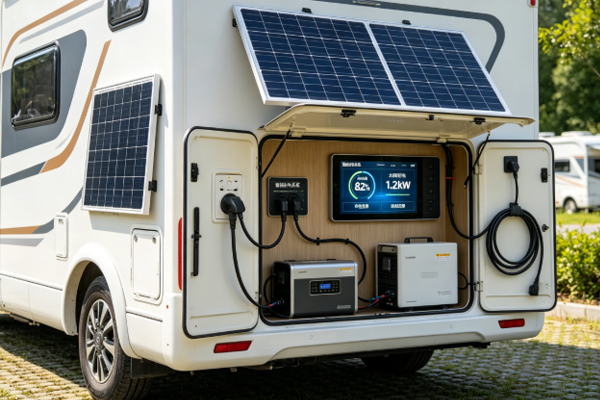
A smart power supply system can coordinate electricity generated during driving, external shore power, solar photovoltaic generation, and battery storage. Users can manage energy according to different stages of a trip. Solar power can replenish the battery during periods of sufficient sunlight, vehicle-generated power can recharge the battery while driving, and external power can provide additional charging when the RV is connected to a campsite power source. LiFePO4 batteries offer good cycling capability, suitable energy storage characteristics for RV applications, and relatively low maintenance requirements, making them an important storage component for mobile living power systems.
Advantages and Usage Methods of Smart RV Power Supply Systems
An RV smart power supply system needs to complete energy storage, power supply, charging, and monitoring functions within limited space. The system design should therefore consider actual electricity consumption patterns. Different RVs have different requirements for air conditioning, refrigerators, kitchen appliances, entertainment equipment, and charging devices. Simply increasing battery capacity cannot solve every power supply requirement. By coordinating LiFePO4 batteries, inverters, BMS, smart controllers, and distribution equipment, the system can allocate stored energy according to changes in load demand.
Advantages of Smart LiFePO4 Power Supply Systems for RVs
A smart power supply system connects the RV’s energy equipment and allows users to monitor remaining battery capacity and current power consumption more conveniently. With properly configured LiFePO4 batteries, an RV can maintain essential daily electricity use for a certain period without being connected to external shore power.
The main advantages include:
- Smart energy scheduling: Charging and discharging strategies can be adjusted according to battery SOC, real-time load, and available energy sources, helping reduce unnecessary power consumption.
- Support for multiple energy sources: Depending on the system design, solar power, vehicle-generated electricity, and shore power can be integrated to improve energy flexibility during travel.
- Suitable for frequent cycling: LiFePO4 batteries are suitable for repeated charging and discharging, making them practical for daily travel and energy storage.
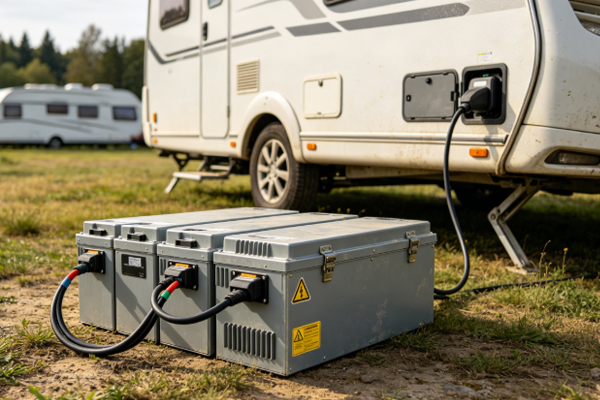
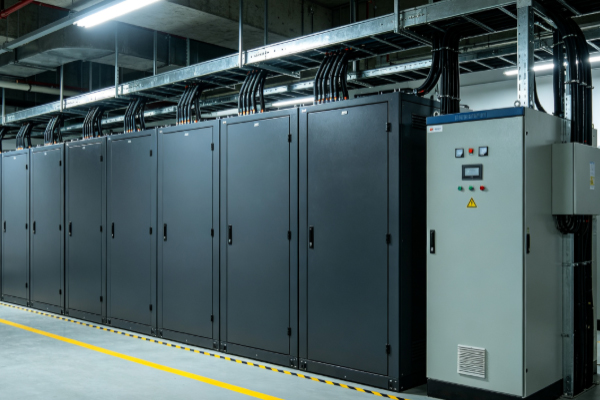
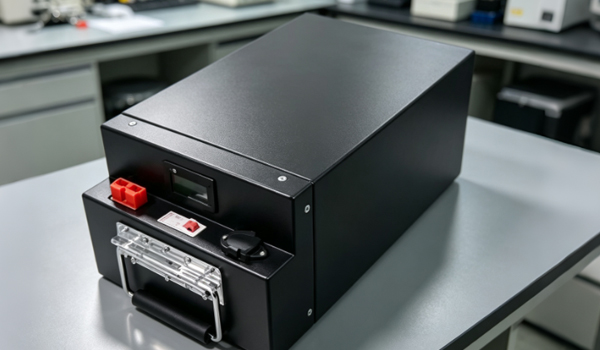
- Efficient use of interior space: Modular battery cabinets can be arranged according to available RV space and installed together with other electrical equipment.
- Critical load protection: Power priorities can be configured according to equipment importance, reserving energy for refrigerators, communication equipment, lighting, and other important loads.
- Real-time status monitoring: Users can monitor battery capacity, charging and discharging power, temperature, and system alarms.
- Convenient system upgrades: When the system architecture permits, additional battery modules, solar panels, or other energy equipment can be added.
These characteristics allow an RV to move beyond a basic battery power supply and establish a smart energy system integrating energy input, storage, control, and monitoring.
How to Use a Smart Power Supply System in an RV
Before using a smart power supply system, users should identify the rated power and daily operating time of major appliances, including refrigerators, air conditioners, microwave ovens, induction cookers, water heaters, televisions, lighting, networking equipment, and electronic devices. Based on usage frequency, loads can be divided into continuously operating equipment, short-term high-power equipment, and critical living equipment. Battery capacity can then be selected according to the expected travel duration and campsite conditions.
During daily use, users can monitor the battery SOC and input and output power through the energy management equipment. When the RV is parked in a location with sufficient sunlight, the solar system can prioritize charging the battery. During driving, the vehicle’s power generation system can recharge the storage battery. After arriving at a campsite and connecting to shore power, the system can provide supplementary charging according to its configured strategy.
The smart control system can adjust energy flows according to battery status and load demand. For high-power appliances such as air conditioners and induction cookers, users should confirm that the inverter’s continuous output and peak power capabilities meet their starting requirements. Operating several high-power appliances simultaneously should be avoided when it could cause an overload condition.
Reference Configuration Table for Smart RV Power Supply Systems
Different RV models, passenger numbers, and travel habits create different requirements for storage capacity and output power. The following configurations can be used as a reference during system planning:
| RV Type | Recommended Battery Configuration | Supporting Equipment | Main Applications | Design Focus |
| Small RV | Small-capacity LiFePO4 battery | BMS, inverter, charger | Lighting, refrigerator, electronic devices | Control weight and installation space |
| Medium RV | Medium-capacity LiFePO4 battery | BMS, inverter, MPPT controller | Daily living electricity | Balance capacity and operating duration |
| Family RV | Medium-to-high-capacity battery system | Inverter, EMS, solar controller | Air conditioning, kitchen, entertainment equipment | Consider continuous output power |
| Long-distance travel RV | High-capacity modular battery | BMS, PCS/inverter, EMS | Multi-day off-grid power supply | Improve storage capacity and expansion capability |
| Solar-powered RV | Expandable LiFePO4 system | PV panels, MPPT controller, inverter | Solar generation and energy storage | Match solar generation with daily load |
| High-power RV | High-output energy storage system | High-power inverter, BMS, smart distribution equipment | Air conditioning and kitchen appliances | Check peak power and thermal management |
The actual configuration should be determined according to appliance power, daily electricity consumption, parking duration, ambient temperature, vehicle payload, and available energy sources.
Application Scenarios and Core Functions of Smart RV Power Supply Systems
Smart power supply systems can cover different energy-use stages during RV travel. Short trips may focus on charging efficiency while driving, whereas extended camping requires stronger off-grid endurance. Winter and summer travel may also create additional loads from air conditioning, heating equipment, and water heating systems. By coordinating batteries, solar generation, vehicle charging, and external power through an energy management platform, different energy sources can be used at appropriate times.
Power Applications for Camping, Long-Distance Travel, and Off-Grid Living
When an RV is parked at a campsite without reliable shore power, LiFePO4 batteries can serve as the primary energy storage source for lighting, refrigerators, networking equipment, televisions, mobile phones, computers, and other devices. For users camping continuously for several days, solar panels can replenish stored energy during daylight hours and reduce dependence on external power. When weather conditions are unfavorable, users can adjust appliance usage according to remaining battery capacity and prioritize refrigerators, lighting, communication equipment, and other critical loads.
During long-distance travel, the RV can use available vehicle-generated energy to recharge the storage battery while driving. After arriving at a campsite, the system can switch to a stationary energy management mode and coordinate charging and discharging according to solar generation and battery SOC. For RVs staying in remote areas for extended periods, users should also consider reduced energy generation during several consecutive cloudy or rainy days and reserve an appropriate amount of battery capacity.
Smart Power Management for Air Conditioning, Kitchen Appliances, and Entertainment Equipment
Air conditioners, induction cookers, microwave ovens, coffee machines, and water heaters are among the higher-power loads in an RV. When several appliances operate simultaneously, inverter output demand can increase rapidly and battery energy can be consumed more quickly. A smart power supply system can help users monitor real-time electricity consumption through load priority settings and power monitoring. For example, while an air conditioner is operating continuously, the use of other high-power appliances can be limited or scheduled at different times.
Televisions, audio systems, projectors, gaming equipment, and computers can be managed according to travel and leisure schedules. During nighttime rest periods, unnecessary devices can be switched off to reduce standby consumption. Intelligent distribution equipment can record electricity consumption from different loads, providing useful data for adjusting energy-use habits. Effective load management can often contribute more to longer off-grid operation than simply increasing battery capacity.
Core Functions of Smart RV Power Supply Systems
A smart RV power supply system needs energy monitoring, automatic control, load management, battery protection, and fault notification functions. These functions allow users to manage mobile electricity resources more conveniently.
- Battery condition monitoring: The BMS monitors voltage, current, temperature, SOC, and other key parameters to track LiFePO4 battery operating conditions.
- Multi-energy management: The system coordinates solar generation, vehicle-generated electricity, and external shore power according to its architecture.
- Automatic charging and discharging control: Charging and discharging can be adjusted according to battery capacity, input power, and load demand.
- Load priority management: Important equipment such as refrigerators, communication equipment, and lighting can be assigned higher power supply priorities.
- Inverter power control: DC electricity from the battery is converted into AC power suitable for RV appliances.
- Remote data monitoring: Compatible displays or smart monitoring equipment can show battery capacity, power output, and alarm status.
- Safety protection: The system can identify and respond to overvoltage, undervoltage, overcurrent, overtemperature, and communication abnormalities.
These functions reduce the need for frequent manual adjustments and help create a coordinated operating relationship between storage batteries, energy sources, and RV loads.
Performance Requirements and Maintenance Design for Smart RV Power Supply Systems
An RV power supply system may operate under vibration, temperature changes, limited installation space, and frequent movement. Performance design therefore needs to consider more than battery capacity. LiFePO4 batteries, inverters, BMS, charging equipment, distribution wiring, and thermal management should form a properly matched system. For RVs used frequently for long-distance travel or extended off-grid camping, particular attention should be given to cycling conditions, continuous output power, charging efficiency, and system reliability.
Performance Matching of LiFePO4 Batteries and Smart Power Equipment
The nominal voltage of the LiFePO4 battery should be compatible with the inverter, charging equipment, and other electrical components. Battery capacity should be determined according to daily electricity consumption and the expected off-grid operating period. For air conditioners, induction cookers, water heaters, and other high-power appliances, the inverter’s continuous output and peak starting capability should be checked. The battery system should also have suitable temperature monitoring and protection functions to support operation in different seasons and environmental conditions.
RV interior space is limited, so the battery cabinet and electrical equipment should be positioned carefully. Weight distribution, ventilation, thermal management, maintenance space, and cable length should all be considered. The BMS should communicate effectively with the inverter and energy management equipment so that battery status can be transmitted to the control system in a timely manner. Users who frequently travel through very hot or cold regions should operate and maintain the storage system within the environmental temperature range specified by the equipment manufacturer.
Modular Expansion and Daily Maintenance of Smart Power Supply Systems
As an RV is upgraded with additional air conditioning, outdoor kitchen equipment, communication devices, or other living facilities, the original storage capacity may no longer meet electricity requirements. A modular LiFePO4 battery system can allow additional storage modules to be installed when supported by the system architecture. Before expansion, battery specifications, operating voltage, communication protocols, BMS compatibility, and inverter capacity should be verified. Battery modules should not be connected simply because they have the same capacity rating.
Daily maintenance should include regular inspection of battery SOC, temperature, charging and discharging power, connectors, cables, fuses, and communication status. When the RV is parked for an extended period, the battery should be maintained at a suitable storage condition according to the manufacturer’s recommendations, with periodic checks of battery status. After long-distance driving, electrical connections, equipment mounting structures, and ventilation passages should also be inspected to identify loose connections, abnormal fixation, or blocked cooling paths. Proper maintenance helps maintain stable energy storage operation and reduce the risk of failures during long-term use.
A smart RV power supply system uses LiFePO4 batteries as its core and integrates solar power, vehicle-generated electricity, external shore power, and stored energy through BMS, inverters, smart distribution equipment, and energy management systems. The solution is suitable for short trips, long-distance travel, camping, off-grid living, and multi-day outdoor stays. When selecting the system, users should consider RV size, electrical appliances, daily energy consumption, off-grid duration, solar conditions, and vehicle payload to determine suitable battery capacity and system power. A properly designed smart power supply system can provide flexible and stable mobile energy support for RV travel under different operating conditions.