As the energy storage market continues to grow, sodium-ion batteries are gradually moving from laboratory research toward commercial applications. Compared with lithium-ion batteries, sodium-ion batteries use sodium ions to transfer charge, and their material systems and some manufacturing processes are different. However, the overall production process still involves several key stages, including material preparation, electrode manufacturing, cell assembly, formation, and testing.
Understanding the sodium-ion battery manufacturing process can help users better understand battery construction and help businesses evaluate battery quality and manufacturing capabilities when purchasing cells or energy storage systems.
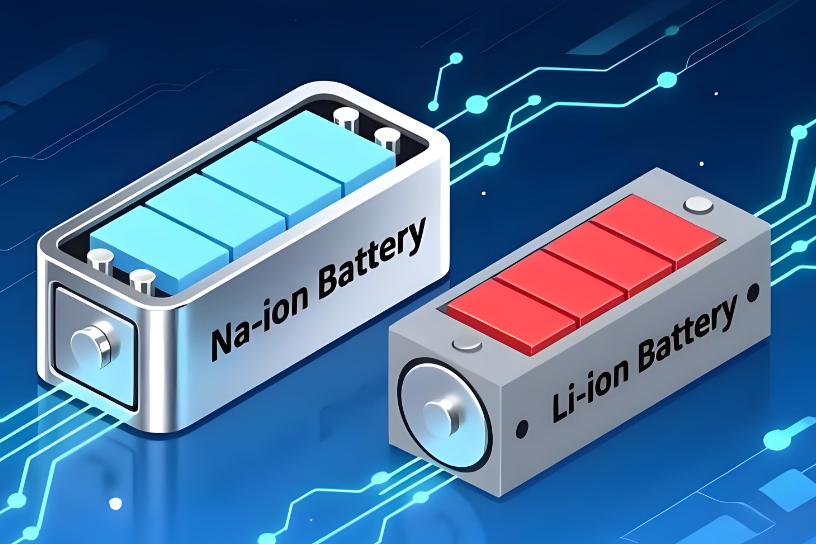
Key Materials Used in Sodium-Ion Batteries
Cathode Materials
The cathode is one of the most important components of a sodium-ion battery. Common material systems include layered oxides, polyanionic compounds, and Prussian blue-based materials.
Different cathode materials can affect energy density, cycle life, operating voltage, and cost. Therefore, manufacturers need to select an appropriate cathode chemistry based on the intended application of the battery.
Anode Materials
The anode stores and releases sodium ions during charging and discharging. Hard carbon is currently one of the most widely studied and commonly used anode materials for sodium-ion batteries.
Hard carbon offers good sodium storage capability and can be produced from a relatively wide range of raw materials. Its structure, porosity, and surface characteristics can all affect the capacity and cycle performance of sodium-ion batteries.
Electrolyte and Separator
In addition to the cathode and anode, the electrolyte and separator are also essential components of a sodium-ion battery.
The electrolyte provides a pathway for sodium-ion movement, while the separator keeps the cathode and anode apart while allowing ions to pass through. The electrolyte formulation, separator properties, and compatibility between different materials can all influence battery safety and overall performance.
Sodium-Ion Battery Electrode Manufacturing
Electrode Material Mixing
Once the battery chemistry has been determined, active materials, conductive agents, binders, and other components are mixed according to a specific formulation.
Uniform mixing is important for achieving consistent coating quality. If the materials are not properly dispersed, differences may occur within the electrode, potentially affecting battery consistency and performance.
Electrode Coating and Drying
After mixing, the resulting slurry is evenly coated onto the surface of a current collector and then dried to remove the solvent.
Coating thickness, slurry viscosity, drying temperature, and production conditions can all affect the final electrode quality. As a result, electrode manufacturing requires careful process control.
Calendering and Slitting
After drying, the electrodes are calendered to achieve the desired thickness and compaction density. They are then slit according to the required dimensions of the battery cell.
Although these processes may appear straightforward, they have an important influence on battery performance and consistency. Excessive or insufficient compaction can affect ion transport and the internal structure of the cell.
Sodium-Ion Battery Cell Assembly
Combining the Cathode, Anode, and Separator
After electrode processing is completed, the materials enter the cell assembly stage.
Depending on the cell design, the cathode, separator, and anode can be assembled through stacking or winding processes. The separator must effectively isolate the cathode and anode while allowing sodium ions to move through the cell.
Strict requirements are placed on dimensional accuracy, material cleanliness, and the production environment during assembly.
Electrolyte Filling
Once the basic cell structure has been assembled, an appropriate amount of electrolyte is added.
The electrolyte needs to sufficiently wet the cathode, anode, and separator to create an effective internal ion-transfer environment. Too little or too much electrolyte can affect battery performance, so the filling process must be carefully controlled according to the cell design.
Sodium-Ion Battery Formation and Testing
Formation Establishes a Stable Operating State
A newly assembled battery cell cannot be used as a finished product immediately. It must first undergo a formation process.
Formation uses specific charging and discharging procedures to establish a stable internal interface and operating condition within the cell. This process can have an important impact on capacity, internal resistance, cycle life, and other performance characteristics.
The specific formation process can vary depending on the material system and cell design.
Aging and Performance Testing
After formation, the cells generally undergo an aging period and further inspection.
Manufacturers may test capacity, internal resistance, voltage, self-discharge, and charging and discharging performance according to product requirements. Cells with similar performance characteristics can then be grouped together.
For energy storage applications, cell consistency is particularly important. Large differences between cells can affect the service life and operating stability of the entire battery pack.
How Do Sodium-Ion Battery Cells Become Finished Products?
Battery Cells Are Integrated into Modules
An individual battery cell is normally only the basic building block of a battery product. Depending on the application, multiple cells can be connected in series and parallel to form a battery module.
Additional components such as connectors, sampling wires, and temperature sensors may also be installed during this stage.
BMS and Enclosure Complete the System Integration
For applications such as energy storage and electric mobility, a Battery Management System (BMS) is also required.
The BMS monitors voltage, current, and temperature and can provide protection against overcharging, over-discharging, overcurrent, and abnormal temperature conditions according to the system design.
After the cells, modules, BMS, enclosure, and other electrical components are integrated, they form a complete sodium-ion battery product ready for practical applications.
Why Does Sodium-Ion Battery Manufacturing Require Strict Quality Control?
From raw materials to the finished product, sodium-ion battery manufacturing involves multiple production stages. Significant deviations at any stage can affect the final battery’s performance.
Therefore, reliable sodium-ion battery manufacturers generally need to implement quality control throughout the entire production process, covering raw materials, electrode manufacturing, cell assembly, formation, testing, and final inspection.
For buyers, it is useful to look beyond battery capacity and price. They can also evaluate the manufacturer’s production processes, quality management system, testing capabilities, and OEM/ODM capabilities.
From material preparation to the finished product, sodium-ion battery manufacturing is a comprehensive process involving materials science, electrochemistry, mechanical manufacturing, and electronic control. Cathode materials, anode materials, electrolytes, and separators establish the basic performance of the cell, while processes such as coating, calendering, assembly, formation, and testing further determine product consistency and reliability.
As the sodium-ion battery industry continues to develop, its potential applications in residential energy storage, commercial and industrial energy storage, renewable energy storage, and electric mobility are worth watching. For businesses, understanding the complete manufacturing process can also make it easier to evaluate whether a sodium-ion battery product is suitable for their specific application.