As energy storage systems, electric mobility, and portable power applications continue to develop, sodium-ion batteries are attracting increasing attention as an emerging battery technology. Their advantages include abundant sodium resources and the potential for lower material costs. Similar to lithium-ion batteries, sodium-ion batteries consist of several key components, including the cathode, anode, electrolyte, separator, current collectors, and auxiliary materials. The selection and structure of these materials directly affect energy density, cycle life, charging and discharging efficiency, and battery safety.
Understanding the main materials used in sodium-ion batteries can help businesses evaluate battery technologies and select suitable solutions for energy storage, electric mobility, RVs, marine applications, and outdoor power systems.
Basic Structure and Working Principle of Sodium-Ion Batteries
Cathode and Anode: Core Materials for Sodium-Ion Storage
A sodium-ion battery generates electrical energy through the movement of sodium ions between the cathode and anode. During charging, sodium ions leave the cathode and migrate through the electrolyte and separator toward the anode. During discharge, sodium ions move back toward the cathode, while electrons travel through the external circuit to generate electrical current.
The cathode and anode largely determine the battery’s operating voltage, reversible capacity, rate capability, and cycle stability. Because sodium ions have a larger ionic radius than lithium ions, some materials commonly used in lithium-ion batteries are not directly suitable for sodium-ion batteries. Therefore, sodium-ion battery materials require specific structural and chemical optimization.
What Materials Are Used for Sodium-Ion Battery Cathodes?
The cathode is one of the most important components affecting the energy density and operating voltage of a sodium-ion battery. Current cathode technologies mainly include layered transition metal oxides, polyanionic compounds, and Prussian blue analogues.
Layered Transition Metal Oxides
Layered transition metal oxides are commonly represented by materials with the general formula NaₓMO₂, where M can include transition metals such as iron, manganese, nickel, cobalt, and copper.
These materials can provide relatively high theoretical capacity and suitable operating voltages, making them attractive for applications that require higher energy density.
However, some layered oxide materials may experience structural changes during repeated sodium-ion insertion and extraction. Air stability and capacity degradation can also present challenges. Elemental doping, surface coating, and structural modification are commonly explored to improve material stability and cycling performance.
Polyanionic Compounds
Polyanionic cathode materials include phosphate, fluorophosphate, and pyrophosphate systems. Examples include Na₃V₂(PO₄)₃ and NaVPO₄F.
These materials generally have stable crystal structures and good thermal stability. Some polyanionic compounds also offer good rate performance.
One challenge is relatively low electronic conductivity in certain materials. Carbon coating, nanoscale engineering, and conductive composite structures can be used to improve electron transport and overall electrode performance.
Prussian Blue and Prussian Blue Analogues
Prussian blue analogues feature open three-dimensional crystal structures that provide channels for sodium-ion transport. Their potential advantages include relatively abundant raw materials, tunable structures, and promising manufacturing prospects.
Iron-based and manganese-based Prussian blue analogues are widely studied. Factors such as crystal water, vacancy concentration, particle structure, and material purity can influence capacity, cycle life, and processing performance. Therefore, controlling synthesis conditions is important for commercial battery production.
What Materials Are Used for Sodium-Ion Battery Anodes?
The anode stores sodium ions during charging and has a significant impact on initial coulombic efficiency, cycle life, fast-charging capability, and low-temperature performance.
Hard Carbon
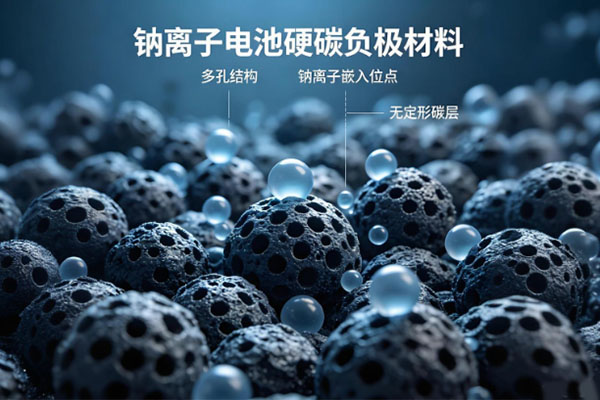
Hard carbon is one of the most widely studied anode materials for sodium-ion batteries. Its disordered carbon structure provides storage sites for sodium ions and overcomes the difficulty of efficiently storing sodium ions in conventional graphite.
Hard carbon can be produced from carbon-containing precursors such as biomass, resins, and sugars through thermal treatment. Its advantages include a relatively low sodium-storage potential, promising cycling performance, and a broad range of potential raw materials.
However, the final electrochemical performance depends strongly on the precursor, carbonization temperature, pore structure, and surface defects.
Alloy-Type Anode Materials
Materials such as tin, antimony, and phosphorus can store sodium through alloying reactions and offer high theoretical capacities. Tin-based, antimony-based, and phosphorus-based materials are therefore important areas of sodium-ion battery research.
The major challenge is volume expansion during the alloying and dealloying process. Significant volume changes may cause particle pulverization, active-material detachment, and capacity degradation.
To address these issues, researchers use strategies such as nanoscale structures, carbon composites, and porous material designs.
Titanium-Based and Other Anode Materials
Titanium-based oxides, sulfides, metal oxides, and organic anode materials are also being investigated for sodium-ion batteries.
Some titanium-based materials offer good structural stability and cycling performance, although their capacity or electronic conductivity may be relatively limited. The selection of anode material should therefore consider the balance between capacity, stability, cost, and manufacturing requirements.
What Materials Are Used in Sodium-Ion Battery Electrolytes?
Sodium Salts
Sodium salts are essential components of the electrolyte because they provide the sodium ions required for ion transport. Common sodium salt systems include sodium hexafluorophosphate (NaPF₆), sodium perchlorate (NaClO₄), and sodium bis(fluorosulfonyl)imide (NaFSI).
The type, purity, and concentration of sodium salt can affect ionic conductivity, interfacial stability, temperature performance, and battery safety.
Different sodium salts must be matched with appropriate solvents and electrode materials. Therefore, electrolyte selection should be based on the complete cell chemistry rather than a single performance indicator.
Organic Solvents
Organic solvents dissolve sodium salts and provide a liquid medium for sodium-ion transport. Common solvent systems include carbonate-based and ether-based solvents.
Properties such as dielectric constant, viscosity, oxidation stability, and volatility can influence charging efficiency and safety. Battery developers need to select suitable solvent combinations according to the operating voltage, temperature range, and electrode chemistry.
Electrolyte Additives
Electrolyte additives are usually used in relatively small amounts to improve the interface between the electrolyte and electrodes. They can help form stable solid electrolyte interphase (SEI) or cathode electrolyte interphase (CEI) layers.
A suitable additive system can reduce unwanted side reactions, improve cycling stability, and enhance battery performance under high-temperature or high-rate conditions. The selection of additives should be validated through cell-level testing and safety evaluation.
Separators, Current Collectors, and Auxiliary Materials
Separator Materials
The separator is positioned between the cathode and anode. Its primary function is to prevent direct contact between the two electrodes while allowing sodium ions to pass through.
Common separators are based on microporous polyolefin materials. Ceramic-coated separators and other composite separator technologies are also being developed.
Key parameters include porosity, thickness, mechanical strength, thermal stability, and electrolyte wettability. These characteristics can affect internal resistance, cycle life, and battery safety.
Current Collectors and Electrode Additives
Current collectors collect and conduct electrical current from the electrodes. Aluminum foil and other metal foils can be used depending on the electrode potential and electrolyte chemistry.
Electrode manufacturing also requires conductive agents, binders, and processing solvents. Conductive agents help establish an efficient electronic conduction network, while binders improve adhesion between active materials and current collectors.
Although these auxiliary materials account for a relatively small proportion of the electrode, they can significantly influence electrode processing, mechanical integrity, and cell consistency.
What Material Factors Should Businesses Consider When Purchasing Sodium-Ion Batteries?
For applications such as energy storage systems, RVs, marine equipment, outdoor power supplies, and electric mobility, battery selection should not be based only on nominal capacity or price. Businesses should also understand the cell chemistry and material configuration.
Match Cell Materials with the Application
Different cathode and anode systems offer different combinations of energy density, cycle life, rate capability, and temperature performance.
Businesses should select battery chemistry according to power requirements, operating environment, charging and discharging frequency, available installation space, and expected service life.
Evaluate Electrolyte and Safety Design
Electrolyte formulation, separator performance, BMS protection, and cell packaging all contribute to battery safety.
When evaluating a sodium-ion battery supplier, it is useful to review protection functions such as overcharge, over-discharge, short-circuit, and temperature protection, as well as relevant testing and quality-control procedures.
Consider Customization and Quality Control Capabilities
Stable raw-material sourcing, mature cell manufacturing processes, batch consistency testing, and technical support are important for long-term battery applications.
For projects requiring customized voltage, capacity, dimensions, connectors, or packaging, businesses should also evaluate the supplier’s OEM and ODM capabilities.
The main materials used in sodium-ion batteries include cathode materials, anode materials, electrolytes, separators, current collectors, and electrode additives.Cathode materials influence operating voltage and capacity, while anode materials determine sodium-storage capability and cycling performance. Electrolytes and separators play important roles in ion transport, interfacial stability, and battery safety.As sodium-ion battery materials and manufacturing technologies continue to advance, sodium-ion batteries are expected to expand into applications such as stationary energy storage, low-speed electric vehicles, RVs, marine equipment, and outdoor power systems.For businesses, understanding battery material systems and working with a supplier that offers stable manufacturing, quality control, and customization capabilities can help build reliable sodium-ion battery solutions.