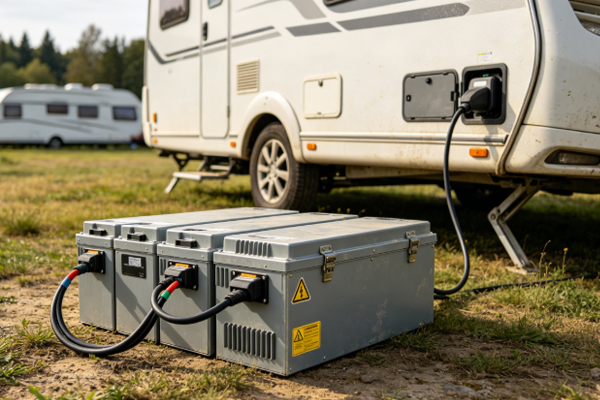
12V LiFePO4 battery packs are widely used in RV energy storage, solar energy storage, marine power supplies, portable power stations, low-speed electric vehicles, and various DC power supply systems. When selecting cells or customizing a battery pack, it is usually necessary to determine the appropriate number of cells connected in series. The voltage configuration of a 12V LiFePO4 battery pack cannot be determined simply by looking at “12V”; it must also be calculated based on the voltage parameters of individual LiFePO4 cells. A typical LiFePO4 cell has a nominal voltage of approximately 3.2V, while its fully charged voltage is usually around 3.65V. According to the principle that voltages add when cells are connected in series, four 3.2V cells connected in series provide a nominal voltage of approximately 12.8V. Therefore, the 12V LiFePO4 battery packs commonly found on the market generally use a 4-series configuration, or 4S. If 100Ah individual cells are used for assembly, the battery pack capacity remains unchanged when only connected in series. If a 2-parallel configuration is added to the 4-series arrangement, a 12.8V 200Ah battery pack can be formed.
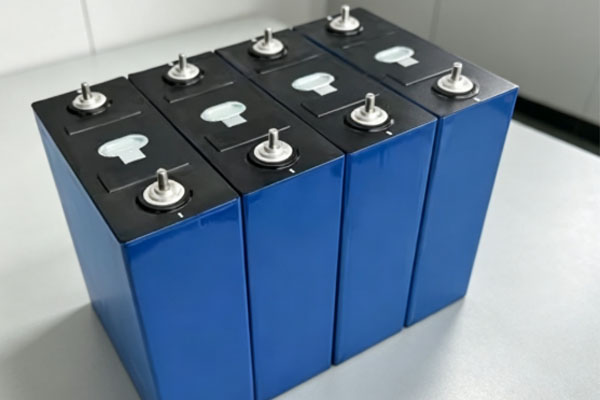
It should be noted that a 12V LiFePO4 battery pack is not necessarily a simple structure consisting of only four cells. “4S” only describes the connection method at the voltage level. In an actual battery pack, parallel connections are often added according to capacity requirements to increase the overall capacity and discharge capability. For example, 4S1P represents a 4-series 1-parallel configuration, 4S2P represents a 4-series 2-parallel configuration, and 4S4P represents a 4-series 4-parallel configuration. Different series-parallel configurations directly affect the capacity, output current capability, overall size, and structural design of the battery pack.
Why Does a 12V LiFePO4 Battery Use 4 Cells in Series?
A Single LiFePO4 Cell Is Approximately 3.2V
The nominal voltage of a LiFePO4 cell is generally calculated as 3.2V. When a single cell is used directly, it cannot reach the operating voltage required by a conventional 12V system, so cells need to be connected in series to increase the voltage.
The basic series calculation is quite simple: 3.2V × 4 = 12.8V
Therefore, after four LiFePO4 cells are connected in series, the nominal voltage is 12.8V. Although it is still referred to as a “12V battery,” its actual nominal voltage is generally 12.8V.
The Voltage Is Not Only 12V When Fully Charged
A 4S LiFePO4 battery pack has a nominal voltage of 12.8V, but its voltage will be significantly higher when fully charged.
Based on a fully charged voltage of approximately 3.65V per cell: 3.65V × 4 = 14.6V
Therefore, the charging termination voltage of a typical 12V LiFePO4 battery pack is usually set around 14.4V–14.6V. The specific parameters need to be determined according to the cell specifications and BMS settings. This is also why a 12V LiFePO4 battery cannot simply be charged using an ordinary 12V lead-acid battery charger. The charger’s voltage curve, cutoff voltage, and protection method all need to be compatible with the LiFePO4 battery.
How Do You Calculate Series and Parallel Connections for a 12V LiFePO4 Battery Pack?
When understanding a 12V LiFePO4 battery pack, “series” and “parallel” can be considered separately. Series connections are mainly used to increase voltage, while parallel connections are mainly used to increase capacity and output capability.
4S1P: 4 cells connected in series, nominally 12.8V, with a capacity equal to that of a single cell.
4S2P: 8 cells arranged in a 4-series 2-parallel configuration, nominally 12.8V, with approximately twice the capacity of a single cell.
4S3P: 12 cells arranged in a 4-series 3-parallel configuration, nominally 12.8V, with approximately three times the capacity of a single cell.
4S4P: 16 cells arranged in a 4-series 4-parallel configuration, nominally 12.8V, with approximately four times the capacity of a single cell.
For example, when using 100Ah cells:
4S1P = 12.8V 100Ah
4S2P = 12.8V 200Ah
4S4P = 12.8V 400Ah
Therefore, when a user asks “how many cells are needed in series,” if the question only concerns the voltage configuration of a 12V LiFePO4 battery pack, the answer is generally 4 cells in series. If the required battery capacity also needs to be determined, the number of parallel connections must be specified as well.
How Can 12V LiFePO4 Batteries with Different Capacities Be Configured?
Small-Capacity Batteries Are Suitable for 4S1P
If the equipment only requires a relatively small capacity, a 4S1P configuration can be used. For example, connecting four 25Ah cells in series produces a 12.8V 25Ah battery pack. This configuration uses fewer cells, making the battery pack relatively easy to install. It is suitable for some small energy storage devices, DC lighting equipment, portable devices, and similar applications.
Medium-Capacity Batteries Can Increase the Number of Parallel Connections
If a longer operating time is required, the number of parallel connections can be increased on the basis of a 4-series configuration. For example, four 100Ah cells connected as 4S1P provide 12.8V 100Ah. After adding another identical group of four series-connected cells, a 4S2P configuration can be formed, increasing the capacity to approximately 200Ah. It should be noted that cells connected in parallel should ideally have the same model, capacity, internal resistance, and operating condition to avoid uneven current distribution caused by cells with different performance characteristics operating in parallel over an extended period.
Large-Capacity Configurations Require a BMS
When a battery pack uses a 4S multi-parallel configuration, both the battery capacity and maximum output current increase, resulting in higher requirements for the BMS. The BMS should be selected according to the battery pack’s continuous operating current, peak current, charging current, and operating environment. For 4S100Ah, 4S200Ah, or even larger battery packs, the BMS should not be selected based solely on battery capacity. The actual equipment power must also be checked. For example, if the equipment has a power rating of 1000W and operates at 12.8V, the theoretical operating current is approximately:
1000W ÷ 12.8V ≈ 78.1A
If the equipment has a startup surge current, additional margin should also be reserved for the discharge capability of both the BMS and the cells.
Frequently Asked Questions
Q: Is a 12V LiFePO4 battery always 4 cells in series?
A: A conventional 12V LiFePO4 battery pack generally uses a 4-series configuration, or 4S. This is because a single LiFePO4 cell has a nominal voltage of approximately 3.2V, and four cells connected in series provide approximately 12.8V.
Q: Does 4S mean there are only four cells?
A: Not necessarily. 4S1P does consist of four cells, but 4S2P requires eight cells, while 4S4P requires 16 cells. The number of series connections determines the voltage, while the number of parallel connections determines the capacity.
Q: Why is a 12V LiFePO4 battery 12.8V?
A: Because a single LiFePO4 cell has a nominal voltage of approximately 3.2V, and four cells connected in series provide 12.8V. “12V” is mainly a conventional designation based on traditional 12V power systems, while the actual nominal voltage is 12.8V.
Q: How many volts is a 12V LiFePO4 battery when fully charged?
A: A typical 4S LiFePO4 battery pack has a fully charged voltage of approximately 14.4V–14.6V. The specific value should be determined according to the cell manufacturer’s specifications and BMS parameters.
Determining the 4-series configuration is only the starting point of battery design. For a typical 12V LiFePO4 battery pack, 4S determines the nominal voltage of approximately 12.8V, the number of parallel connections determines the Ah capacity, while the cell specifications and BMS determine the actual operating performance. Therefore, when purchasing or customizing a battery pack, it is necessary to check the equipment’s operating voltage, rated power, startup current, continuous operating time, and charging method at the same time. For example, both 100Ah and 200Ah 12V LiFePO4 batteries can use a 4-series configuration, but the number of cells inside the two battery packs may be different, resulting in different energy storage capacities and operating times. If the equipment requires a high instantaneous current, the continuous discharge rate of the cells must also be considered rather than judging performance solely based on Ah capacity.
A standard 12V LiFePO4 battery pack generally uses four cells in series, namely a 4S configuration, with a nominal voltage of approximately 12.8V and a fully charged voltage of approximately 14.6V. If additional capacity is required, the number of parallel connections can be increased on the basis of the 4-series configuration, such as 4S2P, 4S3P, or 4S4P. After selecting the appropriate series-parallel configuration, the corresponding BMS and charger specifications should be matched to form a complete and stable 12V LiFePO4 battery system.