With the development of portable energy storage, smart devices, power tools, and new energy applications, users’ requirements for the flexibility and compatibility of battery components continue to increase. The DIY battery box, as an important component connecting battery cells and devices, is mainly used to fix and protect cells, and it also affects the safety and scalability of the battery system. Through different structural and functional designs, it can adapt to various capacities, voltages, and usage environments. Understanding its classification helps users choose more suitable solutions and improve the reliability and efficiency of power systems.
DIY Battery Boxes Classified by Compatible Cell Type
This classification is based on the battery cell specifications supported by the battery box. Different sizes determine system capacity and application direction.
18650 Battery Box
The 18650 battery box is the most widely used and most mature type of DIY battery box.
- Designed specifically for 18650 cylindrical lithium cells, with standardized dimensions and strong compatibility.
- Supports series or parallel configurations of multiple cells to achieve different voltage and capacity setups.
- Commonly used in power banks, LED lighting, small energy storage devices, and electronic DIY projects.
Due to its mature supply chain and moderate cost, this type of battery box plays an important role in entry-level and mid-range applications and is suitable for makers to quickly build power systems.
21700 Battery Box
The 21700 battery box targets higher energy density and higher power demand scenarios.
- Compatible with larger 21700 cells, offering higher single-cell capacity.
- Provides longer runtime and more stable discharge performance within the same volume.
- Suitable for power tools, electric bicycles, and high-power energy storage systems.
This type of battery box typically focuses more on heat dissipation and current-carrying capability to ensure stable operation under high load.
Multi-Spec Compatible Battery Box
The multi-spec compatible battery box improves flexibility through structural optimization.
- Compatible with multiple cell types such as 18650 and 21700.
- Allows users to freely switch cell types based on requirements, reducing development costs.
- Facilitates future upgrades in capacity or system configuration.
This design is suitable for experimental projects or applications requiring frequent adjustments.
DIY Battery Boxes Classified by Structural Form
The structural form determines installation method, scalability, and operational stability.
Fixed DIY Battery Box
The fixed battery box focuses on stability and long-term reliability. Its internal slots are precisely designed according to cell dimensions to ensure a tight fit. Once installed, the cells remain firmly in place, effectively reducing risks caused by vibration or impact. This type of battery box is suitable for monitoring systems, fixed energy storage devices, and other equipment requiring long-term stable operation. Its overall design is more engineering-oriented, emphasizing durability and operational consistency.
Modular DIY Battery Box
The modular battery box achieves greater scalability through a split-structure design.
- Battery modules can be independently installed and removed, allowing flexible combinations.
- Capacity can be dynamically adjusted by increasing or decreasing modules.
- Maintenance and upgrades are more convenient.
It is suitable for energy storage systems, experimental platforms, and continuously expanding projects.
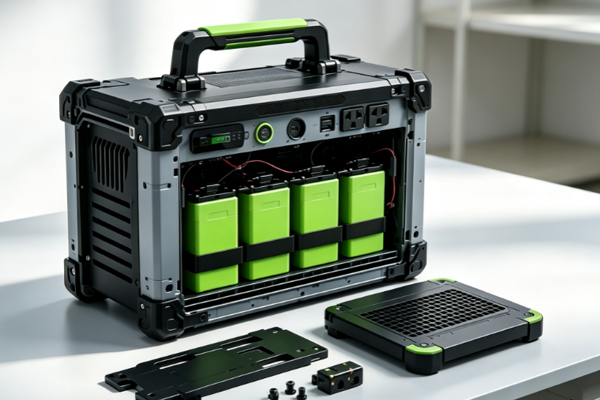
Portable DIY Battery Box
The portable battery box emphasizes lightweight design and mobility.
- Compact structure with reduced weight for easy carrying.
- Equipped with standard output interfaces for quick device connection.
- Suitable for outdoor power supply and emergency power scenarios.
This type focuses more on convenience and mobile energy experience.
DIY Battery Boxes Classified by Application Scenario
Different environments place different emphasis on battery box performance, making scenario-based classification more practical for matching needs.
Outdoor Energy Storage DIY Battery Box
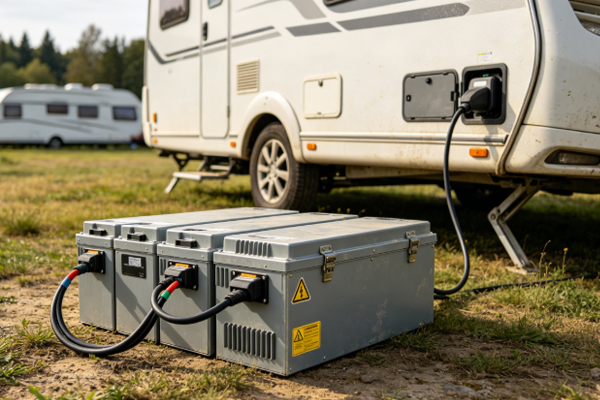
The outdoor energy storage battery box is designed for complex environments and long-duration power supply.
- Can be paired with solar systems for cyclic charging.
- Suitable for camping, emergency rescue, and off-grid environments.
- Features strong protection and heat dissipation design.
It serves as a core energy storage component in outdoor power systems.
DIY Battery Box for Electric Devices
Battery boxes for electric devices emphasize high power output and stability.
- Optimized current output to meet high-load requirements.
- Must strictly match device voltage levels.
- Structural design focuses on shock resistance and connection reliability.
Widely used in power tools, robots, and mobility devices.
DIY Battery Box for Maker Projects
Maker-oriented battery boxes focus on flexibility and experimental capability.
- Supports quick replacement of battery configurations.
- Open structure for easy module expansion.
- Suitable for robotics and smart hardware development.
It significantly improves development efficiency and testing flexibility.
DIY Battery Boxes Classified by Functional Design
Functional design determines performance in safety, intelligence, and environmental adaptability, making it an important classification for advanced applications.
Basic Protection DIY Battery Box
The basic type focuses on safe fixation, providing a stable installation space, reducing external impact, and optimizing internal wiring layout. It is suitable for basic power system construction needs. Its structure is relatively simple, allowing users to complete assembly and maintenance quickly. With lower cost, it is ideal for entry-level DIY power projects.
DIY Battery Box with BMS Management Function
The smart battery box integrates a battery management system.
- Real-time monitoring of voltage, current, and temperature.
- Provides overcharge, over-discharge, and short-circuit protection.
- Improves system safety and battery lifespan.
It is suitable for both energy storage systems and power systems.
Enhanced Protection DIY Battery Box
The enhanced protection battery box is designed for harsh environments.
- Stronger housing with improved impact resistance.
- Higher levels of water and dust protection.
- Optimized sealing and heat dissipation structure.
It is suitable for industrial and high-reliability outdoor scenarios.
Driven by different cell specifications and system requirements, DIY battery boxes have gradually formed a diversified structure system covering 18650, 21700, modular designs, and BMS-integrated solutions. These designs not only improve the flexibility of power system construction but also continuously enhance safety control and scalability. With the ongoing development of new energy and smart devices, their value in personalized power design and energy management will continue to grow.